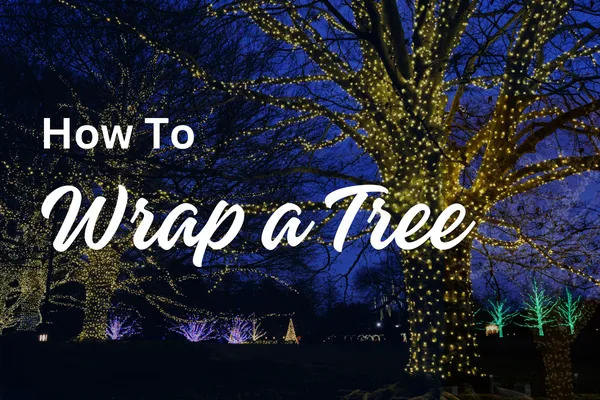
How to Wrap a Tree With Christmas Lights Like a Pro
You can wrap a tree with Christmas lights in an afternoon and make it look like a pro did it. The trick is spacing, tension, and a plan. Most people who wrap a tree with Christmas lights end up with bunched strands at the bottom and a bare top. You can avoid that.
I spent years as a firefighter, then built an install business to over $1 million a year with four crews. Wrapping trees was some of our best money, and I trained every crew member how to do it the same way. Today I coach more than 43,000 contractors at ChristmasLights.io.
Watch me wrap tall trees like a pro in the video above. Then follow the steps below on your own tree.
What kind of tree wrap should you use?
There are two common ways to light a tree. Pick one before you buy lights.
| Method | How it looks | Best for |
|---|---|---|
| Trunk wrap | Lights spiral up the trunk and main limbs. | Bare trees and deciduous trees |
| Branch wrap | Lights follow each limb out and back. | Big shade trees and a fuller look |
| Canopy or outline | Lights cover the outside of the tree. | Evergreens and thick trees |
Trunk wraps are the fastest. Branch wraps take longer and look richer. Evergreens usually get the outside covered because the needles hide the branches.
What lights do you need?
- Mini string lights. They wrap tight and stay light on the branch. Shop our mini string lights.
- Twinkle lights. They add motion and work well on evergreens.
- Extension cords. Get the right length and rating from extension cables and splitters.
- A timer. Set the lights to switch on at dusk and off at night.
Buy more strands than you think you need. A tree swallows lights. If you have to make a second trip to the store, you lose the afternoon.
How do you wrap a tree with lights, step by step?
- Test every strand first. Plug it in on the ground. Fix or toss the bad ones.
- Plan the power. Decide where the cord enters the tree. Keep the plug up off the ground and out of water.
- Start at the base. Anchor the first wrap near the trunk bottom.
- Wrap the trunk in a steady spiral. Pull snug, not tight. The tree needs room to move.
- Space the wraps evenly. I use about four fingers between each wrap. Steady spacing looks like a professional job.
- Follow the main limbs. Go out along a limb and come back in the same path. Do not cut across open air.
- Connect the next strand with a knot. Tie an overhand knot with the two cords before you plug them together. Wind will not pull it loose.
- Work upward. Keep your spacing the same at the top as at the bottom.
- Plug in at dusk. Step back and check for gaps.
For trees taller than your reach, use a pole and stay on the ground. I have a full method for tall trees. It uses a hook made from a paint roller on a long pole. Do not climb a tree.
How do you measure a tree before you buy?
Do this before you spend a dime on lights.
- Measure the trunk. Wrap a tape around it at chest height. That gives you the size of one full wrap.
- Measure how tall the wrapped part is. Count from the base to where you will stop.
- Divide by your spacing. Four fingers is a good guide. That tells you how many wraps go up the trunk.
- Add the limbs. Measure each limb you plan to wrap, out and back.
- Add a buffer. Buy extra strands for waste and for the power run.
This takes a few minutes and saves you a second trip. It also tells you if the tree is too big for a weekend job.
Is wrapping a bush different?
Yes. A bush gets covered, not spiraled. You weave the lights through and over the shape so the whole thing glows. Pros price bushes by the strand, not by the bush, because some bushes take one strand and others take three. Try the bush lighting price calculator for a quick estimate.
How do the pros make it look so clean?
They plan, they pre-build, and they repeat the same motion. On a crew job we prepared the strands at the shop, tested each one, and had the exact spacing in our heads before we reached the tree. There was no guessing on site. That is how a two-person crew wraps a tree fast and the trunk still looks even from the street.
You can use the same idea at home. Test your lights on the garage floor. Lay out your strands so the plugs are easy to reach. Wrap in a steady rhythm. Do not rush the last few feet at the top, because that is where a tree shows its mistakes.
If you plan to turn this skill into a business, tree work is a great add-on once your rooflines are dialed in.
How much does it cost to have a pro wrap your tree?
If you would rather hire it out, pros price trees by the foot of height.
| Item | Pro price | Example |
|---|---|---|
| Deciduous tree (loses leaves) | $30 to $50 per foot of height | A 12 foot tree runs $360 to $600 |
| Evergreen tree (keeps needles) | $40 to $60 per foot of height | A 12 foot tree runs $480 to $720 |
| Bushes | $30 to $50 per strand | Some bushes take 3 strands |
| Porch and entry columns | $100 to $600 each | Most land around $250 |
Evergreens cost more because they take more bulbs and more time. All prices include takedown and storage. Get a quick number with our tree lighting price calculator. To hire a local pro, use find an installer. For the full list, read the installation cost guide.
What mistakes ruin a tree wrap?
- Bunching at the bottom. You run out of reach and cram lights low. Plan even spacing from the start.
- Wrapping too tight. A tight wrap can hurt a growing branch.
- Skipping the knots. Connections come apart in wind.
- Ignoring the power path. A cord across the yard with a plug in a puddle is a hazard.
- Leaving lights up too long. Take them down when the season ends.
When should you put the lights up?
Do it on a dry, calm day, well before the first hard freeze. Cold makes cords stiff and plastic brittle, and wind makes a pole or a ladder a bad partner. Wrap in daylight so you can see your spacing, then come back at dusk to check the glow.
Tree Wrap FAQ
How many strands does a tree need?
It depends on the height, the width, and how full you want the look. Buy extra so you never stop short.
Should I wrap the trunk or the branches?
Trunk wraps are faster. Branch wraps look fuller. Pick based on your time and the tree type.
How far apart should the wraps be?
I use about four fingers between wraps. Even spacing matters more than the exact distance.
Can I leave the lights on a tree all year?
No. Take them down after the season. Trees grow and a tight wrap can hurt a branch.
Is it safe to use a ladder on a tree?
Keep it low and stable. For tall trees, use a pole and stay on the ground.
Which tree in your yard would look best wrapped this year?


