
Marketing in 2026: How to Grow Your Christmas Light Business
Success in the Christmas lights installation business doesn't come from hoping customers find you or relying on last year's strategies. The industry is evolving rapidly—AI is changing how customers search for services, video content dominates social algorithms, and homeowners increasingly expect businesses to have comprehensive online presence before ever making contact.
The Christmas lights installers who will thrive in 2026 are already planning their marketing strategies now, in January, not scrambling in August when competitors flood the market. This isn't about finding a "magic pill" or secret shortcut—those don't exist. It's about implementing proven strategies consistently, investing strategically in channels that generate measurable returns, and committing to uncomfortable activities that separate six-figure installers from struggling operators.
This comprehensive guide reveals the complete marketing roadmap for 2026, covering both free and paid strategies that have helped Christmas lights businesses grow from zero to $100,000, from $150,000 to $300,000 in a single season, and from startup operations to million-dollar enterprises. These aren't theoretical concepts—they're battle-tested tactics currently generating millions in revenue across multiple markets.
The Foundation: Why January Marketing Planning Determines November Revenue
Most Christmas lights installers wait until August or September to think about marketing. This creates a predictable cycle: scramble for leads when season hits, get overwhelmed with installations, stop marketing because "too busy," watch lead flow dry up in December, panic about lack of pre-bookings for next year, repeat.
The Success Pattern vs. The Struggle Pattern
Struggling installers: Hope referrals will sustain growth, start marketing when desperate for leads in October, stop marketing when busy installing in November, wonder why they can't break $50,000
Successful installers: Plan marketing in January, execute consistently year-round (yes, even in summer), track what works and scale it aggressively, invest 10% of revenue goals in proven channels starting in spring
The difference between installers doing $50,000 and installers doing $500,000 isn't installation skill, equipment quality, or market size—it's systematic marketing execution starting months before season begins.
The 10% Investment Rule for Christmas Lights
Industry standard across successful Christmas lights businesses: invest 10% of your revenue goal in marketing.
$100,000 revenue goal = $10,000 marketing investment $200,000 revenue goal = $20,000 marketing investment $500,000 revenue goal = $50,000 marketing investment
This feels uncomfortable—especially when you're working your day job in March and contemplating spending $10,000 on marketing for a season nine months away. But the math is undeniable: $10,000 invested in proven channels generating $100,000 revenue is a 10:1 return. No other business investment delivers comparable ROI.
Sample $10,000 marketing budget allocation:
Yard signs (1,000 signs): $3,000-$4,000
Google Ads (September-November): $3,000-$4,000
Facebook ads or organic boosting: $2,000-$3,000
Website improvements and SEO: $1,000
Writing Down Your Marketing Plan
Goals that exist only in your head rarely materialize. Goals written down and reviewed daily increase achievement probability by 76% according to research.
The written commitment process:
Write specific marketing actions: "I will deploy 200 yard signs monthly starting August (50 weekly)"
Write frequency commitments: "I will post one video daily for 365 days about Christmas lights"
Write investment commitments: "I will spend $4,000 on yard signs, $3,000 on Google Ads"
Review daily: Keep your written plan visible and read it every morning
One successful installer committed to one video daily for 2026 with accountability: missing a day costs $25 to the group. Financial consequence creates follow-through when motivation wanes during July when Christmas feels impossibly far away.
The Essential Foundation: Google Business Profile for Christmas Lights
Before investing in any paid advertising, maximize your Google Business Profile. This free tool remains the highest-ROI marketing channel for local Christmas lights businesses.
Why Google Business Profile Matters More for Christmas Lights Than You Think
The surprising truth: While hundreds of pressure washing companies optimize Google Business Profiles in every market, typically only 5-10 Christmas lights installers do. Most landscapers who occasionally install lights don't create separate Christmas lights profiles. Most handymen don't optimize profiles. Most part-time installers don't even know Google Business Profile exists.
This creates massive opportunity: In most markets, having 50-100 reviews on a well-optimized Google Business Profile places you #1 automatically. There's simply no competition. Pressure washers need 150+ reviews to rank. Christmas lights installers need 50.
Local search intent is gold: Someone searching "Christmas lights installation near me" or "Christmas lights installer [your city]" in October is ready to hire immediately—not researching or price shopping. Appearing in those top 3 "map pack" results converts at 30-40% compared to 10-15% for website traffic from other sources.

The Complete Google Business Profile Optimization Strategy
Reviews are everything: 100+ five-star reviews places you ahead of 98% of Christmas lights competitors. 50 reviews places you ahead of 90%. Systematic review collection is non-negotiable.
Year-round review collection system:
During sales process: "Our goal is making you so happy you'll give us a five-star review and tell all your neighbors"
During installation: "Is there any reason you wouldn't give us five stars when we're finished?"
At completion: Use NFC tap cards (customer taps phone to card, review page opens instantly) or QR codes printed on business cards—ask while standing there
Text follow-up within 24 hours if they don't leave review immediately
Email follow-up 48 hours later with direct review link
Phone call during takedown in January: "Hope you loved your lights! Would you mind leaving us a quick review?"
The tap card advantage: Jobber can send automated review requests, but conversion is 10-20%. Tap cards while standing with customer converts at 60-70% because you're there to help them through the process.
Photos drive engagement: Upload 100+ photos minimum. Focus on:
Spectacular finished installations at night (the "wow factor" shots)
Beautiful homes with lights during day showing quality
Happy customer families in front of their decorated homes
Close-ups showing professional installation details
Variety of styles (all-white, multicolor, elegant, Griswold-style)
Don't upload: Installation process shots (ladders, tools, guys on roofs), bare lights not installed, daytime-only photos, low-quality phone pics
Post 1-2x weekly year-round, daily during season: Google rewards active profiles with higher rankings. Posts don't need to be complex:
January-July: "Planning your 2026 Christmas display? Book early for best availability!" with past installation photo
August-September: "Installation season starts soon! Schedule your free quote today"
October-December: "Just completed this stunning display in [neighborhood]! Still have a few November spots open"
Proximity matters but can't be controlled: Google prioritizes businesses closest to searcher. You can't change your location, so maximize everything else: reviews, photos, posts, response time to messages, profile completeness.
The Website Connection
Google Business Profile works better—and in 2026, often requires—a professional website linked. Google increasingly mandates websites for profile verification. Installers without websites struggle to get profiles approved.

Website requirements for Christmas lights in 2026:
Mobile-first design: Google ranks based on mobile experience, not desktop. 80% of Christmas lights searches happen on phones. If your site isn't flawless on mobile, you're invisible.
Service location pages: Don't just target your city. Create pages for every suburb, neighborhood, and nearby city where you install:
"Christmas Lights Installation [Suburb Name]"
"Holiday Lighting [Neighborhood Name]"
"[City Name] Christmas Light Installers"
Each page should include unique content (not copy-paste), 3-5 photos from installations in that area if possible, and description mentioning the specific location 3-5 times naturally.
Fast loading: Slow sites get buried in rankings. Optimize images, use quality hosting, eliminate unnecessary plugins.
Easy quote requests: Minimal form fields. Name, address, phone, email only. Every additional required field reduces conversions 10-20%. "How many stories is your home?" can be asked later—don't lose leads by asking too much upfront.
Photo galleries showcasing variety: Separate galleries for all-white displays, multicolor, commercial, rooflines only, full-property lighting. Customers want to see examples matching their vision.
Important multi-business tip: If you also run pressure washing, landscape lighting, or permanent lighting, you need separate phone numbers and ideally separate addresses for each. Google penalizes multiple businesses at identical locations with identical contact info.
Free Marketing Strategies That Generate Six Figures in Christmas Lights Revenue
Paid advertising accelerates growth, but free strategies build sustainable businesses that don't collapse when ad budgets pause in February.
Facebook: The $500,000-$750,000 Organic Channel for Christmas Lights
Multiple Christmas lights installers generate $500,000-$750,000 annually from Facebook alone with zero advertising spend. Bobby Duncan is the most famous example—posts 5-10 times daily on personal Facebook page, generates 100+ leads monthly organically, and builds million-dollar business without ads.
The Facebook domination strategy for Christmas lights:
Post 5-8 times daily on personal page: Mix installation photos, customer reactions, before/afters (day vs. night), holiday tips, behind-the-scenes team content, personal life glimpses creating authentic connection
Max out friends (5,000) then build followers: Personal pages generate 10-50x more engagement than business pages due to algorithm prioritization. Christmas lights are inherently visual and emotional—personal posts outperform corporate posts dramatically.
Join and post in 50-100 local groups: Neighborhood groups, mom groups (70% of Christmas lights buyers are women), home improvement groups, local buy/sell/trade groups, HOA community pages
Post in groups 2-3x weekly per group: Share beautiful installation photos with captions like "Just finished this stunning display in [Neighborhood]! We still have a few November installation spots available. Comment or message for free quote!" Include 3-5 photos showing variety.
Go live weekly starting in September: Facebook rewards live video with massive organic reach. Weekly live sessions showing installations in progress, answering common questions, revealing spectacular finished displays at night builds authority and engagement.
Focus on personal brand over company brand: People hire people, not companies. Your face, personality, and story sell better than your company logo. Share why you love Christmas, family traditions, the joy you see in customers' faces—emotion sells lights, not technical specifications.
The consistency requirement: Posting 5x daily sounds insane. But it works. One installer posts 15x daily and gets 150+ leads monthly organically. Another posts 2x weekly and gets 8 leads monthly while spending $2,000 on ads. The math isn't even close.
Facebook Groups: The $150,000 Side Channel
One Christmas lights installer posts in 50-100 neighborhood Facebook groups weekly and generates $150,000 annually from group posts alone—no ads, no website, just systematic group posting.
The group posting formula:
Join 50-100 local groups: Focus on affluent neighborhoods where you want to work. Mom groups are gold—they share recommendations constantly.
Post 2-3x weekly in each group: Rotate groups so you're not spamming. Monday post in groups 1-25, Wednesday in groups 26-50, Friday in groups 51-75.
Use before/after and day/night photos: "Transformations" get highest engagement. Show house during day (pretty but plain) and same house at night (spectacular and glowing).
Frame as helpful, not salesy: "We just finished this beautiful display in [Neighborhood]! If anyone is still looking for Christmas lights installation, we have a few spots left before Thanksgiving. Happy to provide free quotes!" Include 3-5 photos.
Respond to every comment: Engagement signals to algorithm that your post is valuable. "Thanks for the kind words! I'll message you about getting a quote" keeps thread active and visible.
Expect some posts removed: Group admins sometimes delete promotional posts. That's fine—you only need 10-20% of posts to stay up to generate massive returns.
Video Content: The 2026 Requirement for Christmas Lights
Video content separates growing Christmas lights businesses from stagnating ones in 2026. AI increasingly generates text content, making written material less differentiating. Video remains authentically human and builds trust faster than any other medium.
Why video dominates for Christmas lights in 2026:
Christmas lights are inherently visual—video showcases installations better than photos
Customers want to "meet" you before calling—video builds trust and familiarity
Algorithms heavily favor video content (Facebook, Instagram, TikTok, YouTube all prioritize video)
One video answers hundreds of customer questions simultaneously, reducing phone time
Video creates perceived expertise and professionalism separating you from part-time competitors
The daily video commitment for Christmas lights: Post one video daily—short-form (60 seconds for Instagram/TikTok/Facebook Reels) or long-form (3-10 minutes for Facebook/YouTube). Content ideas are endless:
Installation content:
Time-lapse of complete installation from start to finish
Showing specific techniques (clipping lights, wrapping columns, installing on tile roofs)
Problem-solving on unique architectural features
Before/after transformations with dramatic music
Customer-focused content:
Customer reactions when seeing lights lit for first time
Testimonials from happy customers
Neighborhood tours showing multiple homes you've installed
Educational content:
"How much do Christmas lights cost?" (explaining per-foot pricing)
"Should I hire someone or DIY?" (position yourself as expert while being fair)
"When should I book my Christmas lights installation?" (creating urgency)
"What's the difference between C9 and mini lights?" (demonstrating expertise)
Seasonal content:
Planning tips in January-July
Booking reminders in August-September
Installation updates in October-November
Spectacular finished displays in December
Tools making video simple: CapCut and Captions are user-friendly apps enabling professional-looking videos filmed and edited entirely on phones in 5-10 minutes.
Overcoming video resistance: Everyone hates their first 50-100 videos. You'll think you look terrible, sound weird, and appear unprofessional. Customers don't care—they value authenticity and expertise over Hollywood production quality. Your perceived flaws matter far less than you think.
Start with easy content requiring minimal talking: installation time-lapses with music, before/after photo slideshows, customer reaction videos focusing on customer not you. Graduate to answering questions once comfortable.
Paid Marketing Strategies That Scale Christmas Lights Businesses
Free strategies build foundations. Paid strategies accelerate growth to six and seven figures.
Yard Signs: The Highest-ROI Channel for Christmas Lights
Yard signs consistently deliver the highest return on investment for Christmas lights businesses. $3,000-$4,000 investment in 1,000 yard signs generates $50,000-$150,000+ in revenue when deployed strategically.
Why yard signs work so well for Christmas lights:
Homeowners driving through neighborhoods see signs exactly where they're visualizing lights
Signs placed near spectacular installations create immediate association with quality
Signs in affluent neighborhoods target high-value customers ($2,000-$4,000 average tickets)
Cost per lead is $5-$15 compared to $50-$150 for Google Ads
Signs work 24/7 for weeks or months
Yard sign success formula for Christmas lights:
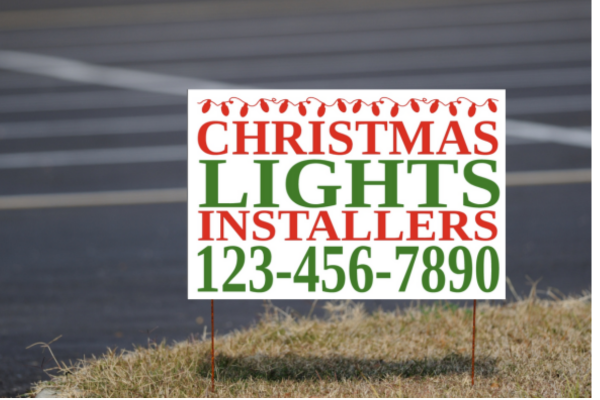
Keep design ultra-simple: "CHRISTMAS LIGHTS" and huge phone number only. Don't clutter with logos, taglines, website addresses, or images. Bold letters visible from 100+ feet away outperform everything else.
Color psychology: Red and green scream Christmas but blend into holiday decorations. Many successful installers use blue and white or all-white signs that stand out. Test both in your market.
Deploy 200-300 monthly starting August: Maintain consistent visibility through season.
August-September: 50-100 signs weekly building awareness early
October: 200+ signs weekly as booking urgency increases
November: Continue deploying despite being busy—these fill your December spots
Target affluent neighborhoods exclusively: Place signs in $500,000+ home neighborhoods, not everywhere. High-income areas generate $2,000-$4,000 average tickets. Middle-income areas generate $1,000-$1,500 average tickets from identical marketing cost.
Strategic placement locations:
Intersections near neighborhoods you've installed in (social proof)
Entrances to upscale subdivisions
High-traffic routes affluent homeowners drive daily (school drop-off routes, shopping areas)
Near homes with beautiful existing Christmas displays (not competitors—just decorated homes)
Use tracking app: Simple Crew app allows hired help to photograph sign placements with GPS tracking. This prevents the disaster one installer experienced: hired someone to deploy 100 signs who dumped them all in a pile in a field instead.
Expect signs to disappear: Some last weeks, others get removed within days. Budget for 30-50% removal rate. Cost per sign is low enough ($3-$4) that even 50% removal rate still delivers exceptional ROI.
The Thanksgiving week blitz: Deploy every remaining sign the week before Thanksgiving. This is peak urgency week when homeowners suddenly realize Thanksgiving is days away and their homes remain undecorated. 200-300 signs deployed Monday-Wednesday before Thanksgiving generates more calls than entire October.
Google Ads: The Qualified Lead Machine
Google Ads for Christmas lights generates the highest-intent leads possible—people actively searching "Christmas lights installation near me" are ready to hire immediately, not researching.
The scaling story: One installer spent $20-$30 daily on Google Ads generating modest revenue. After calculating that Google Ads delivered 10:1 ROI with highest-quality leads (30% close rate vs. 15% for Facebook), he increased spend to $100-$200 daily. Revenue jumped from $150,000 to $300,000 in one season—same market, same competition, just strategic investment in what already worked.
Google Ads strategy for Christmas lights:
Budget aggressively September-November: $50-$200 daily depending on market size. Christmas lights is intensely seasonal—spend heavily during the only three months that matter.
Target location-specific keywords:
"Christmas lights installation [your city]"
"Christmas lights installer near me"
"holiday lighting [suburb names]"
"Christmas light installation cost [city]"
Avoid generic keywords: "Christmas lights" without "installation" attracts DIYers shopping for bulbs, not hiring installers.
Mobile-optimize everything: 80% of Christmas lights searches happen on phones. Ensure ads, landing pages, and quote forms are flawless on mobile.
Track obsessively: Calculate cost per lead, cost per customer, and ROI. If spending $3,000 monthly generates $30,000 revenue (10:1), increase budget immediately. If generating 3:1 or below, pause and fix conversion issues (usually landing page or quote follow-up problems).
Consider hiring agency: Google Ads requires expertise. Poorly managed campaigns burn money fast. If you're generating under 5:1 ROI, hire specialist or use Simple Ads service specifically for home service businesses.
Facebook Ads: The Visual Showcase Channel
Facebook Ads work exceptionally well for Christmas lights because the service is inherently visual and emotional. Spectacular installation photos trigger impulse bookings.
Facebook Ads success factors:
Target affluent zip codes specifically: Don't waste budget on broad "50-mile radius" targeting. Select specific zip codes with $500,000+ median home values.
Use stunning visual content: Carousels showing 5-7 spectacular installations outperform single images. Video showing home transformation from plain to spectacular outperforms photos.
Focus on emotion and lifestyle, not technical details: Ad copy should emphasize "Imagine pulling up to your beautifully lit home this Christmas" not "We use commercial-grade C9 bulbs with 18-gauge SPT-2 wire."
Retarget website visitors: Most people visit websites 3-5 times before booking. Retargeting keeps you top-of-mind through that consideration period.
Budget $2,000-$5,000 for season: Facebook Ads typically delivers 3:1 to 8:1 ROI for Christmas lights. Budget accordingly based on goals.
A/B test creatively: Test different photos, video vs. images, various ad copy, and multiple calls-to-action. What works in Dallas might fail in Boston—test locally.
Nextdoor: The Neighborhood Goldmine
Nextdoor often gets overlooked but delivers exceptional results for Christmas lights in the right markets.
Why Nextdoor works for Christmas lights:
Hyper-local (literally your target neighborhoods)
Homeowners actively seek service recommendations
Neighbors trust neighbor recommendations more than ads
Less competitive than Facebook (fewer installers using it)
Nextdoor strategy:
Join all neighborhoods in service area: Claim all neighborhoods where you install
Post 2-3x weekly starting September: Share installation photos from that specific neighborhood when possible: "Just finished this beautiful display on [Street Name]! We have a few November spots remaining for [Neighborhood Name] residents."
Respond to every recommendation request: When homeowners post "Can anyone recommend a Christmas lights installer?" respond within minutes with photos and offer to provide quote.
Encourage customer reviews: Ask satisfied customers to recommend you on Nextdoor. Social proof from neighbors converts extremely well.
Results vary dramatically by market: Some installers generate $100,000+ annually from Nextdoor. Others get minimal results. Test with organic posting before investing heavily.

Year-Round Marketing: The Overlooked Advantage
The biggest mistake Christmas lights installers make: only marketing August-December and wondering why they can't scale past $100,000.
Why Year-Round Marketing Matters
SEO doesn't pause: Google ranks websites based on consistent activity and fresh content. Sites updated quarterly outrank sites updated only during season.
Social media algorithms reward consistency: Posting year-round maintains higher organic reach. Accounts inactive for months get buried when they resume posting in September.
Early bookers book early: 20-30% of customers book in May-August. These are typically high-value customers who plan ahead and book premium services. Missing them because you're "not marketing yet" costs $20,000-$50,000 in revenue.
Competition is zero in off-season: Posting about Christmas lights in March feels weird—that's why no competitors do it. Which means your content gets all the attention.
The Year-Round Content Calendar
January-March (Takedown season):
Post takedown photos and customer thank-yous
Share "book early for 2026" messages with early-bird discounts
Upload 2025 season's best installation photos to Google Business Profile
Create blog content: "Planning Your 2026 Christmas Display"
April-June (Planning season):
Post monthly on Google Business Profile: "Early bird booking open for 2026!"
Share design inspiration: "Trending Christmas Light Styles for 2026"
Video content showing past installations and style options
Email past customers about 2026 booking with 10-15% early-bird discounts
July-August (Pre-season push):
Increase posting to 3-4x weekly
Start yard sign deployment (50-100 weekly)
Launch Google Ads and Facebook Ads campaigns
Send final "book now or risk missing installation window" messages to past customers
September-December (Full marketing blitz):
Daily social media posts
Deploy 200+ yard signs weekly
Max out Google Ads and Facebook Ads budgets
Daily videos showing installations in progress
Weekly Facebook Live sessions
Constant review collection

When should I start marketing for Christmas lights if season doesn't begin until October?
Start in January—seriously. Maintain Google Business Profile year-round (weekly posts, quarterly photo uploads, continuous review collection). Begin customer-facing marketing in May-June with early-bird booking campaigns (10-15% discounts for pre-season bookings). Ramp up marketing in August (yard signs, increased social posting, website updates). Launch full marketing blitz in September (Google Ads, Facebook Ads, daily posting, aggressive yard sign deployment). Installers who wait until September compete with everyone scrambling simultaneously. Installers who build presence year-round and capture early bookers dominate when season hits and generate 20-30% of revenue before competitors even start marketing.
How many Google reviews do I need to rank #1 for Christmas lights in my area?
Most markets require only 50-100 reviews to rank #1 for Christmas lights because so few competitors optimize profiles. Pressure washing might need 150+ reviews to crack top 5. Christmas lights typically needs 50. Check your local competition: search "Christmas lights installation [your city]" and count how many reviews the top 3 results have. Your target: 20-30 more reviews than current #1. In markets with zero optimized competitors, even 25 reviews can rank #1. Implement systematic review collection getting 2-5 reviews weekly during season—you'll hit 50-100 reviews in a single season and dominate rankings for years.
What's the ROI on yard signs compared to Google Ads or Facebook Ads for Christmas lights?
Yard signs deliver the highest ROI: $3,000-$4,000 investment in 1,000 signs generates $50,000-$150,000 revenue (12:1 to 37:1 return) when deployed in affluent neighborhoods during August-November. Google Ads typically delivers 5:1 to 10:1 ROI. Facebook Ads delivers 3:1 to 8:1 ROI. However, yard signs require physical deployment labor (hire help for $15-$20/hour using Simple Crew app to track placements), while digital ads are set-and-forget. The optimal strategy: maximize yard signs first (they have highest ROI and lowest competition), then layer in Google Ads for high-intent searchers, then add Facebook Ads if budget allows. Never skip yard signs to "just do digital"—you're leaving money on table.
Should I invest in Google Ads or Facebook Ads as my first paid marketing for Christmas lights?
Start with yard signs first ($3,000-$4,000 for 1,000 signs)—highest ROI and simplest execution. If you have additional budget, add Google Ads next for Christmas lights. Google Ads captures high-intent searches ("Christmas lights installer near me") that convert at 25-35% compared to Facebook's 10-15% conversion. Budget $3,000-$5,000 total for September-November ($50-$100 daily). Once Google Ads profitably running, add Facebook Ads to reach customers who haven't searched yet but would love to see spectacular installation photos. Facebook works exceptionally well for visual services like Christmas lights but typically converts lower than Google despite lower cost per click. Optimal allocation: 40% yard signs, 35% Google Ads, 25% Facebook Ads for $10,000 total marketing budget.
How do I create daily video content about Christmas lights when season is only 3 months long?
Christmas lights video content works year-round: January-March: Post takedown process, thank customers, showcase 2025's best installations, share planning tips for 2026. April-June: Design inspiration videos, style comparisons (all-white vs. multicolor), answer FAQs ("How much do Christmas lights cost?"), show past installations. July-August: Build anticipation ("Installation season starts in 8 weeks!"), showcase different home styles you install on, share booking urgency messages. September-December: Installation process, before/afters, customer reactions, neighborhoods you're working in, spectacular finished displays at night. The content never runs out—you're just documenting your business and answering customer questions. One successful installer posts daily year-round and generates 100+ monthly leads organically even in July.
What marketing actually works for getting commercial Christmas lights contracts?
LinkedIn dominates for commercial Christmas lights work. Connect with property managers, facility managers, HOA board members, and commercial building owners (20-30 connection requests daily). Comment on their posts 5-10 times daily (don't just post—engagement matters more). Post 3x weekly showing large commercial installations completed, safety protocols, and professional results. Join and actively participate in commercial real estate groups, property management associations, and facility management communities. In-person networking delivers even better results: Join local apartment association, become active member (attend meetings, volunteer for committees), take leadership position if possible. One installer generates $200,000+ annually in apartment complex contracts through apartment association membership alone. Commercial customers value relationships over lowest price—networking builds relationships digital marketing cannot.
How do I compete with installers charging $4-$6 per foot when I need $10-$12 per foot?
You don't compete with them—you target completely different customers in completely different neighborhoods. Installers charging $4-$6 per foot serve price-shopping customers in middle-income neighborhoods generating $800-$1,200 average tickets. You serve value-focused customers in affluent neighborhoods who prioritize quality, reliability, and spectacular results over lowest price, generating $2,000-$4,000 average tickets. Differentiate through: 50+ five-star Google reviews, professional vehicle wraps, comprehensive mockups, spectacular portfolio photos, systematic communication, guaranteed callbacks, premium materials. Market exclusively in $500,000+ home neighborhoods through targeted Facebook ads, strategic yard sign placement, and neighborhood-specific content. Never mention competitors' pricing—present your value confidently. Customers in affluent neighborhoods expect to pay $10-$12 per foot and think $4-$6 installers are unlicensed, uninsured handymen.
What's the best way to get my first 50 Google reviews for my Christmas lights business?
Implement systematic collection at every customer interaction: (1) During sales: "Our goal is making you so happy you'll give us a five-star review and tell all your neighbors." (2) During installation: "Is there any reason you wouldn't give us five stars?" (3) At completion: Use NFC tap card (customer taps phone, review opens) or QR code while standing there helping them submit review immediately—this converts at 60-70%. (4) Text within 24 hours: "Thanks for choosing us! Mind leaving a quick review?" with direct link. (5) Email 48 hours later with review link. (6) Phone call during takedown in January: "Hope you loved your lights! Quick favor—would you leave us a review?" This system generates 2-5 reviews weekly during season. At 3 reviews weekly over 12-week season, you'll have 36 reviews. Run for two seasons and you're at 70+ reviews dominating local rankings.
When do Christmas lights leads typically dry up and should I keep marketing?
Lead flow peaks the week before Thanksgiving (highest urgency), remains strong through December 5th-8th, then drops precipitously. After December 10th, expect minimal new bookings except occasional last-minute customers willing to pay rush premiums ($15-$20 per foot for December 20th+ installations). However, keep marketing through December and January for different purposes: (December): Capture last-minute bookings, collect reviews from current customers, post finished installation photos, build social proof. (January-March): Convert 2026 leads through takedown visits, early-bird booking campaigns, and "save your spot for next year" messaging targeting customers who missed 2025 deadline. 20-30% of successful installers' revenue comes from early bookings in January-June—stopping marketing in December means missing this entire revenue stream.
How much should I actually invest in marketing if I want to grow from $50,000 to $200,000 in Christmas lights revenue?
Use the 10% rule: invest 10% of revenue goal in marketing. For $200,000 revenue goal, invest $20,000 in marketing. This feels terrifying when you're currently at $50,000, but it's required for exponential growth. Sample $20,000 allocation: Yard signs (2,000 signs over season): $6,000-$7,000, Google Ads (September-November at $100-$150 daily): $9,000-$12,000, Facebook Ads or organic boost: $3,000-$5,000, Website improvements and professional photos: $2,000. Start investing in March-April, not waiting until September. Early investment in website, early-bird campaigns, and summer yard sign deployment captures high-value customers who book early. Track every dollar spent and revenue attributed—if Google Ads delivers 10:1 ROI, increase budget aggressively. If Facebook Ads delivers 3:1, reduce or pause. Most installers stuck at $50,000 invest $3,000-$5,000 in marketing then wonder why they can't scale—the answer is insufficient investment in proven channels.
The Christmas lights installers who dominate 2026 won't discover secret marketing channels unknown to competitors. They'll execute proven strategies with consistency and conviction that competitors lack: optimize Google Business Profile completely and maintain it year-round with weekly posts and continuous review collection, deploy 1,000+ yard signs in affluent neighborhoods from August through November, post daily video content on personal Facebook pages building personal brand and trust, invest 10% of revenue goals in marketing starting in spring (early-bird campaigns) through fall (aggressive acquisition), and track every marketing dollar spent and revenue generated to scale what works while cutting what doesn't.
These aren't optional "nice to have" activities for installers who want to remain at $30,000-$50,000. They're absolute requirements for growth beyond $100,000 and critical for reaching $200,000-$500,000+ revenue levels.
The businesses still at $30,000-$50,000 after 3-5 seasons aren't victims of market saturation, low-price competition, or bad luck. They're victims of inconsistent marketing execution and insufficient investment in proven channels.
Write your marketing plan today. Commit to daily video starting now (yes, in January—document your planning, takedowns, and preparation). Order 1,000 yard signs for August deployment. Optimize your Google Business Profile this week. Implement systematic review collection. Invest 10% of your 2026 revenue goal in marketing starting this spring.
2026 will be an extraordinary year for Christmas lights installers who take action. Which installers


