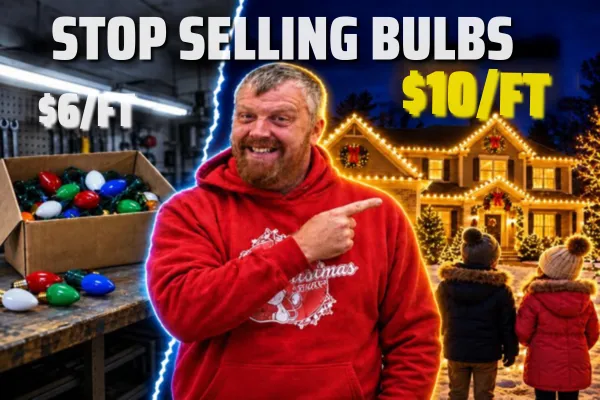
You Can't Get $8 A Foot Because You're Selling Bulbs
You just walked off a job where the homeowner told you $8 a foot was crazy. Three other installers quoted $6. Now you're wondering if premium pricing only works on the other side of the country.
It doesn't. Installers in Dallas and the St. Louis area are closing jobs at $8 to $12 a foot right now. The difference between them and the $6-a-foot crowd has almost nothing to do with the market, and almost everything to do with what they believe, what they sell and how they sell it.
Quick Answer: Professional Christmas light installers are closing jobs at $8–$12 per linear foot in markets where others insist $6 is the limit, including Dallas and the St. Louis area. The ceiling is rarely the market—it's mindset and selling bulbs instead of the experience. Expect a 15%–30% close rate at premium pricing versus 30%–50% at $6 a foot, but you'll do less work and make more money.
This guide lays out how established installers break through the "not in my area" price ceiling, from mindset to the quote. For the full system, see ChristmasLights.io professional installer training.
Is It True You Can't Charge $8–$12 a Foot in Your Market?
No. "You can't get that in my area" is one of the most common objections in the Christmas lights business, and it almost never survives a look at the installer's own quote.
Consider what's happening in markets people swear are "$6 towns":
Dallas: Installers are closing at $8 to $12 a foot and building half-million and million-dollar businesses—in the same city where a widely shared video claims $6 is the ceiling.
Outside St. Louis: One installer came to training, changed his mindset about what he could charge and now closes at $8 to $12 a foot.
Three-year agreements: Installers in the community are signing three-year contracts at $9 a foot this season.
Age is no excuse either: One installer charged $10 a foot and did $125,000 at 17 and 18 years old.
If the market were the problem, none of those numbers could exist. They do, which means the ceiling is somewhere else.
What the "Not in My Area" Quote Usually Looks Like
When an installer insists premium pricing is impossible locally, the fastest diagnosis is to look at the quote. It often reads like a parts invoice: "127 bulbs × $8 per foot." There is nothing on that page about how amazing the home is going to look.
That's a contract, not a vision. There's nothing magical about it, so the homeowner is left comparing price alone—and the installer blames the market for a problem the quote created.
Why Does Your Mindset Set Your Price Ceiling?
Because if you don't believe you're worth $8 to $10 a foot, you'll never be able to sell it at $8 to $10 a foot. You have to believe it and feel it before a homeowner will.
The idea isn't new. A Roman poet wrote some version of it two thousand years ago, and Henry Ford made it famous: whether you think you can or think you can't, you're right. In a Christmas lights business, that belief shows up in dollars.
Who You Listen to Becomes What You Charge
If your feed is full of installers saying "$6 is all this market will bear," you'll absorb it. The next words out of your mouth on a sales call will be theirs. That's why the fastest pricing upgrade many installers make costs nothing: they stop consuming content from people who've accepted a low ceiling and start learning from people closing premium jobs.
Premium Isn't Easy—and That's the Point
Anyone who says this business is easy is selling something. Two pressure washing operators—each a one- or two-person crew—recently closed seven-figure contracts. Neither was the lowest bidder. One followed up for weeks and months before the client said yes. The other had to learn paperwork and processes he'd never touched before.
What they had in common: they put sales first, believed they'd win and kept taking action. The same discipline applies to holiday lighting.
Write the Goal Down and Say It Out Loud
A practical tool from Think and Grow Rich: write a specific revenue target with a date, then read it aloud every morning and every night—with emotion. For example: "I will do $100,000 in Christmas lights by December 31, 2026." When doubt creeps in mid-season, that repetition is what keeps you from dropping your price.
Are You Selling Bulbs or Selling the Magic?
If you sell bulbs, you get bulb prices: $5 to $6 a foot. The $6 installer and the $12 installer both sell the same LED Christmas light bulbs. The customer isn't paying for the bulb—they're paying for how the finished home makes them feel.
The $3 Purse vs. the $3,000 Purse
Two purses can come out of the same factory at the same cost and do exactly the same job. One sells for $3, the other for $3,000. The difference is everything around the product:
$3 purse | $3,000 purse | |
|---|---|---|
Where it's sold | Walmart | One store at one mall in the region |
Scarcity | 20 on the shelf | Hard to find |
Service | Security checks you on the way out; nobody shows you the purse | Staff show you how amazing it is |
The buyer | Grabbing a commodity | Makeup done, $1,000 in clothes, buying the accessory |
Christmas lighting works the same way. Your competitor is selling the left column. Premium installers sell the right one.
What Selling the Magic Sounds Like
Compare two pitches for the same house.
The bulb pitch: "We use the brightest LED bulbs, we'll run the peaks and the ridge, and we point every bulb straight out."
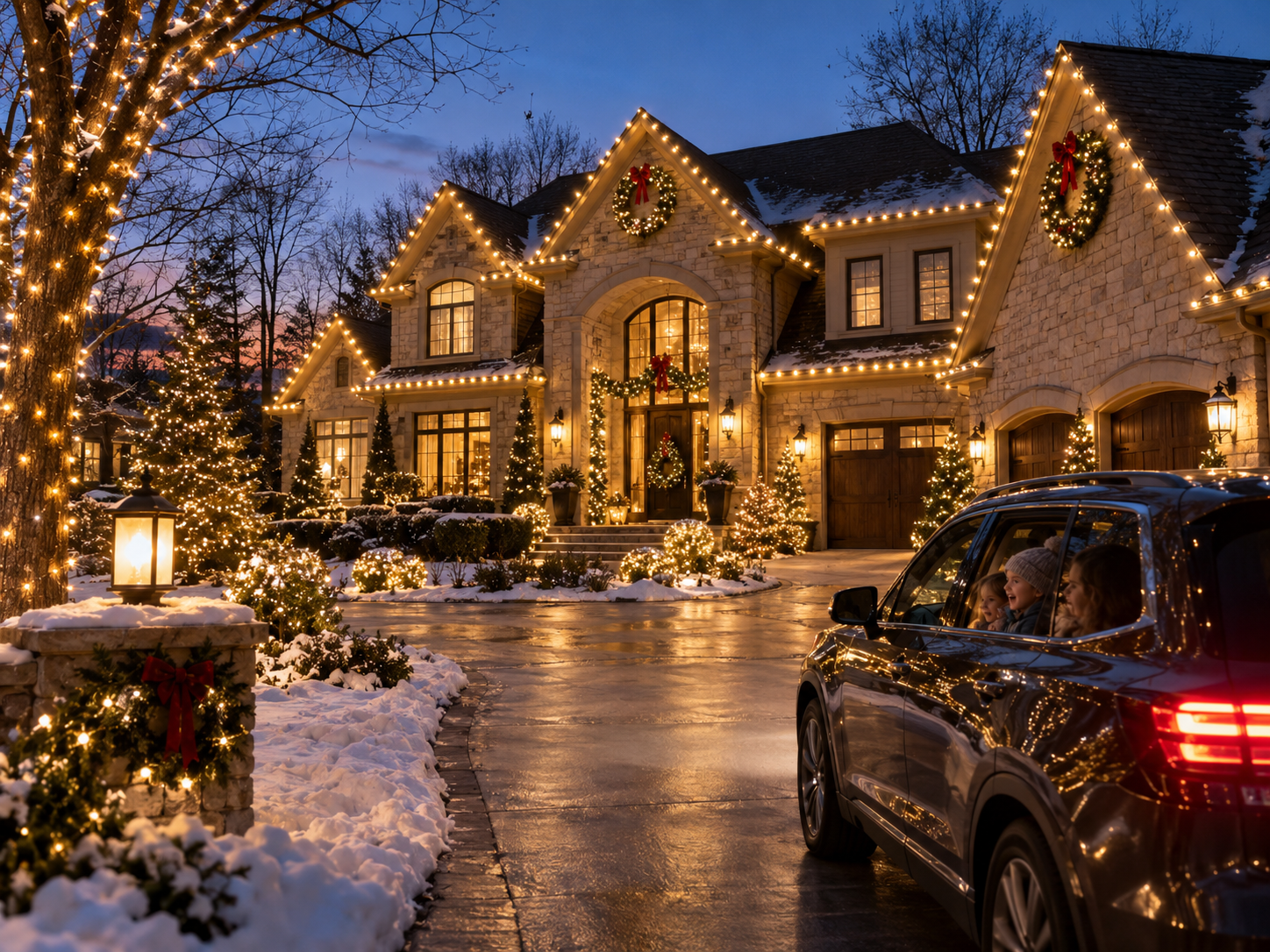
The magic pitch: "When your grandkids pull into the driveway, their faces are going to light up. The whole street will slow down to see this house. Here's a rendering of what it'll look like—can you picture coming home to that every night in December?"
Studies show about 90% of people buy on emotion and how they feel. The first pitch asks a homeowner to compare bulbs. The second asks them to imagine a memory. Only one of those justifies $10 a foot.
How Do Top Installers Actually Sell at Premium Prices?
They control every moment the customer experiences, from the first ring of the phone to the signed proposal. Here's where the $6 and $12 installer split apart.
Look Like a $10-a-Foot Company
Show up in basketball shorts and you'll struggle to get $8 to $10 a foot. Dress nice and look like you own a business—because you do. Age doesn't matter either; young installers win premium work by showing up professional and like they care.
The same rule applies online. If your social media only shows small ranch homes, you'll attract small-ranch budgets. Feature your biggest, most beautiful installs. The customers you showcase are the customers you'll get—and their friends.
Sound Excited on the Phone
If you answer from a roof saying "hold on, let me make sure I don't fall off," you've already lost. Take a breath, smile and answer excited: "Hey, this is [your name]. How can I help you?"
Think of how enthusiastic a certain holiday movie elf gets about spaghetti with syrup. That's the energy. And if you genuinely aren't the best person on your team to answer the phone, hire or assign someone who is. A bad first call can lose the job before a quote exists.
Read the Buyer: DISC and Love Languages
The DISC model sorts people into four styles:
D (Dominance): Direct. Wants to get things done.
I (Influence): Talks a lot.
S (Steadiness): Doesn't want to hear about bulbs or electricity. Buys on emotion.
C (Conscientiousness): Analytical.
Roughly 69% of buyers are S profiles. You sell them on emotion—family, kids and how the home will feel—not the bulbs. It also helps to understand the homeowner's love language so you know what matters to them.
Ask the Memory Question
One of the most powerful questions an installer can ask at a walkthrough: "How did your parents decorate when you were growing up?"
It sends the homeowner back to pulling into Grandma's driveway as a kid. Then you tie it forward: "Our goal is for your kids and grandkids to have that same memory of this house." You've stopped quoting footage and started building a legacy.
Build a Quote That Sells the Vision
Replace the line-item invoice with a proposal that shows a rendered picture of their home lit up and speaks to how amazing the house is going to look. At an in-person quote, don't spend 30 minutes talking about bulbs. Spend it on the family and the kids, building know, like and trust.
What Close Rate Should You Expect at $8–$12 a Foot?
Lower than at $6—and that's fine. At $6 a foot you might close 30% to 50%. At $8 to $12 a foot, expect 15% to 30%. You won't close every job, but you'll do less work and make more money.
If your close rate at premium pricing is really low, look at how you're selling first: the phone call, the walkthrough and the quote. Sometimes you may need to come down a little while you learn to sell better. But price is almost never the real objection—unsold value is.
How Do You Raise Your Average Ticket and Protect Profit?
Raise the ticket before you chase more leads. Every dollar added per job lowers the number of homes you need.
Worked Example: The $100,000 Goal
One second-year installer did $33,000 last season and set a $100,000 target. With $25,000 already booked, the plan was 44 more clients at $1,800 each. The better question: how do you get that average ticket to $2,000, $2,200 or $2,500? A higher ticket means fewer jobs to hit the same goal—and more money in the end.
Add-Ons That Lift the Ticket
Ask what else you can sell on every job, not just the roofline:
Oversized wreaths: A 60-inch wreath from Sam's Club runs about $199 this season, and installers are getting $300 to $500 apiece. They can be reused for four or five seasons. Pro-grade options up to 72 inches are also available in the commercial Christmas wreaths collection.
Ground-stake lighting and ridges: Offer the full package, not just the roofline. Stock up on Christmas light ground stakes and pro Christmas light kits for ridges.
Spritzers: Figure out your cost and the time involved, then price accordingly. LED spritzers come in sizes from 12 to 36 inches.
Know Your Real Profit
Most Christmas light companies fail within three to five years for two reasons: the owner never learned to run a business, and they never knew what a job really cost. "I made $100,000 and only spent $20,000" isn't $80,000 of profit if you haven't paid for the labor you did yourself.
A good rule of thumb is thirds: one-third to marketing, materials and costs, one-third to employees and one-third to profit. Pay yourself as labor, then measure what's left. The book Profit First is a good place to start.
Where Do Premium Leads Come From?
From doing more of what already works—at 10 times the volume. A strong close rate at premium pricing means nothing without enough phone calls.
Scale Your Yard Signs
One installer did $16,000 from 100 yard signs, then asked whether to try Facebook or Google Ads next. The better answer: put out 1,000 signs. If you 10x what worked, you have a shot at $160,000 instead of $16,000.
Another installer committed to 2,000 signs in a single season and finished near $400,000. The common mistake is the opposite: installers who win with signs in year one get lazy in year two, switch entirely to paid ads and wonder why the phone went quiet. Signs sitting in a box don't ring the phone. Keep scaling what works, then layer ads on top. Order in volume through ChristmasLights.io professional yard signs.

Knock on Doors—Especially Commercial Ones
The hardest door to open is your own car door. One installer walked into local car dealerships this season and closed nearly $10,000 across three or four lots. Another picked one busy road, knocked every door on it for a week and sold 50. Commercial prospects rarely come to you. Go to them.
Post Like a Local Brand on Facebook
If your budget won't cover 1,000 signs yet, post five to seven times a week. Skip the "I'm a Christmas light guy, buy my stuff" posts. Post videos and show different things. As your views go up, people start to know you, and that's how you grow on Facebook. Some installers also light up homes for free—for widows, people who are terminally ill and others who need some Christmas cheer—and use them as training homes before paid installs start.
Your 7-Step Plan to Break the $6-a-Foot Ceiling
Audit your inputs. Stop listening to anyone telling you premium pricing is impossible where you live. Learn from installers who are actually closing at $8–$12 a foot.
Write your number down. Set a revenue goal with a date and say it out loud morning and night.
Rewrite your quote. Show a rendered picture of their home and sell how it will look and feel—not a bulb count.
Upgrade your first impression. Dress professionally, sound excited on the phone and show your best homes on social media.
Sell the memory. Ask how they decorated growing up, read their DISC style and talk family before bulbs.
Raise the ticket. Offer wreaths, ground-stake lighting and ridges on every job.
Scale what works. 10x the lead source that already produced for you—signs, doors or Facebook—before adding anything new.
None of these steps is easy, and none requires a different market. They require action. Get uncomfortable: that's where the growth happens.
Ready to learn the full sales, pricing and marketing system? Start with ChristmasLights.io professional installer training. It's not too late to make this your best season yet.

How much should a professional Christmas light installer charge per foot?
Many established professional installers charge $8 to $12 per linear foot, and some are signing three-year agreements at $9 a foot. The price you can get depends on how you sell, not your zip code.
Can I really charge $10 a foot in a lower-income or competitive market?
Yes. Installers in markets where others claim $6 is the ceiling, including Dallas and the St. Louis area, are closing at $8 to $12 a foot. The difference is believing your price and selling the experience instead of the bulbs.
Why do homeowners say my Christmas light quote is too expensive?
Usually because the quote gives them nothing to compare except price. A line-item bulb count invites a race to the bottom. A proposal that leads with a rendering of their home and the family experience shifts the comparison from cost to value.
What is a good close rate for Christmas light installation quotes?
At $6 a foot, installers often close 30% to 50%. At $8 to $12 a foot, 15% to 30% is healthy. A lower close rate at a higher price means less work and more money.
What does "sell the magic, not the lights" mean?
It means leading with how the finished home will make the family feel—grandkids' faces lighting up, the neighborhood coming to see the house, a memory they'll keep—rather than bulb type or brightness. About 90% of people buy on emotion and how they feel.
How do I use DISC profiles to sell Christmas lights?
Identify whether the homeowner is direct (D), talkative (I), steady (S) or analytical (C), then match your pitch. Roughly 69% of buyers are S profiles, who buy on emotion and don't care about bulbs or electricity. The sales process is covered in ChristmasLights.io training.
How many yard signs should a Christmas light business put out?
As many as your results justify. If 100 signs produced $16,000, scaling toward 1,000 is the logical next step before adding paid ads. Installers who have committed to 2,000 signs in a season have reached around $400,000 in revenue. Source them through ChristmasLights.io yard signs.
How can I increase my average Christmas light ticket?
Sell more than the roofline: oversized wreaths, ground-stake lighting, ridges and spritzers. A 60-inch Sam's Club wreath costing about $199 can sell for $300 to $500 installed. Raising your average ticket from $1,800 to $2,000 or more means you need fewer jobs to hit your goal.
What profit margin should a Christmas light business target?
A good rule of thumb is thirds: one-third to marketing, materials and costs, one-third to employees and one-third to profit. Count your own labor as a cost. If you'd have to pay someone to do the work you did, that money isn't profit yet.
Is it too late in the season to start or grow a Christmas light business?
No. It's not too late to start a Christmas light business this season, and many installers are just getting ready to start installing. Learn the system through ChristmasLights.io training and connect with other installers in the ChristmasLights.io installer community.


