
$6,000 and $12,000 Christmas Light Jobs. Here's What They Did.
It's October, and Christmas light installers are closing $1,000 jobs, $5,000 jobs, $6,000 jobs and $12,000 jobs. Some have been in business for years. Some started two weeks ago. What they have in common isn't a perfect logo, a perfect proposal or a perfect market. It's that they took action—fast.
Quick Answer: Installers closing bigger Christmas light jobs at $8 to $12 a foot do a few things differently: they show big homes in their marketing, sell the feeling of Christmas instead of bulbs, contact leads within five minutes, send quotes within 20 minutes and follow up until they get an answer. It takes five to nine touches for someone to say yes, but only about 25% of people follow up at all.
This guide breaks down how installers in ordinary markets are landing $5,000 to $12,000 jobs this season, and the habits you can start this week. For the complete sales system, see ChristmasLights.io professional installer training.
Can You Really Close Big Christmas Light Jobs in Your Market?
Yes. Installers in Missouri, Louisiana, Indiana, Ohio and all over the country are closing jobs at $8, $10 and $12 a foot—in the same markets where people say it can't be done. They're not in the wealthiest places in the country, and they don't know everything. One installer closed a $12,000 bid two weeks after class.
Another installer in a small Missouri town won a free class, showed up and took action. Now he's closing $10,000 and $6,000 jobs in a state where people say you can't make money hanging Christmas lights. What you think and believe is what you'll achieve.
Don't Feel Behind in Your First Year
If it's your first year, it takes time. You don't have a customer base yet, and you don't have the knowledge some veteran installers have. One installer who closed a big job has a huge customer list behind him. So don't compare yourself. Plant your money bushes—your yard signs—and they'll grow into trees that start paying you. Get on Facebook and start making videos. If you're cold calling and haven't booked anything yet, keep calling: call the right person, with the right mindset and with excitement.
Why Does Imperfect Action Beat Perfect Planning?
Perfect never gets done. What you think is perfect today, you'll think is terrible tomorrow, because you'll always find something to nitpick. Take massive imperfect action instead.
You Don't Need a Logo
Nobody buys from you because of your logo. People don't go to Chick-fil-A for the logo, or even the chicken—there are plenty of other chicken places. They go because they know someone will say "my pleasure," and they like how the experience makes them feel. That's what you're selling, too: a feeling.
Get on Video Anyway
If you can't get jobs, go live on Facebook and post reels. One company posts videos two or three times a day—not once a week or once a month. Your first videos won't be good. Post them anyway. Stumbling through is fine; it shows people you're real and not AI.
Throw mud on the wall and see what sticks. A call comes in. A quote goes out. Someone says you're crazy—let that mud fall off. That's what taking action looks like.
How Do You Get Bigger Christmas Light Jobs?
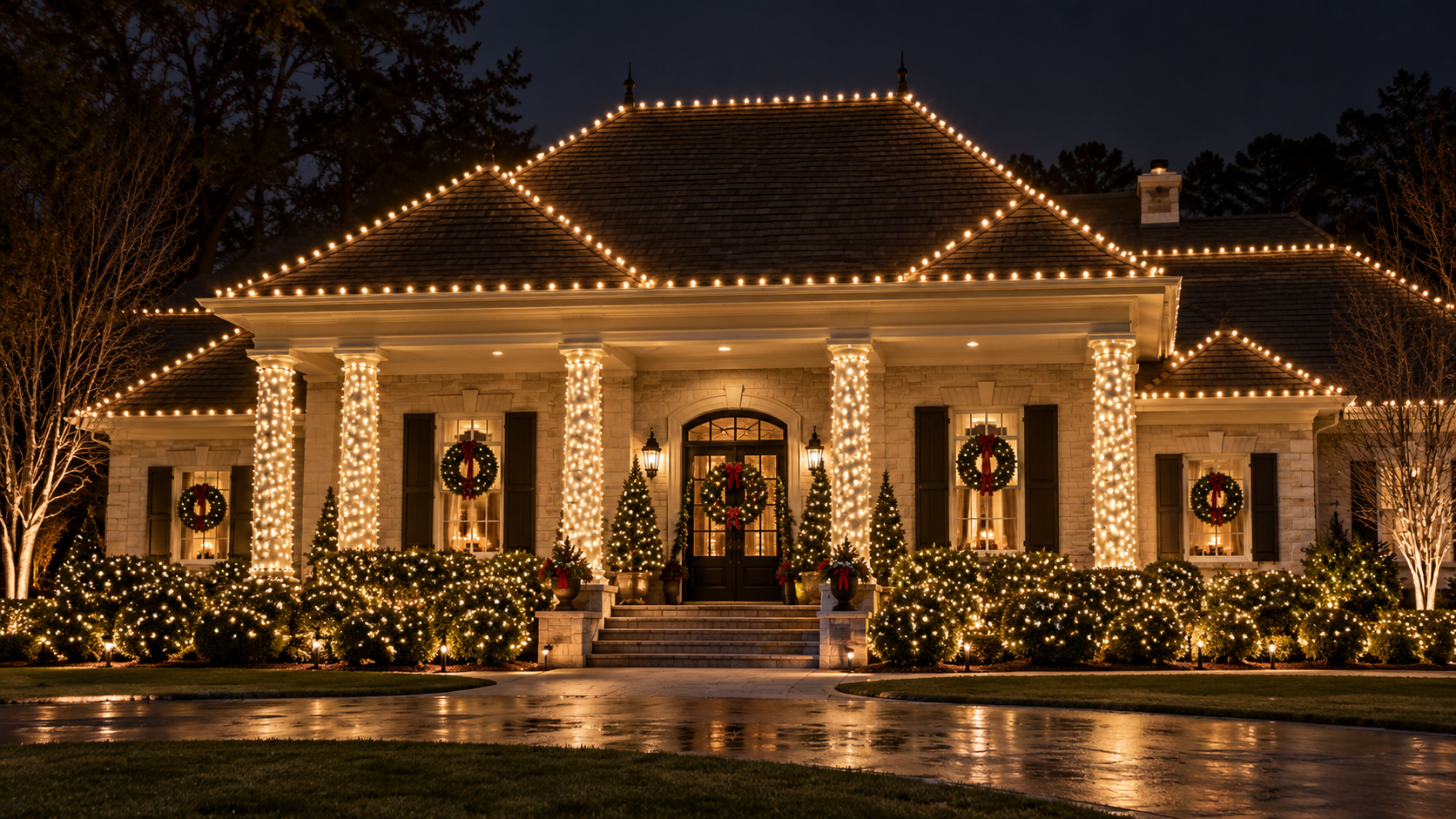
You get big jobs by showing big jobs. If you put lights on a small house and post it as your example, you'll probably get calls from houses that look just like it.
Show a Beautiful Big House
One installer did more than $100,000 his very first year by finding a big house on a corner, making it beautiful and getting job after job from it. If you go that route and do a house for free, don't half-do it with a $500 front roofline. Do the ridges and everything else so you get great pictures. If not, put out your yard signs and get confident selling the jobs that call.
When you quote, show the customer what it will look like. One installer closed a big job with a proposal built with AI that showed the home lit up. It looked magical.
Sell Christmas, Not Lights
An installer who did $79,000 in his first year is on his way to $150,000 this year, with a 40% to 50% close rate and a $2,000 average ticket. His explanation: "I sell Christmas, not lights."
Your customer doesn't care about the bulb, the socket wire or the clips you put in the peak. They want to know what it will feel like. If you sell an ordinary bulb, you'll get ordinary customers—and someone selling the same ordinary thing will always come in cheaper, until it's a race to the bottom. An ad running locally this season offers Christmas lights for $499. That's a great way to go broke. If someone tells you that you can hang lights for less than $8 a foot, be careful who you're listening to.
Think about steak. A $12 steak and a $100 steak can be the same size. One gets flopped on a plate; the other is presented to look amazing. If you want premium customers, your website, your phone presence and your proposals have to look premium. Package names help too—a name like "the Griswold package" makes your offer feel more like Christmas.
How Fast Should You Respond to Christmas Light Leads?
Fast. Make two promises to yourself this week:
Contact every lead within five minutes. It's something like seven times more likely to close.
Send every quote within 20 minutes. Combine a five-minute response with a fast quote, and it's something like 100 times more likely to close.
Speed Over Accuracy
One very successful installer, asked what he'd learned, answered: "speed over accuracy." He'd rather get a quote out in five minutes than spend an hour making it perfect. The little things still matter—but don't sit and tinker with a quote.
One installer lost a job because he sat on a bid for two weeks, agonizing over it. He was $20 cheaper than the company that got the job. The other company simply sent theirs first. Don't stare at a $13,000 quote wondering whether they'll pay it. Hit send. If they take it, great. If not, move on to the next person.
Stay Hungry on Scheduling
Speed doesn't stop at the quote. Some pressure washing companies with 10 crews only want to be booked out one to two days. Being a month booked out means you're comfortable. Being one or two days out means you're hungry—and the companies that stay hungry hire, build systems and get new people trained quickly.
How Do You Make It Easy for Customers to Say Yes?
If it's hard for you to sell, it's hard for them to buy. We live in a world of now—order something on Amazon, and it shows up tomorrow.
Don't make customers do your job. Asking a homeowner to send you a picture of their house makes it harder to hire you.
Shorten your forms. Ten required fields are miserable on a phone. Do you really need to ask how they found you? It's one more button, and the answers usually aren't accurate.
Let them talk. Studies show that if you do 60% of the talking, you're about 20% more likely to lose the job. Let the customer do 60% of the talking, and you're about 40% more likely to close it.
Use your website to build trust. A website ties everything together. Many people who see your Facebook ad will still Google you. Show your face and your crews—when people know, like and trust you, your close rate goes up.
Tell the customer what you'll do, then do it. And if a lead wants a price on every strand so he can pick and choose, he may not be the customer you want.
How Many Times Should You Follow Up on a Christmas Light Quote?
It takes five to nine touches for someone to say yes, but only about 25% of people follow up at all. If you touch a lead once, don't wonder why you didn't close it. Follow up, or fold up. Call the day after you send the quote and ask, "Did you get the quote?"
One installer drove more than 100 miles in a day doing in-person sales and closed one out of five—a $7,100 job. One out of five isn't the end. The other four still get follow-up calls tomorrow. And notice what he wasn't doing: he wasn't on the roof. His crews were out installing while he sold. He's shooting for $750,000 in Christmas lights alone, despite competing with one of the biggest companies in his area.

How Can You Practice Your Sales Script?
If you think your script is the problem, practice it until you're great, not just good. Here's a simple way:
Open ChatGPT on your phone and start a voice conversation.
Tell it you hang Christmas lights, you need help with your sales script and you want it to play the customer, modeled on top salespeople.
Role-play at least 20 times a day until you're confident.
Record your real calls and give them to the AI. Ask what you did wrong—and what you did right on the jobs you closed.
Practice the objections that stop you, like "I have to talk to my spouse."
Michael Jordan didn't become great without practice and coaches for every part of his game. If you can't afford coaches, use AI and get your reps in. The goal is confidence: walking into every quote believing you're the best Christmas light installer in your area.
Why Should You Get Off the Roof?
The roof is the most underpaid job in your business. Pay someone $20, $30 or $40 an hour to be up there, so you can close jobs, answer the phone and get quotes out within five minutes. The goal is a business, not a job—a team with technicians, an office manager, a sales manager, a marketing manager and trucks on the road.
An office person who handles leads and estimates is a game changer. When you wear every hat—operations, sales, marketing, hiring—you do nothing well. Hand off one hat, and that person can be great at it while you focus on bigger bids. An office manager can be almost more important than another technician.
Expect a Learning Curve
Nobody does it perfectly in year one. One business installed 39 jobs its first year. The next year, two people installed around 150 because they had gotten better, faster and more efficient. You build a business brick by brick, and each brick makes it stronger.
How Should You Price Garland and Permanent Lights?
Garland: Price it per section. Good commercial garland comes in 9-foot sections and can be priced at $180 to $200 per section. Most doors take three sections, so about $600 to go around a door. Good garland is expensive to buy, ship and store—you can't just mash it down—while cheap store garland looks like tinsel.
Permanent lights: At this point in the season, push temporary Christmas lights. If you're not busy, permanent lighting jobs can fill the gap. Some customers still want it, but it isn't as hot as it was, partly because cheap products are falling off houses.
Your Action Plan for This Week
Contact every lead within five minutes and send every quote within 20.
Show your best, biggest homes and give customers a visual proposal.
Sell Christmas, not lights. Name your packages and paint the picture.
Follow up five to nine times. Start with a next-day call.
Practice your script with AI every day.
Get off the roof and hire someone to handle leads and estimates.
You will fail. You will break something. The more it costs you, the faster you learn. Excuses that start with "Well, in my area…" don't close jobs.
Ready to close bigger jobs? Learn the full sales and marketing system through ChristmasLights.io professional installer training or start with the online starter course, and connect with other installers in the ChristmasLights.io installer community. When you need supplies, pro light kits from Christmas Lights HQ come with the lights, plugs, clips, males, females and zip cord in one package.

How do Christmas light installers close bigger jobs?
They show big homes in their marketing, use visual proposals, sell the feeling of Christmas instead of bulbs, respond fast and follow up. Installers across the country are closing $5,000 to $12,000 jobs this way.
How fast should I respond to a Christmas light lead?
Within five minutes, which makes a lead something like seven times more likely to close. Send the quote within 20 minutes.
How many times should I follow up on a Christmas light quote?
It takes five to nine touches for someone to say yes, but only about 25% of people follow up. Start by calling the next day to ask whether they got the quote.
What does "sell Christmas, not lights" mean?
It means selling how the home will look and feel, not the bulbs, socket wire or clips. One installer who sells this way has a 40% to 50% close rate and a $2,000 average ticket.
How do I get bigger Christmas light jobs?
Show big jobs. If your marketing shows small houses, you'll get small houses. One installer did more than $100,000 his first year after making a big corner house look beautiful.
Is it better to send a quote fast or make it perfect?
Fast. One successful installer's rule is "speed over accuracy." Another lost a job he was $20 cheaper on because he waited two weeks to send the bid.
How much should I charge for Christmas garland?
Price it per section. Good garland comes in 9-foot sections, and one approach is to charge $180 to $200 per section, so a door with three sections runs about $600.
Should I sell permanent lights during Christmas light season?
Push temporary Christmas lights while you're busy. If you aren't busy and need work, permanent lights can fill the gap, though demand isn't as hot as it was.
How can I practice my Christmas light sales script?
Role-play with ChatGPT in voice mode at least 20 times a day, then record real calls and ask the AI what you did wrong and what you did right.
Should I hire an office person before another technician?
An office person who handles leads and estimates can be almost more important than another technician. It frees you to answer the phone, close jobs and get quotes out fast.


