

C9 & C7 Socket Spools & Stringers
Discover our premium collection of socket wire spools and stringers, the essential foundation for creating stunning light displays. Designed for both professional installers and ambitious homeowners, our range includes bulk C7 and C9 socket wire spools with flexible spacing options, pre-made light stringers for quick setups, and convenient accessories like spool holders. These versatile, durable components are perfect for residential rooflines, enchanting tree displays, and large-scale commercial projects. Suitable for indoor and outdoor use, and compatible with both incandescent and LED bulbs, our professional-grade products offer the quality and flexibility needed to bring your creative lighting visions to life. Explore our selection and elevate your illumination projects with unmatched versatility and reliability.
Socket Spools
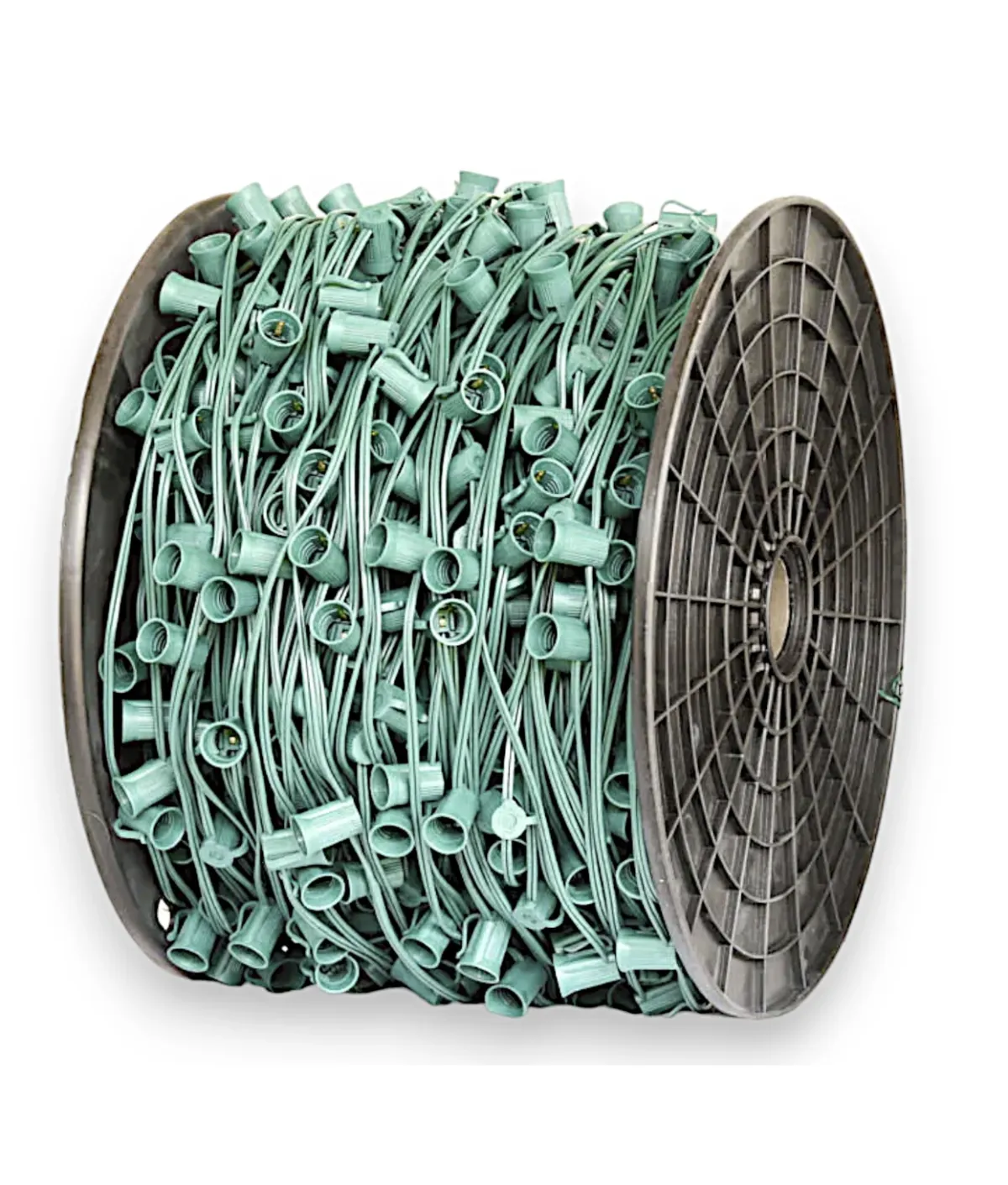
C9 1000' Socket Spool
Our C9 1000' Bulk Spool of Socket Wire, available in green or white, offers professional-grade flexibility for custom lighting projects. With spacing options from 6" to 48", it's ideal for both residential rooflines (12-15" spacing) and tree installations (24-48" spacing). The durable SPT-1 wire withstands outdoor conditions and is compatible with both incandescent and LED C9 bulbs. This customizable spool allows for precise length cutting, minimizing waste and maximizing efficiency for high-quality, adaptable lighting displays.
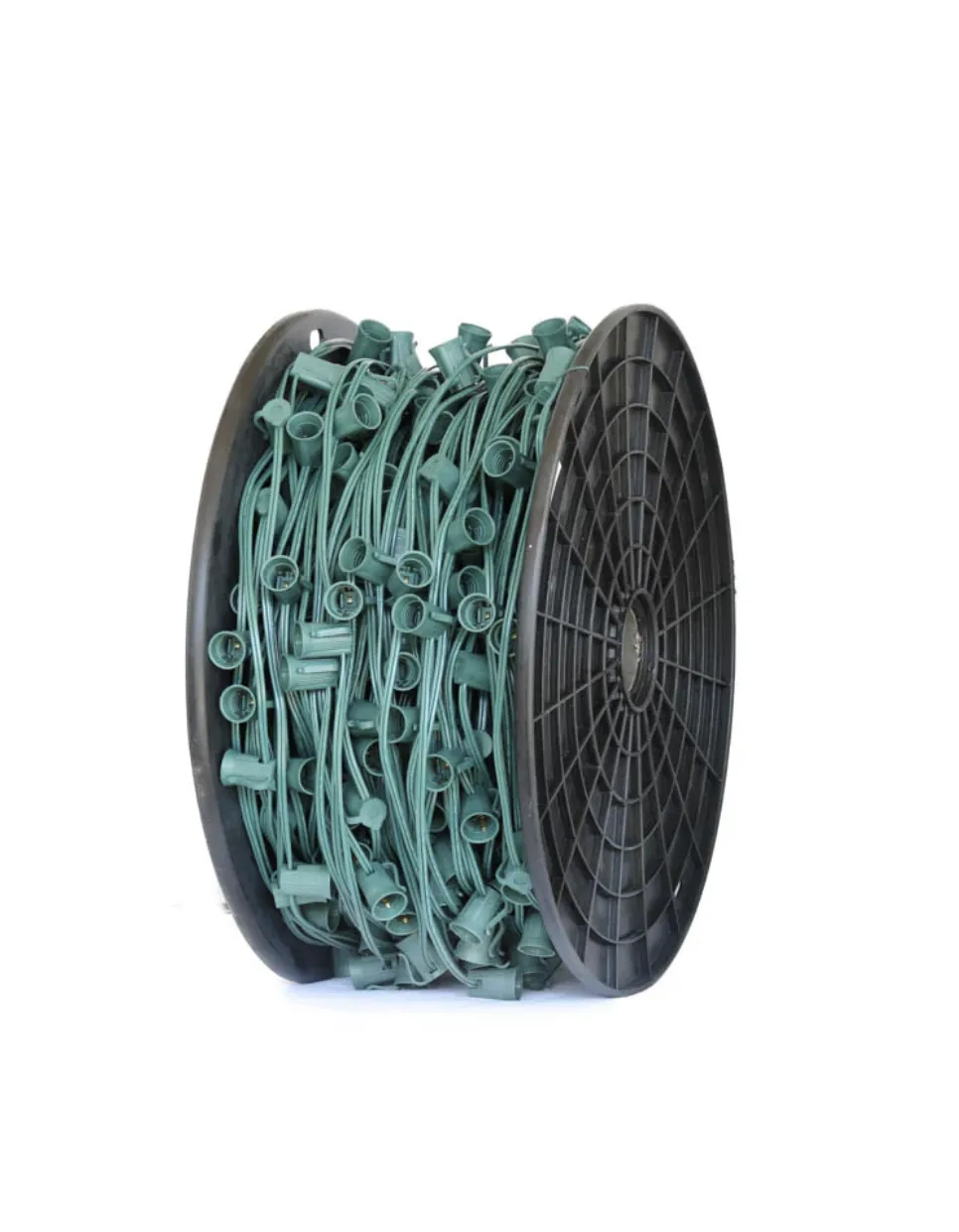
C9 500' Socket Spool
Our C9 500' Bulk Spool of Green Wire, available with 12" (500 sockets) or 15" (400 sockets) spacing, is perfect for professional-grade Christmas lighting installations. Featuring commercial-quality SPT-1, 8-amp wire and durable E17 sockets, this customizable spool is ideal for large-scale outdoor projects. Easily cut to desired lengths and pair with snap-on plugs (sold separately) for tailored lighting solutions in both residential and commercial settings. The 12" spacing offers vibrant, balanced lighting, while the 15" option provides a classic look with fewer bulbs per run.
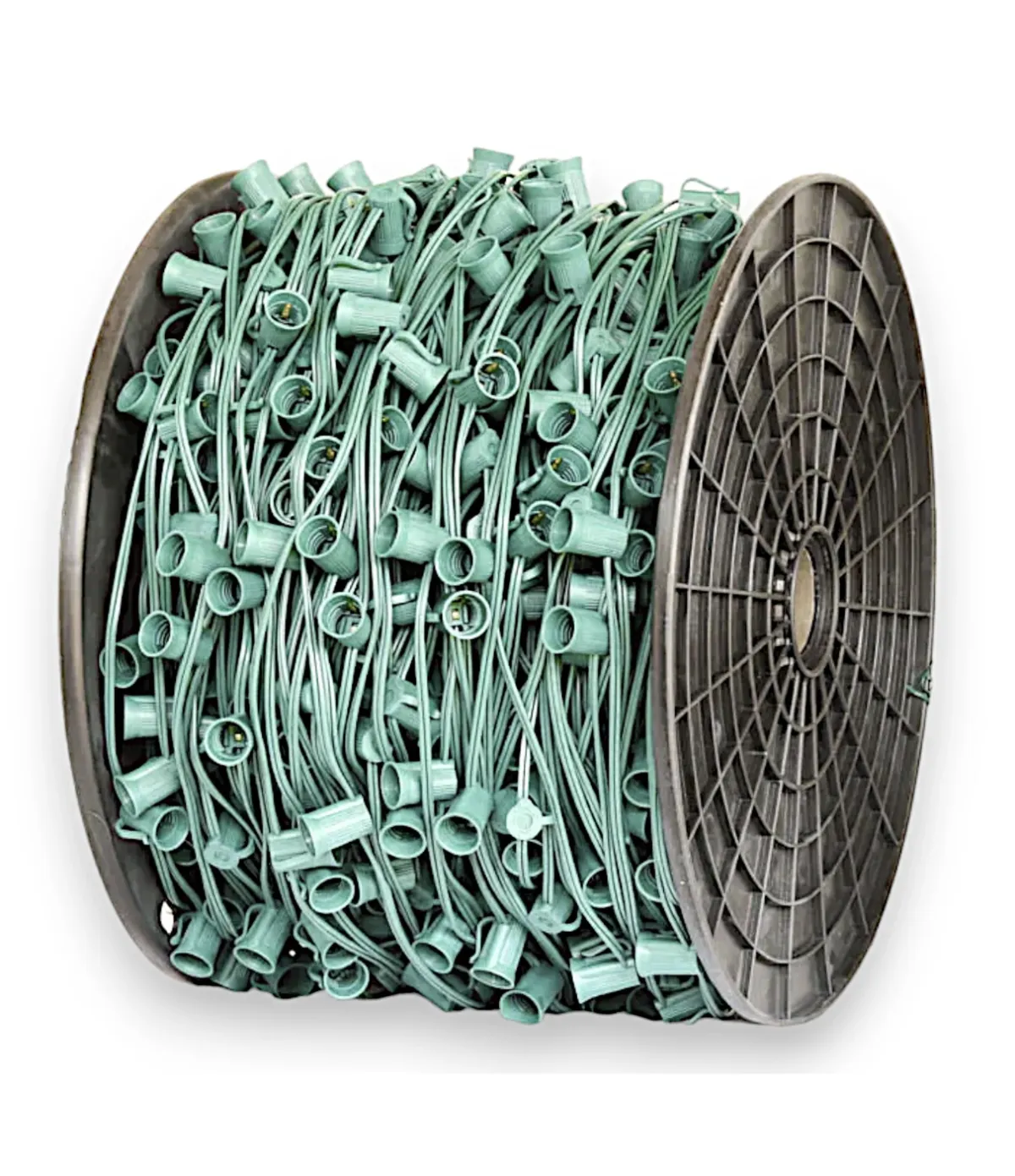
C9 1000' 12"&15" Socket Wire Spool (SPT-2)
Our C9 1000' Socket Wire Spool (SPT-2) offers professional-grade flexibility with dual 12" and 15" spacing options. This customizable spool features heavy-duty SPT-2 wire for enhanced durability in all weather conditions. The 12" spacing is perfect for dense, vibrant displays on rooflines and pathways, while the 15" option provides a classic look with fewer bulbs per run. Compatible with both incandescent and LED C9 bulbs, this 1000' spool allows for precise cutting to fit any residential or commercial lighting project, ensuring efficient and long-lasting installations.
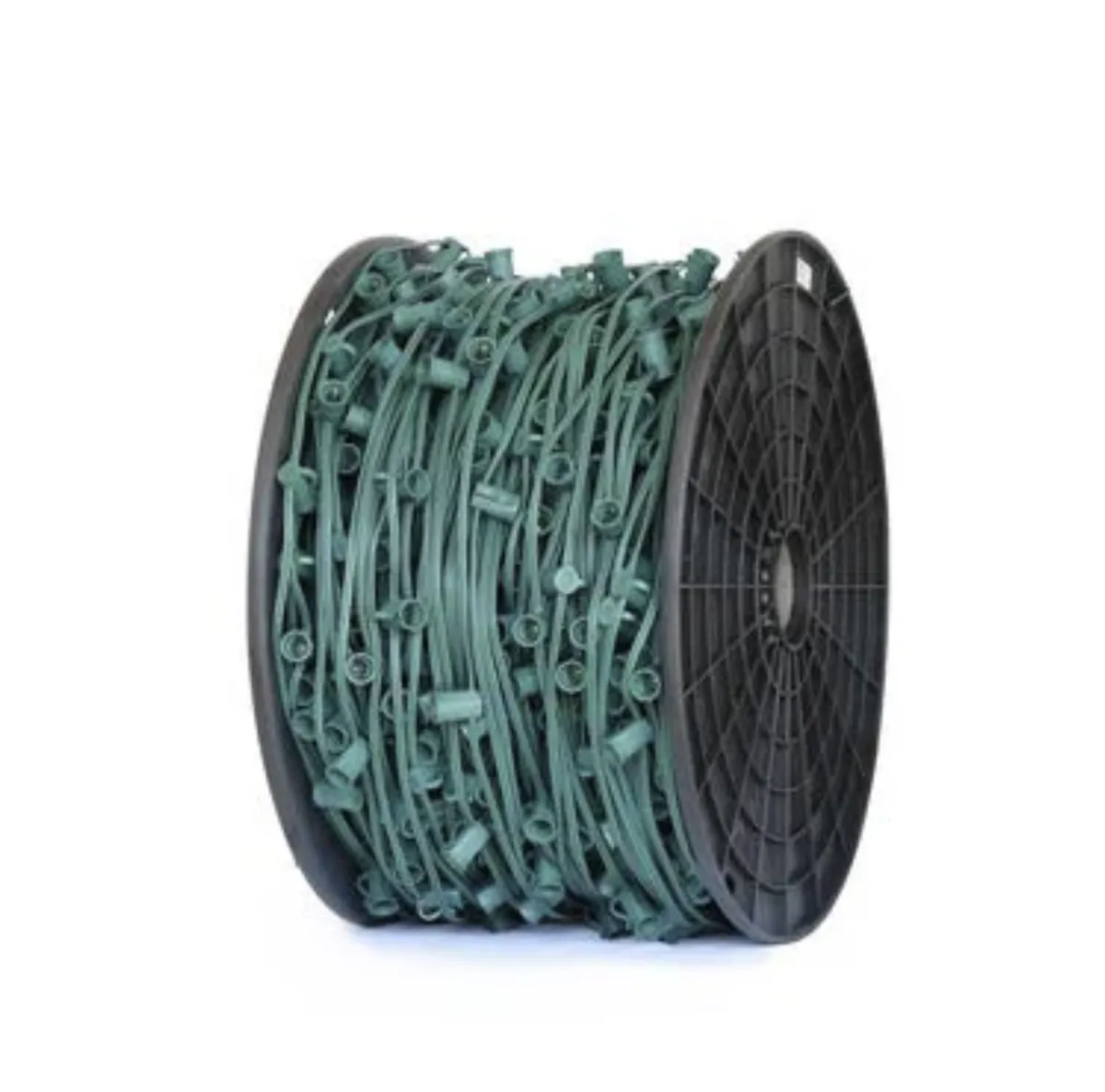
C7 1000' Green Wire Socket Spool (SPT-2)
Our 1000' bulk spool of green SPT-2 wire features 15" spacing with 1000 C7 sockets, ideal for commercial and residential outdoor displays. This 8-amp (960-watt) commercial-grade wire with Admiral Brand sockets allows for custom-length installations using snap-on plugs (sold separately). Suitable for indoor/outdoor use, it accommodates up to 160 sockets with 5-watt incandescent bulbs or 384 sockets with 1-watt LED bulbs per run. This versatile, durable C7 light line is perfect for creating professional-quality lighting displays in various settings.
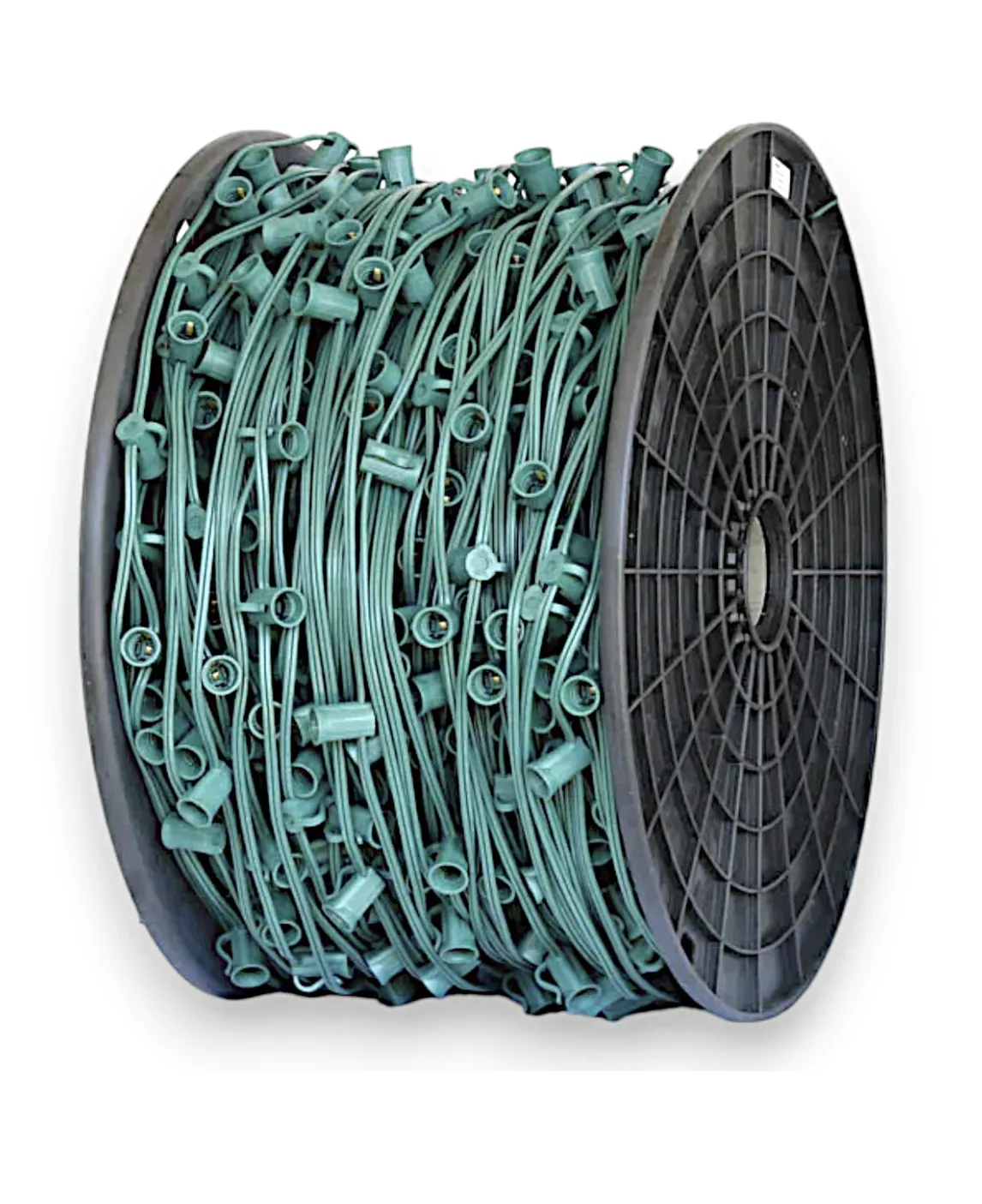
C7 1000' Socket Spool
Our C7 1000' Bulk Spool of Socket Wire offers professional-grade flexibility for custom lighting projects. Available in green or white, with spacing options from 12" to 36", it's ideal for both residential rooflines (12-15" spacing) and tree installations (24-36" spacing). The durable SPT-1 wire withstands outdoor conditions and is compatible with both incandescent and LED C7 bulbs. This customizable spool allows for precise length cutting, minimizing waste and maximizing efficiency for high-quality, adaptable lighting displays in various settings.
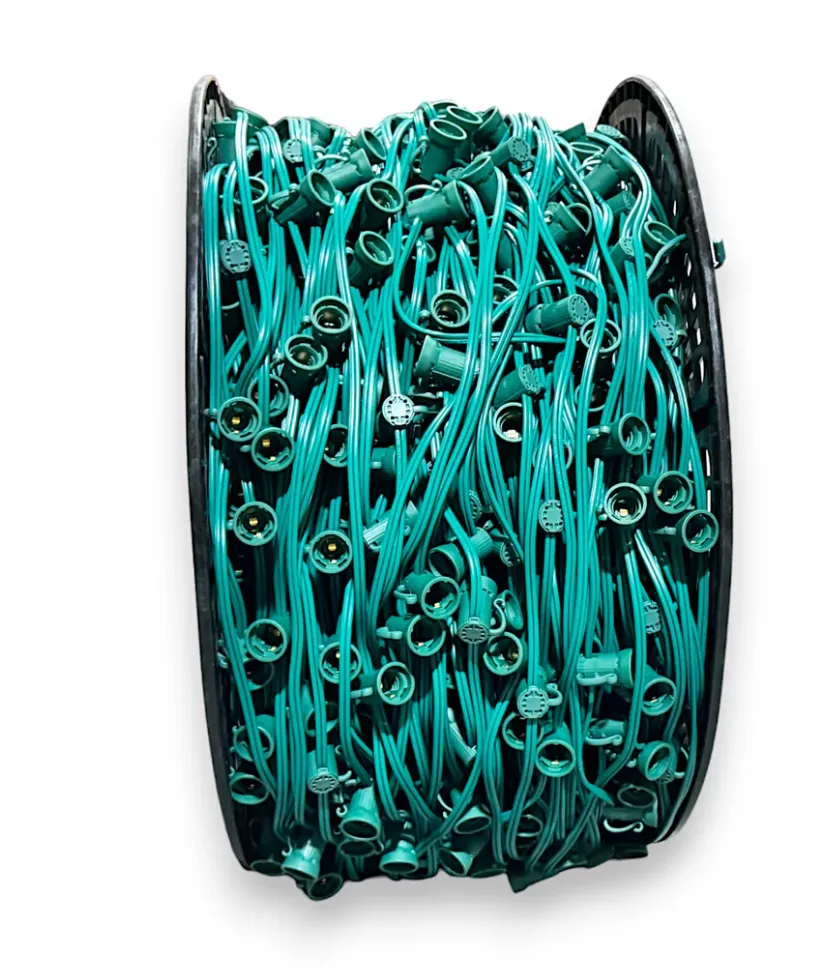
C7 1000' Socket Spool
Minleons C7 1000' socket wire spools with options for factory Socket clips
or without factory Socket Clips. Available in 12" or 15" spacing.
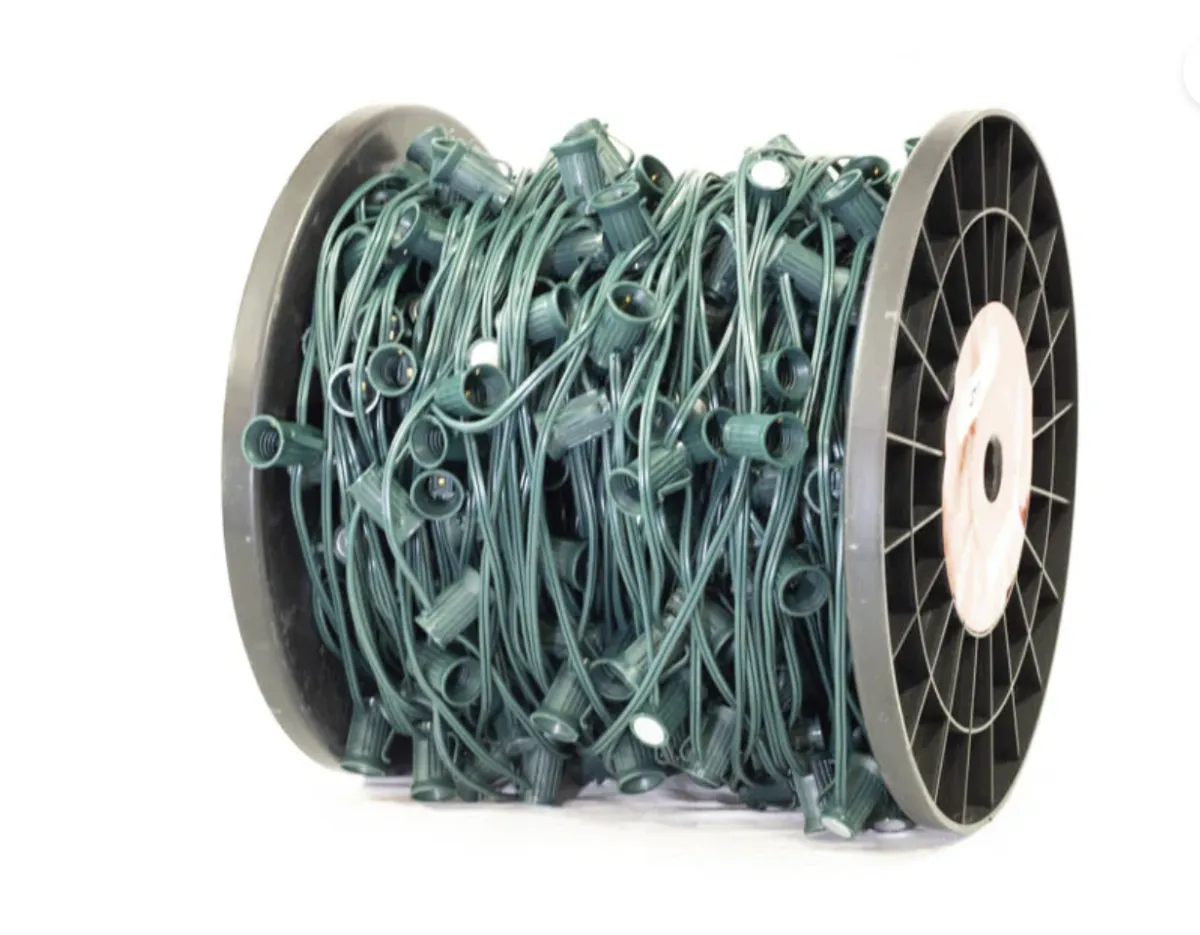
C9/C7 500' Magnetic Spool
The Fastest Way to Install Holiday Lights on Metal Surfaces. Save time and effort this holiday season with Magnetic Spools. Designed for quick and easy installation, these magnetic spools are perfect for decorating your home or office building. The magnetic sockets eliminate the need for traditional mounting clips, making your installations faster and more efficient. Whether you’re lining rooflines, gutters, or fences, these spools are ideal for any surface where ferrous metal is present.
Available in 500' & 250', 12" or 15" Spacing.
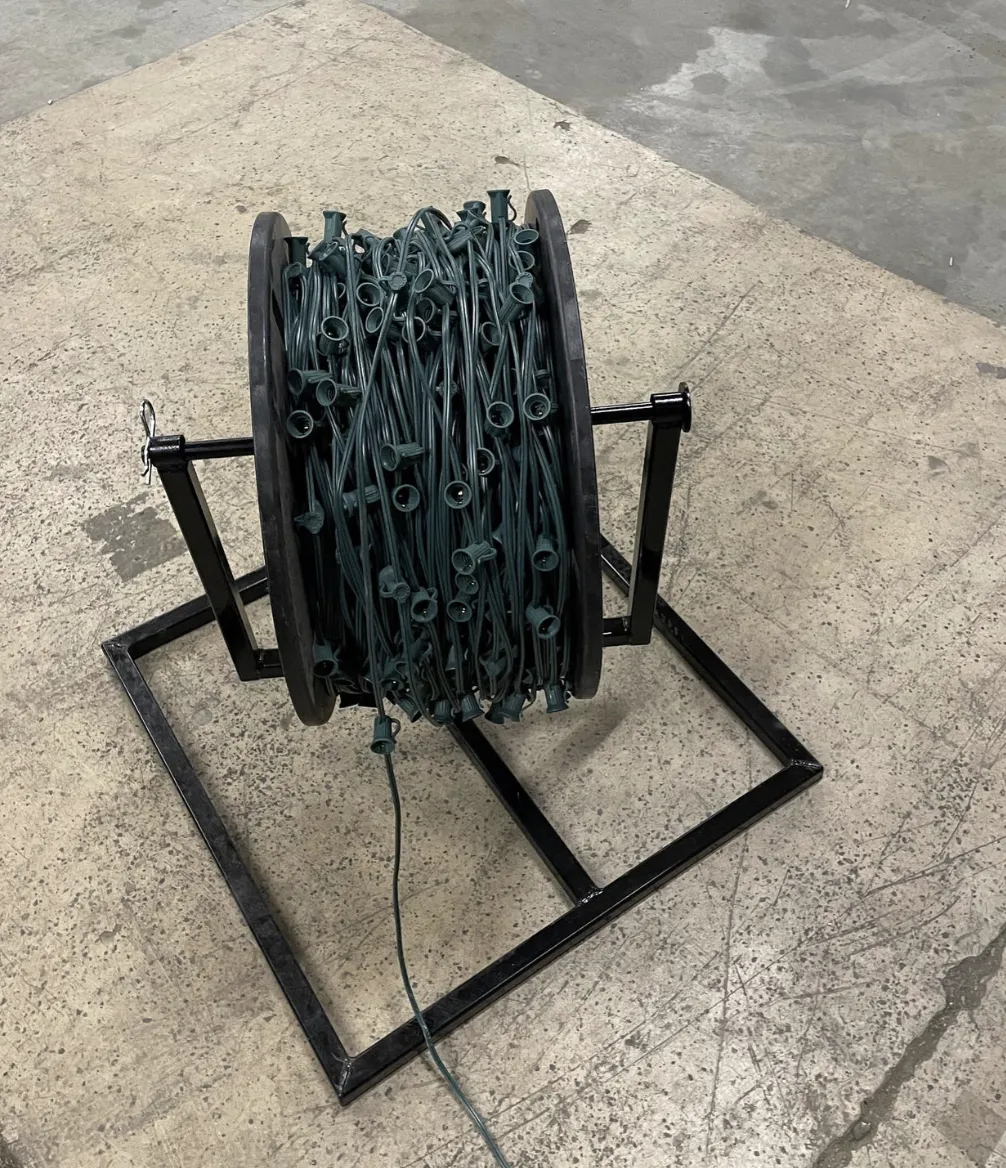
C9/C7 Heavy Duty Swivel Spool Holder
Versatile Wire Spool Holder:
• Compatible with C7 and C9 spools
• 360-degree swivel capability
• Foldable design for compact storage
• Dimensions: 24" x 24" x 20"
Note: Socket wire sold separately.
Socket Wire Stringers
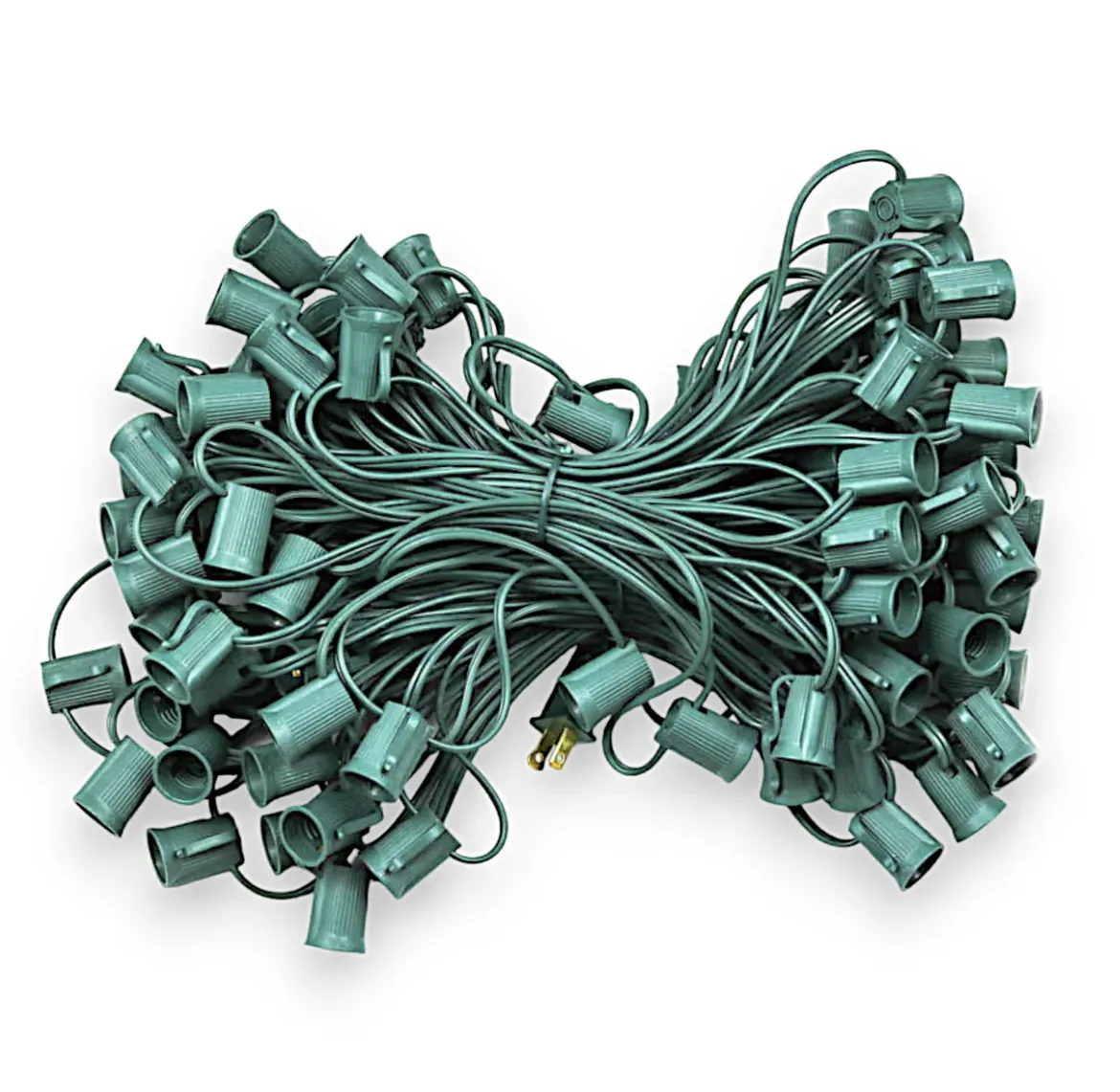
C9 12" Spacing Socket Wire Stringers
Our 25', 50' or 100' Holiday Light String features professional-grade, UV-protected 18-gauge wire with sockets spaced 12" apart. Designed for both indoor and outdoor use, these UL-recognized strings offer 5 Amp capacity SPT-1 insulation and durable sockets with weep holes for all-weather performance. Compatible with E12 Candelabra base bulbs (C7, C9, G30; sold separately), these versatile strings allow end-to-end connectivity for extended displays. Perfect for holiday decorations, event lighting, and year-round use in residential and commercial settings. Available in Green, White, Brown and Black.
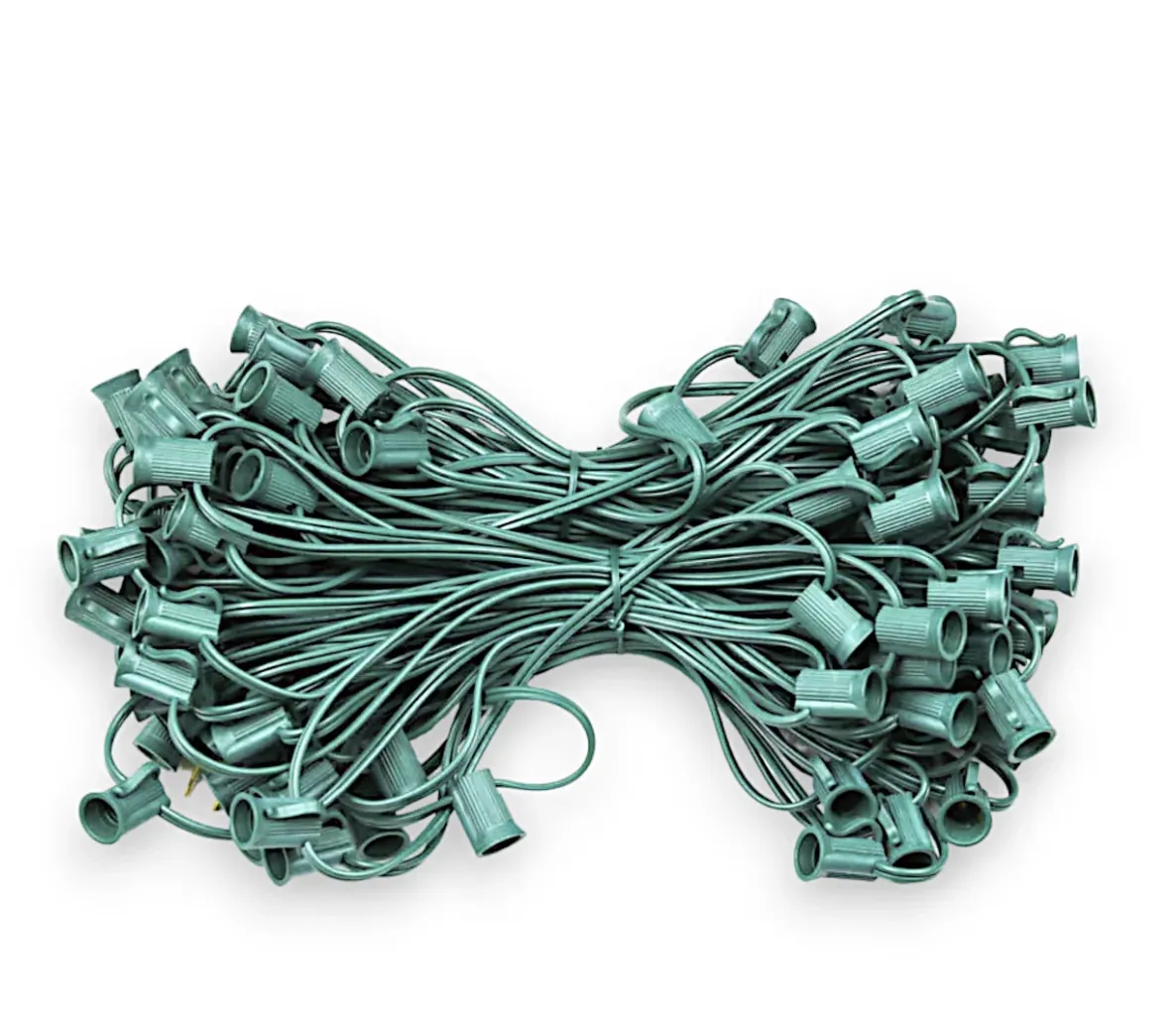
C7 12" Spacing Socket Wire Stringers
Our professional-grade 25', 50' or 100' light string features sockets spaced 12" apart, perfect for commercial and residential decorators. Designed for both indoor and outdoor use, it's compatible with incandescent or LED C7, G30, and G40 bulbs (sold separately). The SPT-1 insulated wire offers 5 Amp capacity and includes weep-hole sockets for all-weather performance. With male and female plugs for end-to-end connections, these UL-recognized strings can handle up to 480 watts per run. Ideal for holiday displays, patio lighting, and year-round events, these durable strings ensure long-lasting, brilliant illumination for any occasion. Available in Green, White, Brown and Black.
Frequently Asked Questions
What's the difference between socket wire spools and stringers?
cket wire spools are bulk reels of wire with sockets at regular intervals, allowing for custom-length cuts. Stringers are pre-cut lengths of socket wire, typically with plugs attached, ready for immediate use.
Can I use the same socket wire for both C7 and C9 bulbs?
No, C7 and C9 bulbs require different socket sizes. Always check the product specifications to ensure you're using the correct socket wire for your chosen bulb type.
How do I determine the right spacing for my project?
Common spacings are 12", 15", and 24". Use closer spacing (12"-15") for dense, vibrant displays on rooflines or fences. Wider spacing (24" or more) works well for tree wrapping or creating a more subtle effect.
Are these socket wires suitable for outdoor use?
Most of our socket wires are rated for both indoor and outdoor use. Look for products labeled as "weatherproof" or "outdoor-rated" for the best durability in external conditions.
How many bulbs can I safely connect on a single run?
This depends on the wire's amperage rating and the wattage of your bulbs. For example, on an 8-amp wire, you can typically run up to 160 sockets with 5-watt incandescent bulbs or 384 sockets with 1-watt LED bulbs. Always check the product specifications and local electrical codes for safe operation.
Discover Expert Tips on Our Blog
You Asked, I Answered: Christmas Light Business Q&A (Real Questions)
The most common question in Christmas lights Facebook groups: "Can I really charge $10-$12 per foot in my market?" The answer is always yes—but the question reveals a deeper problem than pricing strategy. It exposes limiting beliefs that keep installers trapped in poverty pricing while competitors in identical markets thrive at premium rates.
This Q&A addresses the real questions installers ask (and the ones they should be asking) about premium pricing, mindset shifts, and building sustainable businesses. These answers come from real conversations with installers who've made the transformation from struggling at $6 per foot to thriving at $12-$15 per foot—in the exact same markets.
Pricing & Mindset Questions
Q: I'm charging $6 per foot and barely breaking even. How do I justify raising prices to $10-$12 per foot?
A: You don't justify it—you calculate it. At $6 per foot, here's your reality:
Materials: $1.00-$1.50 per foot (if using quality LEDs)
Labor: $1.50-$2.00 per foot
Insurance, gas, vehicle wear: $0.50-$1.00 per foot
Marketing to generate leads: $0.50 per foot
Equipment depreciation: $0.25 per foot
Total costs: $3.75-$5.25 per foot
Net profit at $6 per foot: $0.75-$2.25 per foot
On a 100-foot installation, you're netting $75-$225. That's not a business—it's volunteering with extra steps.
At $10 per foot with identical costs, you net $4.75-$6.25 per foot ($475-$625 per 100-foot job). Now you can afford:
Proper liability and workers' comp insurance
Professional safety equipment (Cougar Paws, pitch hoppers, harnesses)
Strategic marketing investment to generate more leads
Competitive wages attracting quality employees
Actual profit sustaining your family
You're not "raising prices"—you're finally charging enough to run a legitimate, sustainable business instead of a nonprofit hobby.
Q: But won't I lose all my customers if I raise prices from $6 to $10 per foot?
A: Yes—you'll lose the worst customers. One installer raised prices from $4 to $8 per foot and made a shocking discovery: the "crappy customers" disappeared.
Price shoppers, constant negotiators, and problem clients self-selected out. The customers who remained (and the new ones attracted by premium positioning) were:
More respectful of his time
More understanding of weather delays
Less likely to demand callbacks for minor issues
More likely to refer quality customers
More profitable with less hassle
His revenue increased 60% while his headaches decreased 80%. He worked fewer jobs, made more money, and actually enjoyed the business.
The customers you lose at $10 per foot are the ones destroying your profitability at $6 per foot. Good riddance.
Q: I would never personally pay $3,000-$4,000 for Christmas lights. How can I charge that?
A: Stop paying out of your wallet. You're not your customer.
Do you:
Earn $200,000+ annually?
Live in a $750,000-$1,000,000 home with an $8,000 monthly mortgage?
Drive two vehicles totaling $3,000+ in monthly payments?
Spend $10 daily at Starbucks ($3,600 annually)?
Own $5,000-$10,000 purses and designer items?
If you answered no, then your financial perspective is irrelevant. Your target customers think about money completely differently than you do.
To them, $4,000 for professional holiday lighting creating magical family memories is a minor expense—comparable to a weekend trip or monthly car payment. They spend more annually on coffee than your entire installation costs.
The question isn't "Would I pay this?" The question is "Does this create value worth $4,000 to my target customer?" The answer is always yes when you're selling memories, not bulbs.
Q: Last year I struggled to get $7 per foot. How did one installer jump to $10-$15 per foot in the same market?
A: He changed everything except his location. Specifically:
What Didn't Change:
Same city, same neighborhoods
Same competitors charging the same low prices
Same economic conditions
What Did Change:
Hired professional sales team who excel at sales instead of trying to do it all himself
Targeted affluent customers with Facebook ads aimed at $200,000+ household incomes
Created professional social media presence with consistent, high-quality content
Invested in presentation: wrapped vehicles, professional website, abundant reviews
Positioned as luxury service instead of commodity installer
He stopped competing on price with bottom-feeders and started targeting customers who value quality over cost. Same market, different customer segment, completely different results.
The market didn't change—his approach did.
Q: My area is super competitive. Houston/Dallas/[insert city] customers only care about price. Can I really charge $10 per foot here?
A: Houston has 6-8 million people in the metro area. Approximately 15% earn $200,000+ annually. That's 900,000-1,200,000 affluent households.
You're telling me in a market with nearly 1 million wealthy households, you can't find 50-100 willing to pay $2,000-$4,000 for professional Christmas lights?
The problem isn't your market—it's your targeting.
Multiple installers in Houston, Dallas, and every other "impossible" market charge $10-$15 per foot successfully. The difference:
They target $500,000-$1,000,000+ homes exclusively (not every house in the zip code)
They present professionally (wrapped vehicles, professional websites, 50+ reviews)
They market strategically (Facebook ads targeting high-income demographics)
They believe in their value (confidence communicates through every interaction)
Every market has price shoppers. Every market also has value buyers. You're fishing in the wrong pond, not the wrong lake.
Q: What's the single biggest mindset shift that enables premium pricing?
A: Recognizing you're selling magic and memories—not bulbs and clips.
Low-price installers sell features: "We install C9 LED lights. They're really bright. We space them evenly. We have insurance. Your front roofline is $1,200."
Premium installers sell outcomes: "Tell me about your Christmas plans... Oh, your grandchildren are visiting from South Dakota for the first time in two years? How old is Timmy? Four years old—that's such a magical age for Christmas! Can you imagine his face when you pull up and this entire house is glowing like a winter wonderland? He'll be jumping up and down with pure excitement!
We'll light up your entire roofline, wrap those beautiful front trees, add a gorgeous wreath on the door, and line the walkway so it looks like a magical path. When Timmy sees this, it'll be a memory you'll treasure forever. We can install Thursday or Friday—which works better? We just need 50% deposit to secure your spot."
See the difference? One quotes commodity installation. The other sells the priceless moment when Grandma sees Timmy's face light up with wonder.
That moment is worth $4,000, not $1,200. But you can only charge for it if you recognize you're selling it.

Sales & Customer Psychology Questions
Q: How do I close more jobs without lowering my prices?
A: Stop selling and start asking questions. Installers struggling to close typically talk too much and listen too little.
The Magic Question: "Why do you want Christmas lights this year?"
Surface answers like "I think they're pretty" hide real emotional drivers. Dig deeper:
"What's special about this Christmas?"
"Who's visiting during the holidays?"
"What memories are you hoping to create?"
"Do you have traditions from childhood you want to recreate?"
These questions uncover the real reasons:
Example 1: Grandchildren visiting for first time in two years → Creating magical memories for kids they rarely see makes price irrelevant
Example 2: New homeowners → First Christmas in new home drives desire for something special and memorable
Example 3: Neighborhood competition → They want the best display on the block—budget is secondary
Example 4: Terminal illness in family → When time is limited, families invest heavily in creating perfect memories
When you understand the emotional why, you connect your service to their deepest desires. You're no longer comparing price—you're fulfilling needs that have no price tag.
Then you close with: "We can create this magic for you Thursday or Friday—which works better? We just need your deposit to lock in your installation date."
Q: A customer said I'm too expensive compared to a competitor charging half my price. What do I say?
A: "I appreciate you letting me know. We're definitely not the cheapest option—we're the premium option. Our pricing reflects commercial-grade materials with 5-year warranties, comprehensive insurance protecting your property, experienced crews with professional safety equipment, and guaranteed satisfaction.
If lowest price is your priority, we may not be the best fit. But if you want professional, hassle-free service creating stunning results that make your family memories magical, we're perfect for you."
Then stop talking. Whoever speaks first loses the negotiation.
Most installers panic in silence and start justifying, explaining, or discounting. Don't. The silence feels awkward—embrace it.
Often the customer says: "Well, the quality does seem better with you..." and signs the contract.
If they choose the cheap competitor, you've dodged a problem customer who would have complained, demanded callbacks, and left negative reviews anyway.
Q: Should I present cheap, medium, and expensive packages, or just quote high?
A: Always present the comprehensive premium package first.
Show everything: rooflines, ridge caps, ground stakes, tree wrapping, columns, wreaths, garland—the complete vision at $3,000-$5,000.
Then say: "This is our complete display creating maximum wow factor. We can install Thursday or Friday for $4,200. Which day works better?"
If they balk, remove items: "We can skip the garland and one wreath, bringing it to $3,400. Does that work better?"
Starting low anchors expectations to cheap pricing. Starting high establishes value and lets customers self-select their investment level.
Customers can't buy options you don't present. If you only quote the front roofline, that's all you'll ever sell.
Q: How do I get customers excited enough to pay premium prices?
A: You must be genuinely excited first. Excitement is contagious. Boredom is repulsive.
What excitement looks like:
Wear the gear: Santa hat, Christmas sweatshirt, festive accessories
Speak energetically: Animated voice, positive language, genuine enthusiasm
Smile constantly: Even on phone calls—customers hear smiles in your voice
Paint vivid pictures: "Imagine driving home to this magical display every evening!"
Use their names: Especially children's names when discussing family memories
If you treat Christmas lights like commodity installation, customers shop on price. If you treat it like creating magic, they invest in the experience.
One installer asks every customer: "When you picture pulling into your driveway after we're done, what do you see?" Then he describes that exact vision in vivid detail, connecting it to their emotional desires.
That's not sales manipulation—it's genuine excitement about creating something meaningful. And it closes jobs at premium prices.
Lead Generation & Marketing Questions
Q: I'm only getting 2-3 leads per week. How do successful installers generate 50+ leads monthly?
A: They implement multiple lead generation channels simultaneously, not one tactic sporadically.
Highest ROI: Yard Signs (200-400 deployed)
Target $500,000+ home neighborhoods exclusively
Deploy Thursday-Saturday before Thanksgiving (peak week)
One well-placed sign generates 5-10 jobs worth $10,000-$50,000
Cost: $2-$5 per sign, ROI: often 100x-1000x investment
Highest Volume: Facebook Advertising ($500-$2,000 monthly budget)
Target $200,000+ household income demographics specifically
Use professional photos/videos showing completed installations
Expect $15-$30 per lead with optimized campaigns
Run aggressively during November-December
Highest Engagement: Social Media Content (8-10 posts daily)
Facebook business page, personal page, Instagram, TikTok
Join local neighborhood groups and mom groups (70% of buyers are female)
Share progress videos, customer testimonials, before/after transformations
One installer: 105,000 Facebook views in 28 days with consistent posting
Foundation: Google Business Profile
Upload 100+ installation photos
Post daily during season
Respond to every review within hours
Collect reviews systematically (QR codes, NFC tap cards)
Installers with 2-3 weekly leads can't sustain premium pricing—they're desperate for every job. Installers with 50+ monthly leads can be selective, maintain pricing, and walk away from problem customers.
Lead volume enables pricing confidence.
Q: What's the absolute fastest way to generate leads if I'm starting late (mid-November)?
A: Yard signs deployed immediately in affluent neighborhoods.
Order 200-300 signs for delivery within 2-3 days (suppliers: Money Bushes, WCR Marketing/Steve Frisch). Deploy them Thursday-Saturday of the week before Thanksgiving in neighborhoods with $500,000+ homes.
This is the critical week when everyone thinks "Oh crap, Thanksgiving is next week and I want lights up before the holiday."
One sign in the right location can generate $20,000-$50,000 in revenue. Even if most get pulled within days, the ROI is astronomical.
Supplement with:
Door knocking 100+ homes in target neighborhoods (wear Santa hat, Christmas gear, be enthusiastic)
Posting 10-15 times daily in local Facebook groups
Facebook ads targeting high-income zip codes ($50-$100 daily budget)
Speed matters more than perfection in mid-November. Deploy everything immediately.

Q: I posted twice on Facebook and got two leads. Why isn't this working better?
A: You posted twice. Successful installers post 8-15 times daily across multiple platforms.
You're confusing "I tried social media" with "I systematically implemented social media marketing."
What "posting 10-15 times daily" actually means:
2-3 posts on business Facebook page (installation photos, customer testimonials, tips)
2-3 posts on personal Facebook page (behind-the-scenes, family-friendly content, not all business)
1-2 posts in each of 5-10 local neighborhood Facebook groups
2-3 Instagram posts/stories
2-3 TikTok short videos
1-2 Google Business Profile posts
It's not spam when content is valuable: showing beautiful installations, sharing tips, answering common questions, highlighting happy customers.
One installer posts 15 times daily and generates 100+ monthly leads organically (zero ad spend). Another posts twice weekly and wonders why the phone doesn't ring.
Consistent, high-volume content creation is the price of organic lead generation. If you won't pay that price, you must pay cash for advertising instead.
Q: Should I invest in Facebook ads or just stick with free marketing?
A: Depends on whether you have more time or money.
Free marketing works if you're willing to:
Post 10-15 times daily across all platforms
Knock 100+ doors weekly
Deploy 200+ yard signs weekly
Engage constantly in local Facebook groups
Create daily video content
Multiple installers generate $300,000-$500,000 annually with zero ad spend using these methods. But it requires treating content creation as a full-time job.
Paid advertising works if you:
Have $500-$2,000 monthly budget during peak season
Create professional ad content (photos, videos, testimonials)
Target affluent demographics specifically ($200,000+ household income)
Track results and optimize based on cost-per-lead
Most successful $500,000+ operations use hybrid approach: consistent organic content supplemented by strategic paid advertising during November-December when leads convert fastest.
Operations & Business Questions
Q: I sent out $50,000 in quotes since November 1st and only closed $8,000. What am I doing wrong?
A: Several potential problems:
1. Wrong target market: Are you quoting $500,000+ homes or $150,000 homes? Sticker shock suggests you're targeting customers who can't afford your service.
2. Poor follow-up: How many times did you follow up on each quote? Once? Installers closing 30-40% of quotes follow up 5-7 times over 7-10 days.
3. Selling features instead of benefits: Are you explaining "C9 LED bulbs, 8-inch spacing, professional clips" or painting emotional pictures of magical family memories?
4. No emotional connection: Do you know WHY each customer wants lights? If not, you can't connect your service to their desires.
5. Unprofessional presentation: Do you have wrapped vehicles, professional website, 50+ Google reviews, and quality mockups? Without these, customers don't trust $3,000-$4,000 investments.
6. Lack of urgency: Are you creating scarcity? "We have two installation slots left before Thanksgiving—we need your deposit today to hold one."
It's rarely a pricing problem when quotes total $50,000 but close only $8,000. It's usually targeting wrong customers or executing sales process poorly.
Q: I'm in my third year, only have a handful of clients, and charge $8.50 per foot. What am I doing wrong?
A: You're not marketing. Answer these questions honestly:
Do you have a Christmas lights website (separate from other services)? Is it professional?
Do you have 100+ photos on your Google Business Profile?
Are you posting daily on Google Business Profile during season?
Do you have 50+ five-star Google reviews?
Are you posting 5-10 times daily on Facebook/Instagram/TikTok?
Are you in 10+ local Facebook neighborhood groups actively engaging?
Have you deployed 200+ yard signs this season?
Are you running Facebook ads targeting affluent demographics?
Have you knocked on 100+ doors in target neighborhoods?
If you answered no to most of these, you have a marketing problem, not a pricing problem.
You can't wait for customers to magically find you. You must actively generate leads through multiple channels simultaneously.
One installer did $45,000 in his first year by implementing all these tactics. Another installer in year three with "only a handful of clients" implemented almost none of them.
The difference isn't the market—it's effort and strategy.
Q: How do I know if a roof is too dangerous to work on, even at premium prices?
A: Trust your fear. If a roof makes you uncomfortable, don't climb it—period.
Some roofs are too dangerous regardless of price:
Steep pitch exceeding your skill level
Wet, icy, or frosty conditions
Damaged or unstable structure
Extreme height without proper safety equipment
High winds or adverse weather
One successful installer completed 37 of his first 39 installations entirely from ladders—only two were flat roofs he actually walked on. There's no shame in ladder-only installations if it keeps you alive.
Safety equipment is non-negotiable at premium pricing:
Cougar Paws ($200) or Christmas lights shoes ($40): Proper traction
Pitch hoppers ($115-$130): Stable platforms on steep pitches
Ladder stabilizers: Prevent kick-out falls
Harnesses and tie-offs: For steep or high installations
Multiple installers fell this season—some breaking both legs from just 10 feet, others surviving only because harnesses caught them. One didn't survive.
No job is worth your life. Premium pricing should fund proper safety equipment, not encourage dangerous risks.
Q: When should I stop scheduling installations this season?
A: Demand drops dramatically December 5th-10th, depending on when Thanksgiving falls.
This year with late Thanksgiving (November 27th), expect:
Peak demand: November 18th-December 5th
Sharp decline: December 6th-10th
Stragglers only: December 11th-24th
After December 10th, you're essentially done except occasional last-minute customers willing to pay premium rush fees.
Critical action steps RIGHT NOW (mid-November):
Deploy every yard sign you own immediately (don't save any for December)
Post 10-15 times daily on all platforms
Follow up aggressively on all outstanding quotes (they go cold in 48-72 hours)
Block out the week before Thanksgiving—customers want installation before the holiday
Answer every lead within 60 minutes maximum
You have approximately 20-25 working days remaining this season. Make every single one count.

Copyright ©2025 All Right Reserved website designed by christmaslights.io
Terms of Service / Privacy Policy
Have questions or need assistance?
Contact us at (855)619-LITE