

Kickstart Your Christmas Lights Installation Business
with Our All-Inclusive Premium Starter Kits
C9 Christmas Lights Starter Packs 12" Spacing
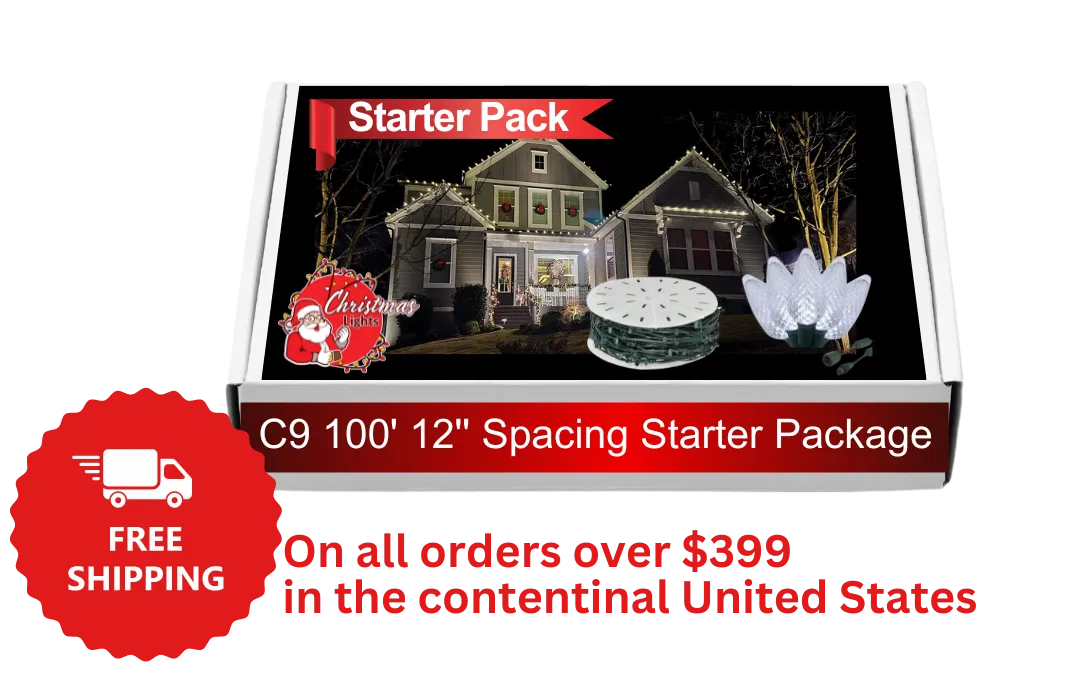
C9 100' 12" Spacing Starter Pack
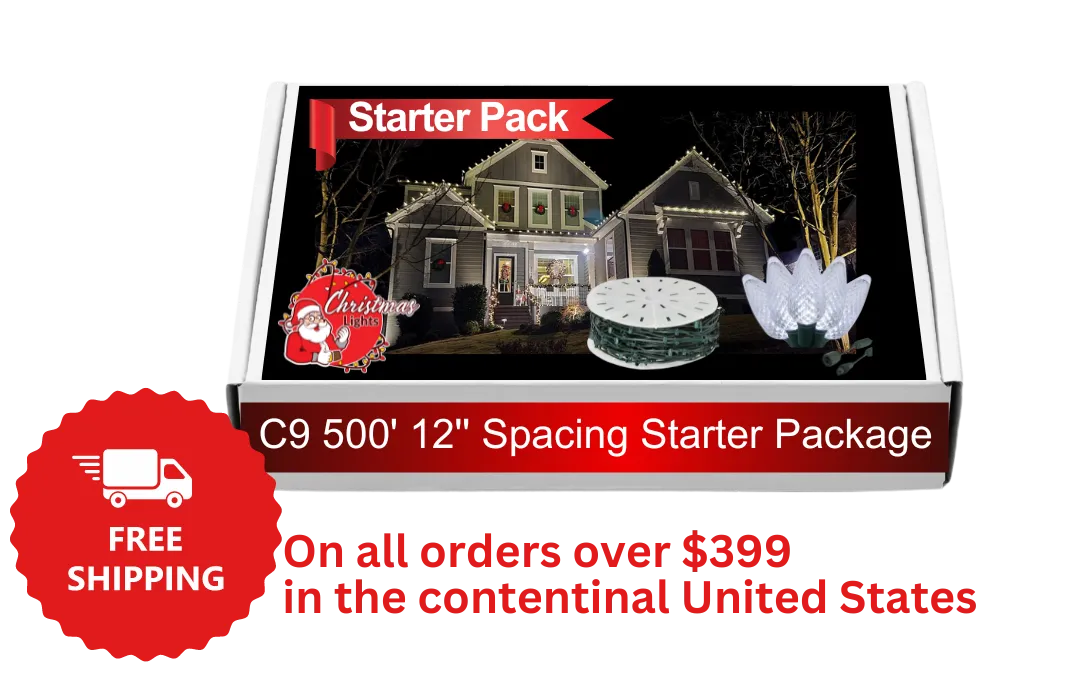
C9 500' 12" Spacing Starter Pack
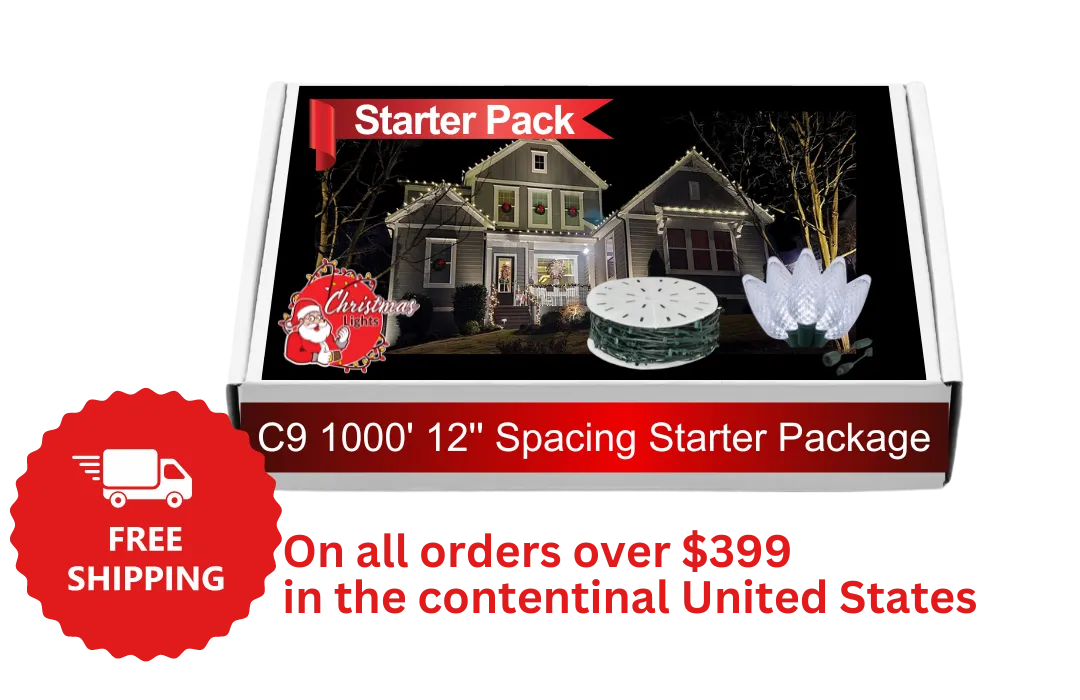
C9 1000' 12" Spacing Starter PacK
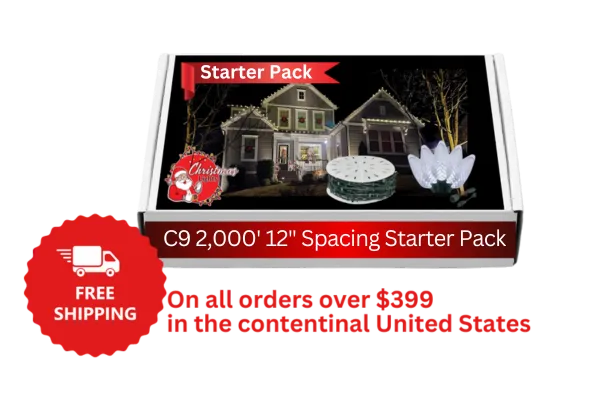
C9 2,000' 12" Spacing Starter Pack

Christmas Light Business Starter Pack
with FREE Training
C9 4,000' 12" Spacing Starter Pack
C9 Christmas Lights Starter Packs 15" Spacing
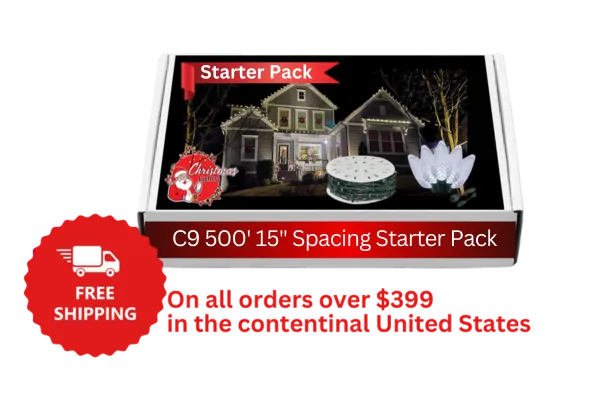
C9 500' 15" Spacing Starter Pack
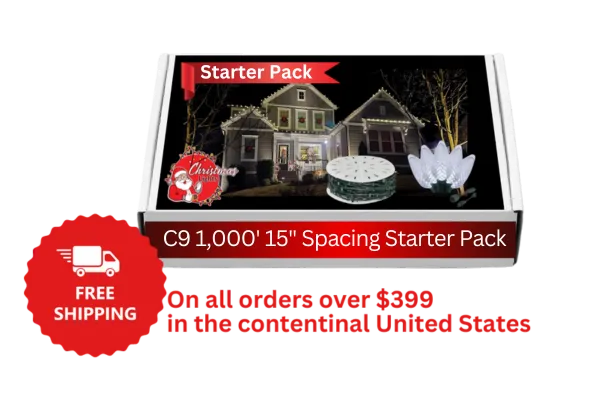
C9 1000' 15" Spacing Starter Pack
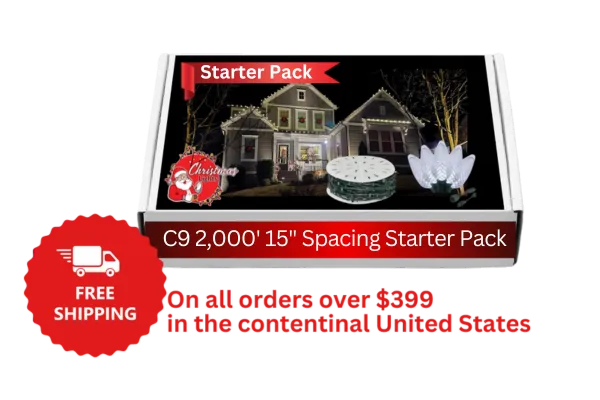
C9 2,000' 15" Spacing Starter Pack

Christmas Light Business Starter Pack
with FREE Training
C9 4,000' 15" Spacing Starter Pack
C7 Christmas Lights Starter Packs 12" Spacing

C7 100' 12" Spacing Starter Pack

C7 1000' 12" Spacing Starter Pack

Frequently Asked Questions
What is included in the Christmas Lights starter pack?
The Christmas Lights starter pack is a comprehensive kit that provides everything you need to get started with your holiday lighting project. It includes all the necessary components, such as clips, male and female plugs, and an extra extension cord.
What specific items are included in the 1000 foot 15" C9 Christmas Lights starter pack?
The 1000 foot starter pack C9 15' spacing package includes the following items:
800 C9 LED Bulbs: These energy-efficient bulbs are the main component of your lighting display, providing bright and vibrant illumination.
800 Tuff Clips: These clips are designed to securely attach your light strings to various surfaces, ensuring a stable and professional-looking installation.
1000' Green 15" Spacing Socket Spool: This spool contains 1000 feet of green wire with sockets spaced every 15 inches, allowing for even distribution of your C9 bulbs.
250' Green Lamp Cord: This additional lamp cord provides extra length for your lighting setup, enabling you to cover larger areas or create extended displays.
50 Green Male Plugs: These plugs are used to connect your light strings to power sources or to join multiple strings together.
50 Green Female Plugs: These plugs are used to create a seamless connection between your light strings, allowing for a continuous and uninterrupted display.
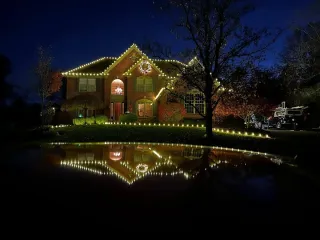
How many houses can I typically light up with a single 1000 foot starter pack?
On average, a 1000 foot starter pack is sufficient to light up approximately 5 to 6 houses, depending on the size and layout of each property.
This estimation is based on the standard components included in the starter pack, such as the 800 C9 LED bulbs and the 1000 feet of socket spool.Headline
However, it's important to keep in mind that every project is unique, and the actual number of houses you can illuminate with a single starter pack may vary.
Factors such as the complexity of the designs, the distance between installation points, and the specific requirements of each client can all impact the coverage of the starter pack.
To ensure a smooth installation process and to accommodate any additional wiring needs, it's always a good idea to have some extra lamp cord on hand for extension purposes.
You may also want to stock up on extra female plugs to facilitate connections between multiple strands of lights or to create custom lengths as needed.
By being prepared with these additional components, you can easily adapt to the specific demands of each project and ensure that you have the flexibility to create stunning and professional-looking lighting displays, regardless of the number of houses you're working on.
Discover Expert Tips on Our Blog
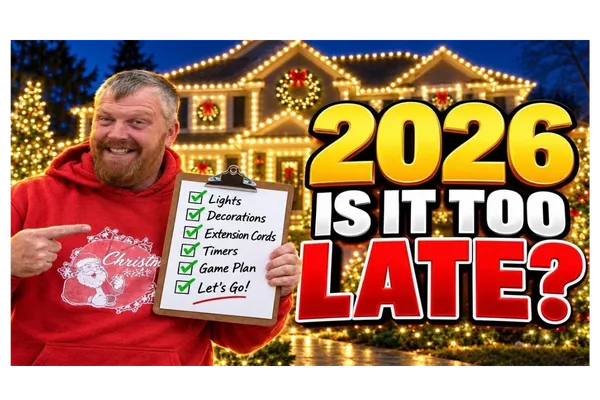
Start a Christmas Light Business in 2026: Is It Too Late?
You've watched other installers hanging lights and booking jobs, and you're wondering if you missed your window this year. You didn't.
Installers have started their businesses in the last week of October and finished their first season at $40,000. One started on November 10 and made $35,000. Others started as late as December 5 and still made $10,000 to $15,000. Starting late is not the problem. Not taking action is.
Quick Answer: No, it's not too late to start a Christmas light business in 2026. You have October and November—about eight weeks—to build your season. Installers who started in late October and November have made $35,000 to $40,000 their first year. What matters is having a written plan, learning to sell and taking action every single week.
This guide covers what new and growing installers need to do right now: the eight-week plan, the sales skills that come before the lights, the little things that let you charge $10 to $12 a foot, and the safety and insurance issues that can end a business overnight. For step-by-step training, start with ChristmasLights.io professional installer training.
Is It Too Late to Start a Christmas Light Business in 2026?
No. It's better to start this year—even in November—than to wait until next year.
Why Starting Late Still Pays Off
The biggest reason to start now isn't just this season's revenue. It's what you learn. The moment you put out yard signs and the phone starts ringing, you start learning how to answer it. Many new installers don't know what to say on the phone or how to talk to a homeowner. You want to learn that this year, not next year.
First-Year Results From Late Starters
These are real results from installers who started late in the year:
An installer who started in the last week of October made $40,000 in his first year.
Another who started the week of November also made $40,000 his first year.
An installer who started on November 10 made $35,000.
Installers who started on December 5 still made $10,000 to $15,000.
Age isn't a barrier either. A 17-year-old high school senior playing football is starting his Christmas light business this year, and an 18-year-old installer is growing his. Meanwhile, one of the largest installers in the Indianapolis area—10 to 15 years in business—has already doubled where he was at this time last year.
This is not an easy business. It takes time and money. But people are building six- and seven-figure Christmas light businesses, and some are reaching $2 million to $3 million.
Do You Have a Plan for the Next Eight Weeks?
You have October and November. That's eight weeks to get to $100,000—or $1 million—this year, and the clock is ticking. Hoping and wishing will never get you there. A written plan will.
Write Down Your Vision
Where do you want to be this year? Where do you see yourself next year? Write it down. If you can't answer those questions, you don't have a target to aim at.
Build a Week-by-Week Marketing Plan
Your plan should say exactly what you'll do every week for the next eight weeks. For example:
I am going to put out this many yard signs this week.
I am going to call this many people every week.
I am going to email this many people every week.
I am going to knock on this many doors this week.
I am going to put out 1,000 door hangers this week.
Numbers on paper turn "I'd like to grow" into actions you can check off.
Do Three Things Before Bed Tonight
One established installer shared a simple nightly routine that's worth copying word for word:
Load 50 yard signs in your truck for tomorrow.
Make a list of five businesses you'll cold call tomorrow.
Write thank-you cards to everyone you gave an estimate to this week.
It's the little things that grow a business, and these are three of them.
Why Should You Learn to Sell Before You Hang a Single Light?
Because if you don't know how to sell, it doesn't matter how well you hang the lights. Most new installers worry about the installation. The ones who grow worry about the sale first.
Master the Phone Call
The phone is where most jobs are won or lost. If you don't know what to say when a homeowner calls, you'll lose jobs you never even got to quote. Start with this breakdown of the eight steps of a Christmas light phone script, and practice it until it sounds natural.
Your Body Language Sells (or Doesn't)
Selling isn't only about your words. People decide whether to buy from you based on your body language, the way you speak and the way you interact with them. Pay as much attention to how you show up and carry yourself as you do to what you say.
Don't Be the $6-a-Foot Installer
Listen to how the $6-a-foot installer sells: "We're the cheapest people out there. We'll put the lights up, we'll risk our lives for $6 a foot, and it's all about the bulb and the clip." Price, bulbs and clips are all they talk about—so price is all the customer thinks about.
Meanwhile, installers who sell differently are getting $9, $10, $11 and $12 a foot. You don't get high average tickets by charging cheap.

What Little Things Let You Charge $10–$12 a Foot?
Customer service is what sets the expectation, and the expectation is what lets you charge $10 to $12 a foot instead of $8. None of this is about putting up the lights. It all happens before you ever get to the lights.
Send Thank-You Cards After Every Estimate
Probably only about 1% of installers send thank-you cards, and these are just for getting an estimate. That alone sets you apart from almost everyone you're competing against.
Communicate Before They Have to Ask
Are you emailing customers to tell them about your company? Are you texting them to let them know you're on the way and will be there in 22 minutes? Small updates like these make the whole experience feel professional.
Look Professional—Even on a Budget
Wear a uniform and a badge with your picture on it. If you're just starting and can't afford a truck wrap, you can still clean-shave, get a haircut and wear a polo. A polo alone goes a long way.
Upgrade Your Quotes, CRM and Website
Ask yourself:
Are you doing in-person quotes or online quotes?
Do your quotes look professional?
Are you using a CRM, or just texting things back and forth?
Does your website have a video that explains what happens next—what you'll do once a customer fills out the form?
These little things go so far. They separate you from everyone else.
How Do You Get a Higher Average Ticket?
You get high average tickets by selling more than the front of the house:
The entire roof, not just the front
Trees and bushes
Add-ons are also how returning clients grow. One installer who didn't have many returning clients in the past now has all of them booked but two—by picking up the phone and adding add-ons.
What This Looks Like at Scale
One established installer recently shared these numbers:
16 jobs sold in a single day, totaling $25,000
An average ticket of $1,610
$381,000 sold season to date
110 calls in September
An 84% renewal rate from last year, with more than 100 still to go
That didn't happen overnight. He's been in business for a couple of years, has been to classes, understands sales, has salespeople and keeps marketing. Another installer in a town of only 80,000 people has washed 1,600 houses and will do $750,000 in lights—without personally installing a single bulb.
What Marketing Actually Grows a Christmas Light Business?
Be a hunter, not a farmer. Farmers want warm leads and the easy button. Hunters go looking for new business, work the long hours and do what's necessary. Yes, you can pay for Facebook ads or Google ads so you don't have to do anything, and sometimes that grows a business some. But the installers growing fastest are out doing the work.
Put Out Yard Signs—Lots of Them
The installer with $381,000 sold put out more than 700 to 800 yard signs in a month. That doesn't happen by wishing. Two practical tips:
Hard ground: When the ground is hard as a rock, take a drill and drill two holes to get the sign in.
Rain: It's easy to put out signs in the rain. There's less traffic, and the stakes go right into the ground. Just be careful—some people don't know how to drive in the rain.
Answer Questions in Text and Video
Marcus Sheridan's They Ask, You Answer—and Endless Customers, which carries the same message—teaches a simple idea: answer your customers' questions and build pages around those answers. One installer's website has tons of pages answering customer questions, in both written and video form, because some people like to read and some like to watch. If you only do one and not the other, that's a problem.
It works outside Christmas lights, too. A roofer went from $0 to $2 million in one year by following Endless Customers, picking up the phone and posting two, three and four videos a day from his job sites.
Post Consistently—Don't Wait for Perfect
Perfection is the number one dream killer. What you think is perfect today, you'll think is terrible six months from now. Your first video won't have the best picture or the best audio. Post it anyway, on Facebook, YouTube and TikTok. Consistently taking action—putting one foot in front of the other—is what makes you better.
Which Christmas Light Timers Cause the Fewest Callbacks?
There's no perfect timer. Some installers spend top dollar on high-end timers, others buy cheap ones, and some have more issues than others. Either way, timers are typically your number one callback—other than a dog, squirrel or other animal chewing through something.
Photocell vs. Pre-Programmed Timers
Photocell timers are simple and easy. If one acts up, you can often flip it or put it in the dark.
Pre-programmed timers work well when they work. But when they have issues, you're guaranteed a trip back out.
If a timer is giving you problems, cut it off. One installer in Minneapolis with 4,000 installs uses the more expensive timer on the site because it's given him the fewest callbacks. Both options are in the Christmas light timers collection.
Other installers report that timers aren't their biggest issue at all. For them, callbacks come from cut wires, minis falling or bulbs.
How Do You Protect Your Crew and Your Business?
All it takes is one fall. A safety mindset will protect your business more than anything else, because a lack of one will take you down faster than anything else.
Falls Are Real—Even for Veterans
At least one installer has already fallen off a roof this year, landing on a railing and injuring his lung. Last year, there were probably six to 10 falls among installers we know of. One had been hanging lights for 20 years and walked backward off a roof. The only thing that saved his life was his Apple Watch.
If you have a crew, get them into a safety mindset—not a "go do the sketchy stuff" mindset. And it's okay to tell people no. You don't have to sell sketchy jobs. There are plenty of easier jobs out there.
Workers' Comp: What to Know Before You Hire
If you 1099 your workers and they don't have workers' comp, they can sue you, and they can sue the homeowner. A hospital stay of more than two or three days can run a $300,000 to $400,000 bill. Here's what installers have learned:
It depends on your state. In Kentucky, coverage had to be paid largely up front and was very expensive. In Ohio, it runs through the state.
Expect roughly 5% to 10% of payroll—sometimes more. If you're classified as roofing, one installer pays $28 per $100 of payroll. Others report paying $3,700 and $5,000.
Estimate payroll honestly. You will get audited. If you estimate $50,000 in payroll and actually pay $100,000, you'll owe the difference.
It typically doesn't cover you as the owner. Some jobs require you to carry a policy anyway, even though it won't pay you if you're hurt.
Don't post photos of your crew on roofs without harnesses and ropes. Carriers can see those photos and drop you.
Talk to your insurance agent about how your work is classified. Costs like these are exactly why you have to charge $8 to $12 a foot.
Your Plan to Start and Grow in 2026
Most businesses fail within three to five years—not because the owners can't hang lights, but because they're great installers who don't know how to run a business or what to charge. Avoid that trap with these steps:
Decide you're starting now. Don't wait for next year. The lessons you learn this season are worth as much as the revenue.
Write your vision and an eight-week plan. Signs, calls, emails, door knocks and door hangers—with numbers for every week.
Learn the phone script. Selling comes before installing.
Do the little things. Thank-you cards, on-the-way texts, a polo, professional quotes and a CRM.
Sell the whole property. Entire roof, ground stakes, trees, bushes and wreaths.
Hunt for business. Put out yard signs, cold call five businesses a day and post videos consistently.
Protect your people. Build a safety mindset and get the right workers' comp before you hire.
There's nothing special about the installers hitting six and seven figures. Two installers in one mentorship program are on track to reach $1 million this year—one in his second full-time year, the other in his third. One former garbage man built a Christmas lights and pressure washing business to more than $1.4 million last year, and he's still taking action after a fire damaged his building. They believed they could, and they took action.
Ready to start or grow your Christmas light business? Learn the full system—installation, sales and marketing—through ChristmasLights.io professional installer training, and connect with other installers in the ChristmasLights.io installer community. When you're ready to stock up, shop professional-grade lights and supplies at Christmas Lights HQ.

Is it too late to start a Christmas light business in 2026?
No. You still have October and November—about eight weeks—to build your season. Installers who started in the last week of October and in November have made $35,000 to $40,000 their first year, and some who started on December 5 still made $10,000 to $15,000.
How much can you make in your first year installing Christmas lights?
It depends on how fast you take action. Late starters have made $35,000 to $40,000 in their first season, and installers trained through ChristmasLights.io have made $30,000, $50,000 and $100,000 in their very first year.
What should I do first when starting a Christmas light business?
Write down your vision and a week-by-week marketing plan, then learn how to sell—starting with the phone. If you don't know how to sell, it doesn't matter how well you hang the lights.
What should I say when a customer calls about Christmas lights?
Follow a proven phone script so you know exactly what to say. This guide to the eight steps of a Christmas light phone script walks through each part of the call.
How do Christmas light installers charge $10 to $12 a foot?
By doing the little things that set expectations: thank-you cards after estimates, on-the-way texts, a professional appearance, professional quotes, a CRM and a website video that explains the next steps. Installers who sell this way are getting $9 to $12 a foot.
How do I increase my average Christmas light ticket?
Sell the entire roof instead of just the front, and add ground-stake lighting, trees, bushes and wreaths.
What's the best timer for Christmas lights?
There's no perfect timer, and timers are typically the number one callback. Photocell timers are simple and easy. Pre-programmed timers work well, but when they fail, you're guaranteed a return trip. An installer with 4,000 installs uses the more expensive option in the Christmas light timers collection because it's given him the fewest callbacks.
How do I put out yard signs when the ground is hard?
Use a drill to drill two holes, then set the sign. Rainy days are also a good time to put out yard signs, because the stakes go right into the ground and there's less traffic.
How much does workers' comp cost for a Christmas light business?
It depends on your state. It's typically around 5% to 10% of payroll and can be more. If your work is classified as roofing, one installer pays $28 per $100 of payroll. Estimate payroll honestly, because you will get audited, and talk to your insurance agent.
Does workers' comp cover me as the business owner?
Typically, no. Workers' comp usually doesn't pay you as the owner if you get hurt, though some jobs still require you to carry a policy. That's one more reason a safety mindset matters for everyone on the roof—including you.

Copyright ©2026 All Right Reserved website designed by christmaslights.io
Terms of Service / Privacy Policy
Have questions or need assistance?
Contact us at (855)619-LITE