

C9 & C7 Socket Spools & Stringers
Discover our premium collection of socket wire spools and stringers, the essential foundation for creating stunning light displays. Designed for both professional installers and ambitious homeowners, our range includes bulk C7 and C9 socket wire spools with flexible spacing options, pre-made light stringers for quick setups, and convenient accessories like spool holders. These versatile, durable components are perfect for residential rooflines, enchanting tree displays, and large-scale commercial projects. Suitable for indoor and outdoor use, and compatible with both incandescent and LED bulbs, our professional-grade products offer the quality and flexibility needed to bring your creative lighting visions to life. Explore our selection and elevate your illumination projects with unmatched versatility and reliability.
Socket Spools
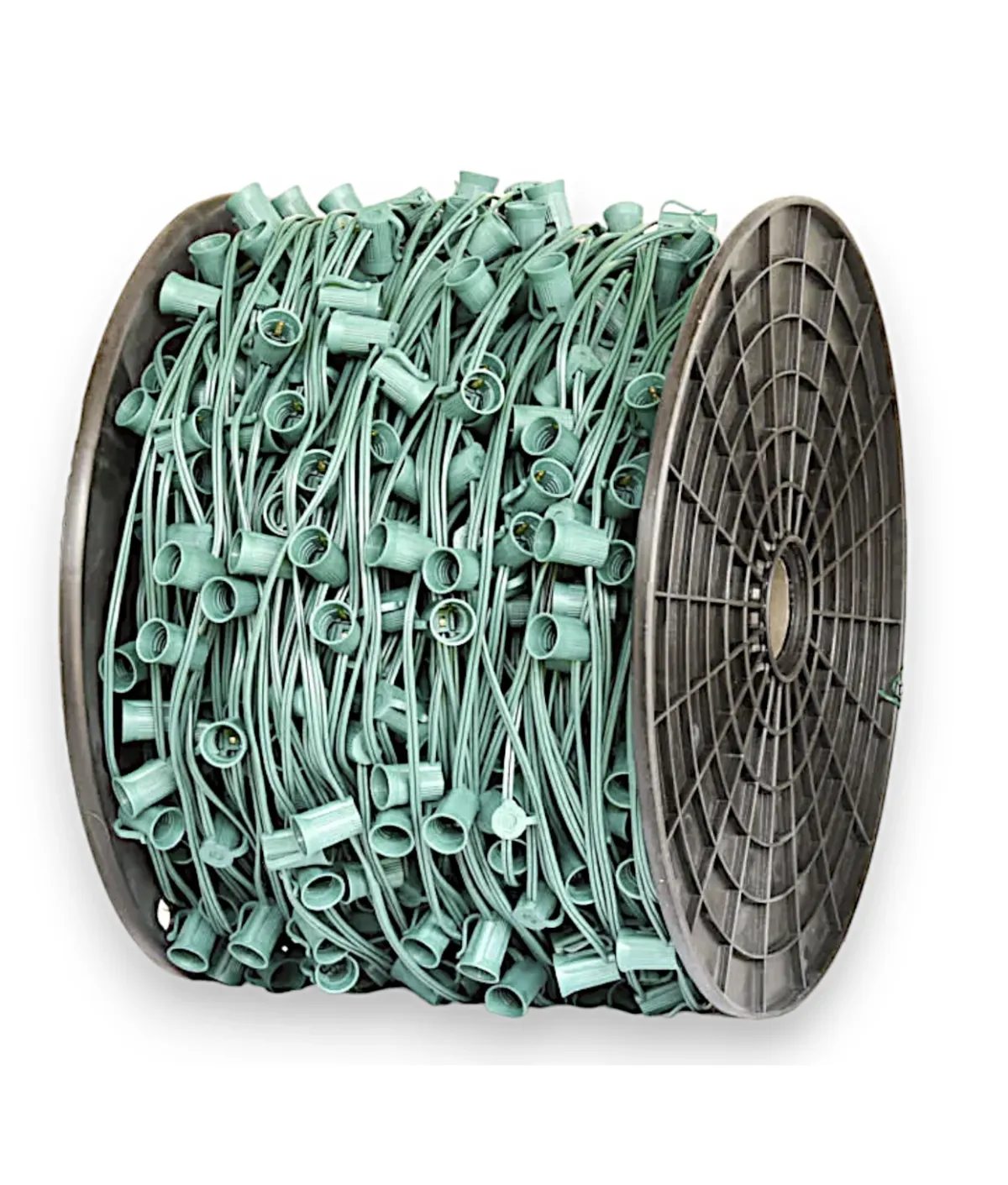
C9 1000' Socket Spool
Our C9 1000' Bulk Spool of Socket Wire, available in green or white, offers professional-grade flexibility for custom lighting projects. With spacing options from 6" to 48", it's ideal for both residential rooflines (12-15" spacing) and tree installations (24-48" spacing). The durable SPT-1 wire withstands outdoor conditions and is compatible with both incandescent and LED C9 bulbs. This customizable spool allows for precise length cutting, minimizing waste and maximizing efficiency for high-quality, adaptable lighting displays.
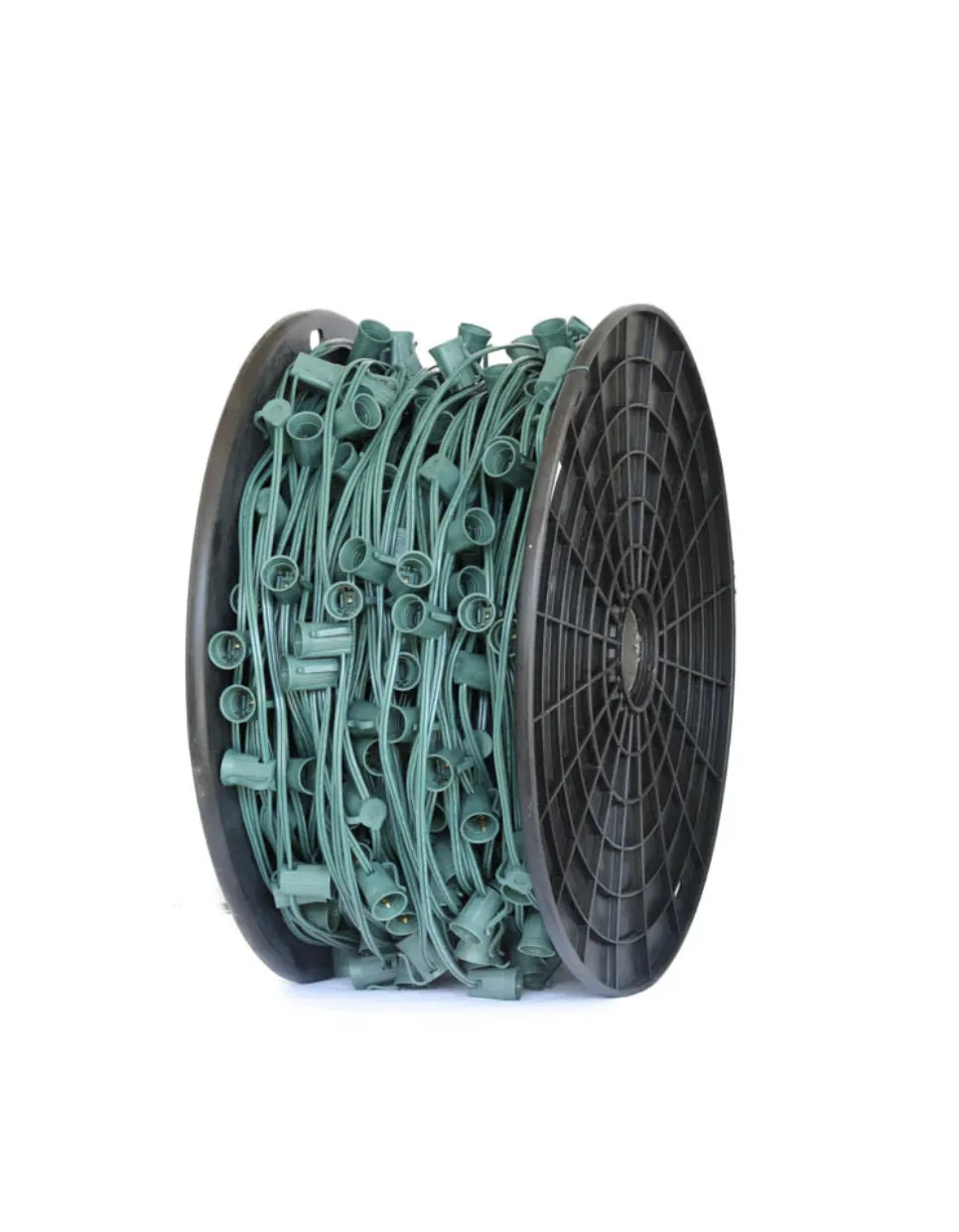
C9 500' Socket Spool
Our C9 500' Bulk Spool of Green Wire, available with 12" (500 sockets) or 15" (400 sockets) spacing, is perfect for professional-grade Christmas lighting installations. Featuring commercial-quality SPT-1, 8-amp wire and durable E17 sockets, this customizable spool is ideal for large-scale outdoor projects. Easily cut to desired lengths and pair with snap-on plugs (sold separately) for tailored lighting solutions in both residential and commercial settings. The 12" spacing offers vibrant, balanced lighting, while the 15" option provides a classic look with fewer bulbs per run.
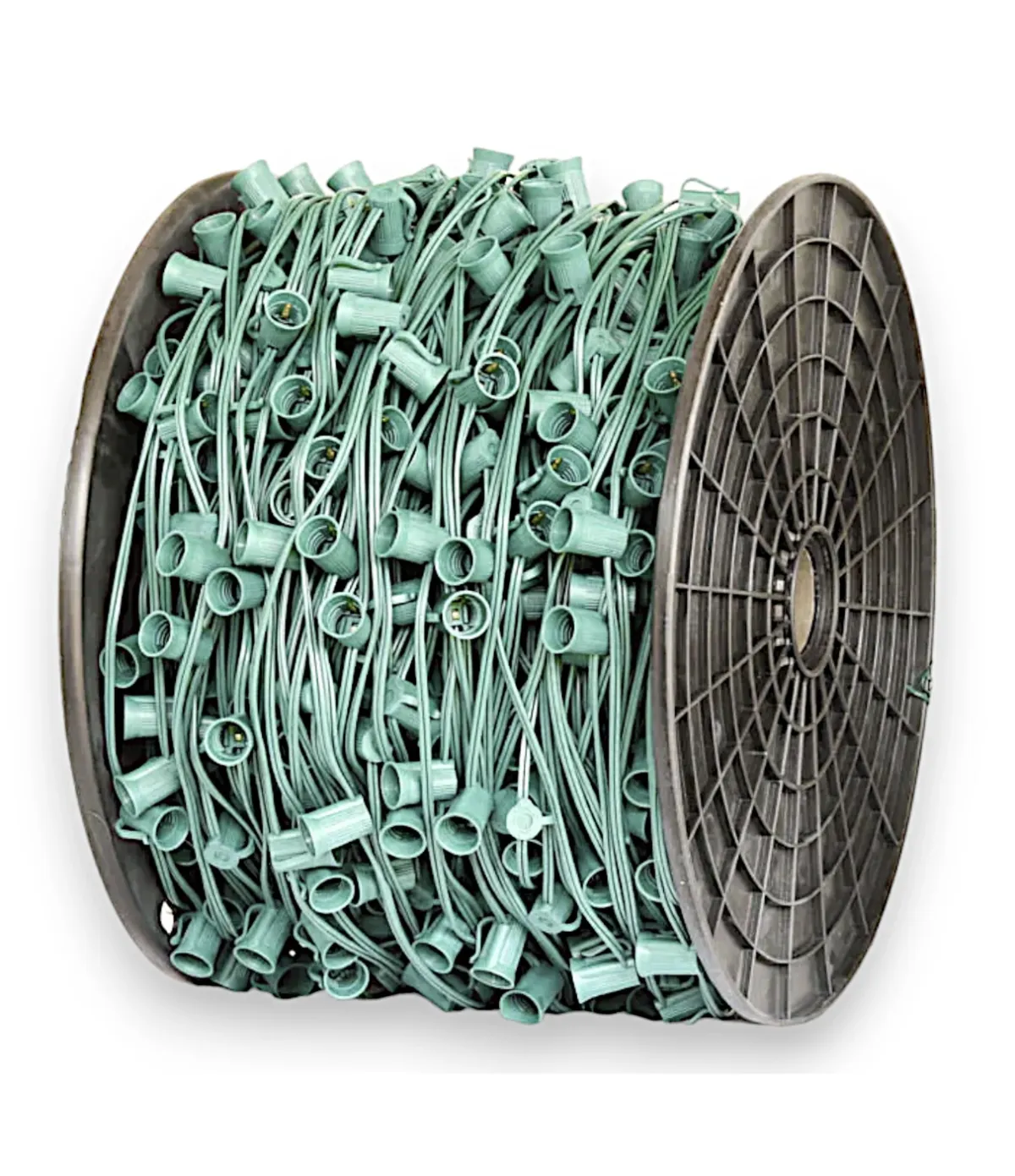
C9 1000' 12"&15" Socket Wire Spool (SPT-2)
Our C9 1000' Socket Wire Spool (SPT-2) offers professional-grade flexibility with dual 12" and 15" spacing options. This customizable spool features heavy-duty SPT-2 wire for enhanced durability in all weather conditions. The 12" spacing is perfect for dense, vibrant displays on rooflines and pathways, while the 15" option provides a classic look with fewer bulbs per run. Compatible with both incandescent and LED C9 bulbs, this 1000' spool allows for precise cutting to fit any residential or commercial lighting project, ensuring efficient and long-lasting installations.
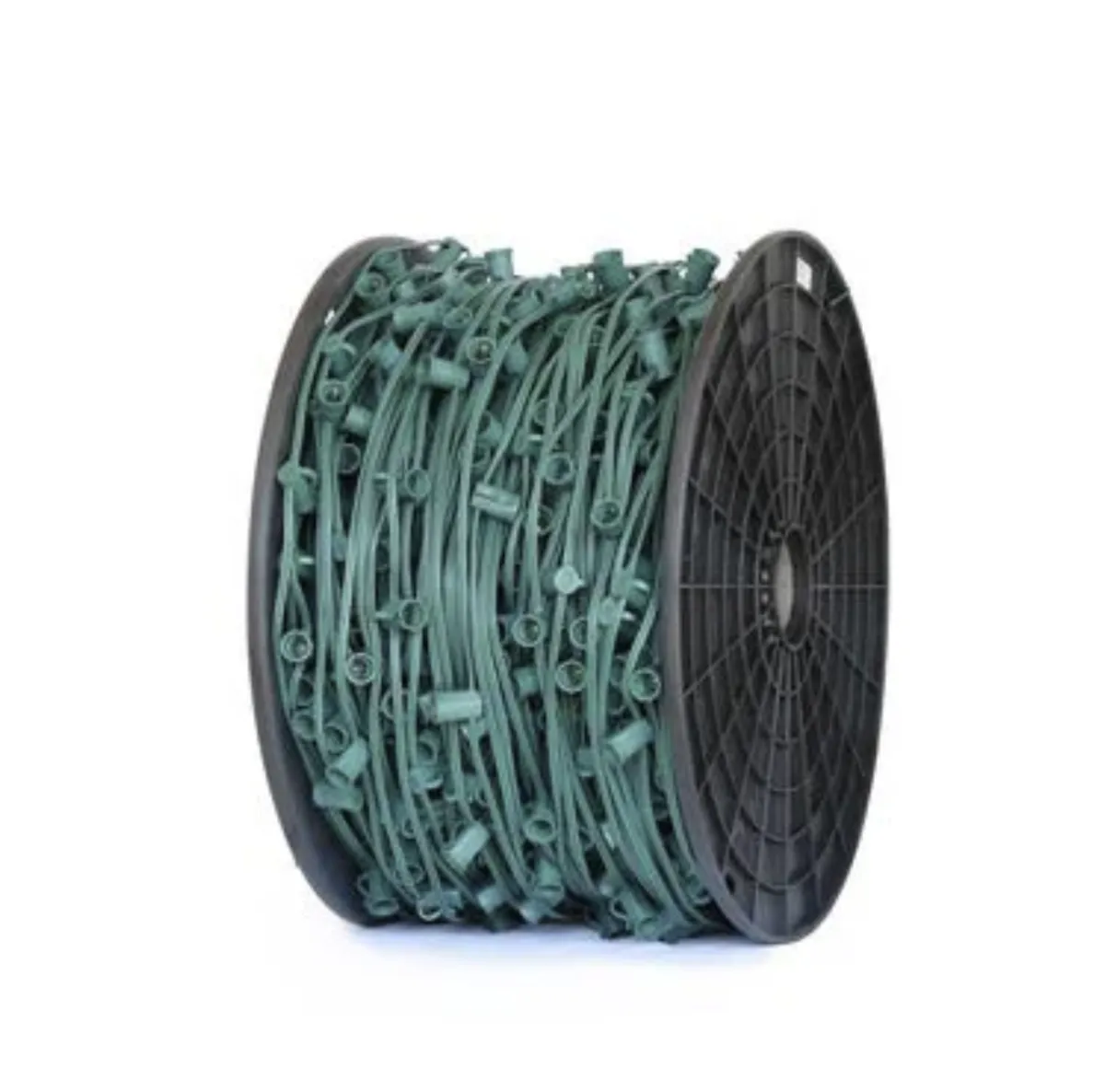
C7 1000' Green Wire Socket Spool (SPT-2)
Our 1000' bulk spool of green SPT-2 wire features 15" spacing with 1000 C7 sockets, ideal for commercial and residential outdoor displays. This 8-amp (960-watt) commercial-grade wire with Admiral Brand sockets allows for custom-length installations using snap-on plugs (sold separately). Suitable for indoor/outdoor use, it accommodates up to 160 sockets with 5-watt incandescent bulbs or 384 sockets with 1-watt LED bulbs per run. This versatile, durable C7 light line is perfect for creating professional-quality lighting displays in various settings.
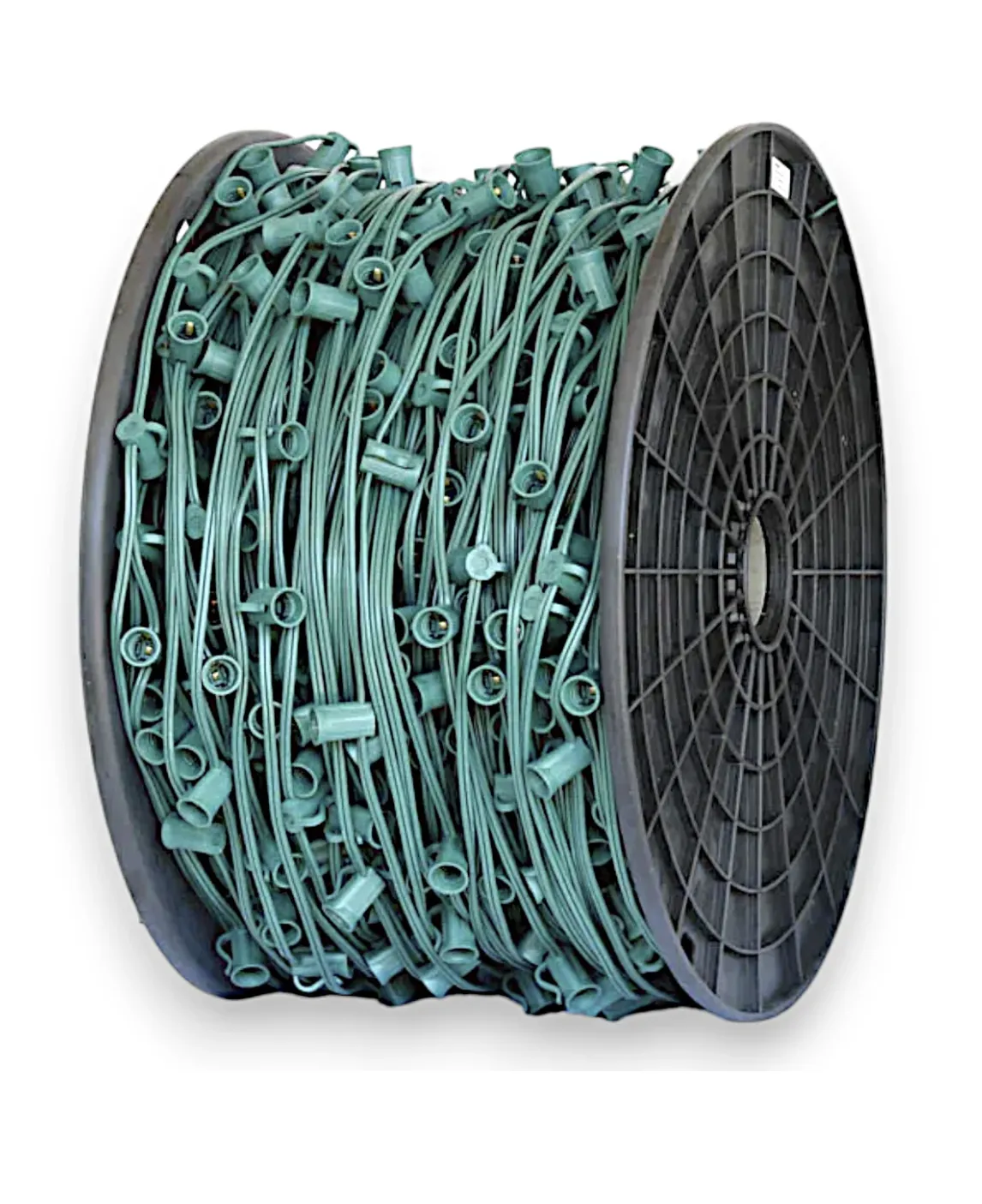
C7 1000' Socket Spool
Our C7 1000' Bulk Spool of Socket Wire offers professional-grade flexibility for custom lighting projects. Available in green or white, with spacing options from 12" to 36", it's ideal for both residential rooflines (12-15" spacing) and tree installations (24-36" spacing). The durable SPT-1 wire withstands outdoor conditions and is compatible with both incandescent and LED C7 bulbs. This customizable spool allows for precise length cutting, minimizing waste and maximizing efficiency for high-quality, adaptable lighting displays in various settings.
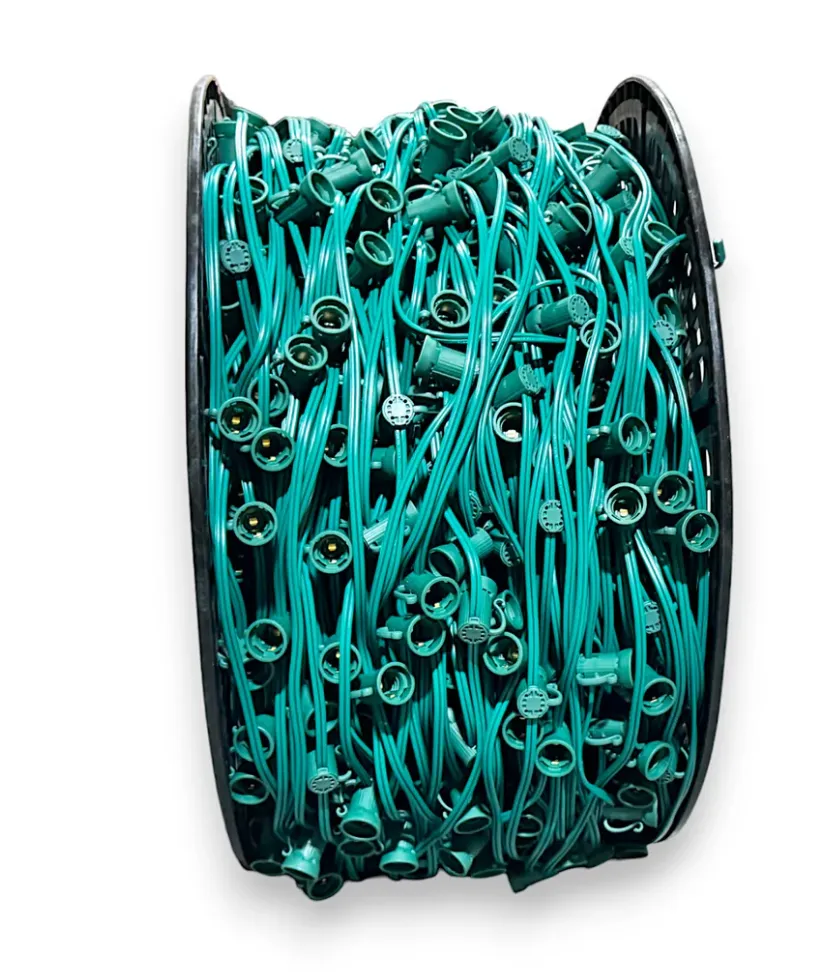
C7 1000' Socket Spool
Minleons C7 1000' socket wire spools with options for factory Socket clips
or without factory Socket Clips. Available in 12" or 15" spacing.
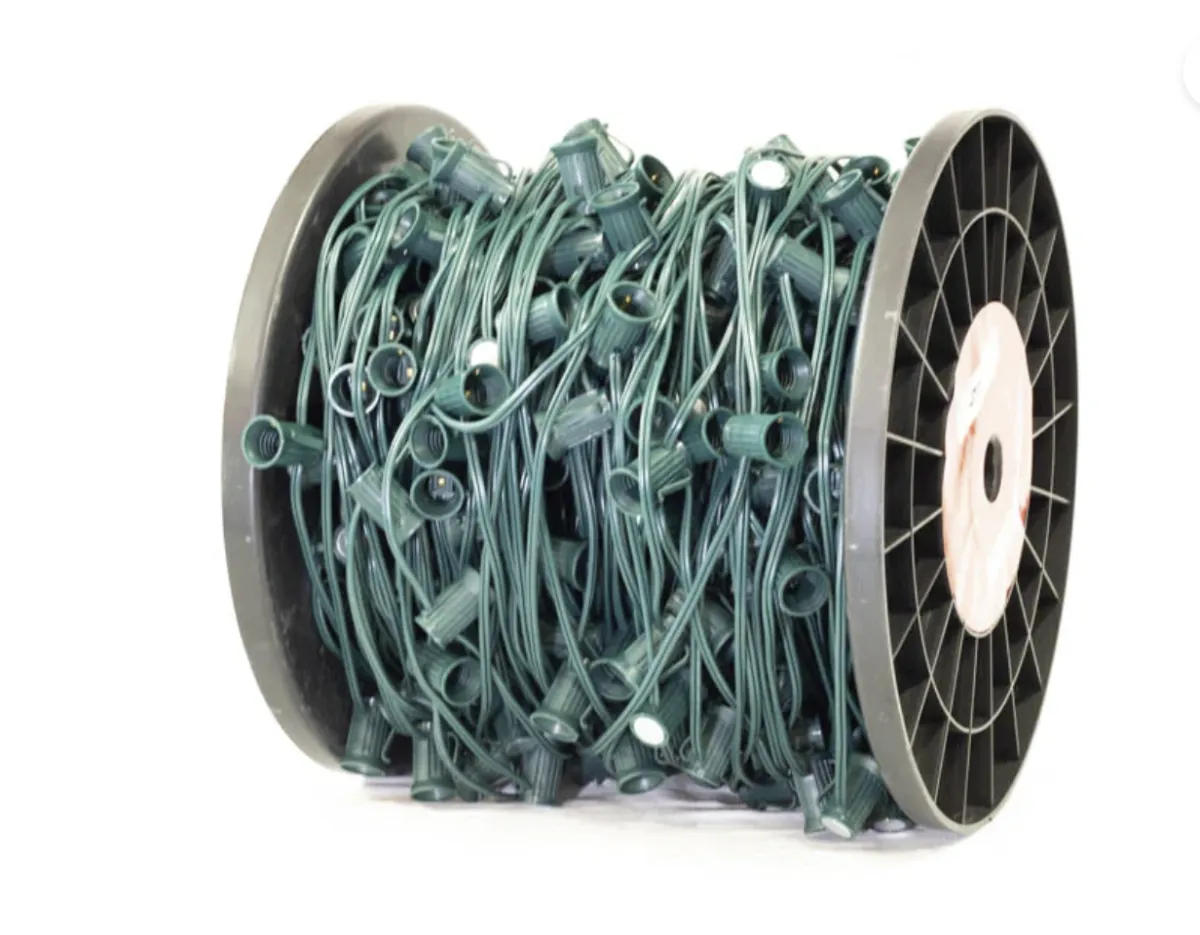
C9/C7 500' Magnetic Spool
The Fastest Way to Install Holiday Lights on Metal Surfaces. Save time and effort this holiday season with Magnetic Spools. Designed for quick and easy installation, these magnetic spools are perfect for decorating your home or office building. The magnetic sockets eliminate the need for traditional mounting clips, making your installations faster and more efficient. Whether you’re lining rooflines, gutters, or fences, these spools are ideal for any surface where ferrous metal is present.
Available in 500' & 250', 12" or 15" Spacing.
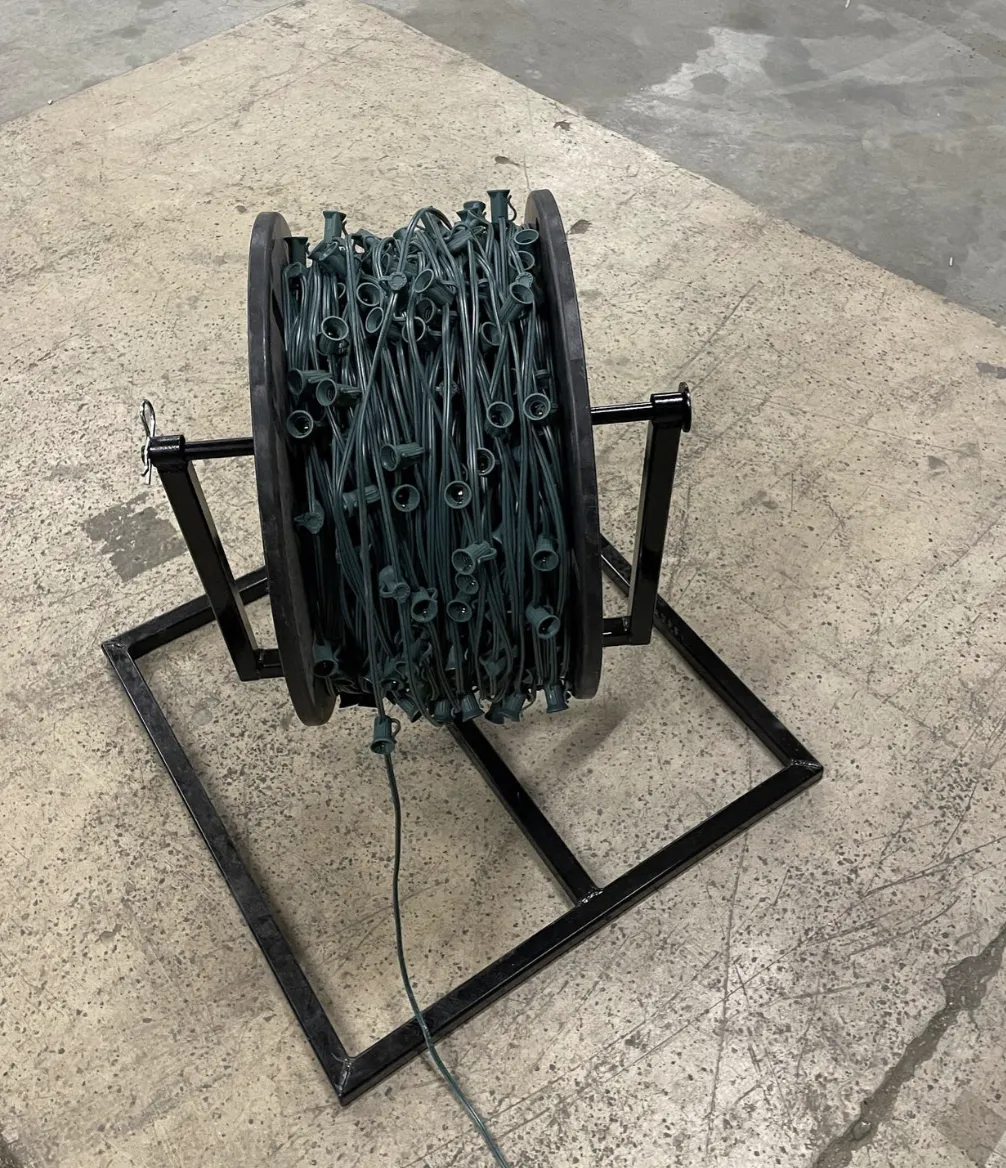
C9/C7 Heavy Duty Swivel Spool Holder
Versatile Wire Spool Holder:
• Compatible with C7 and C9 spools
• 360-degree swivel capability
• Foldable design for compact storage
• Dimensions: 24" x 24" x 20"
Note: Socket wire sold separately.
Socket Wire Stringers
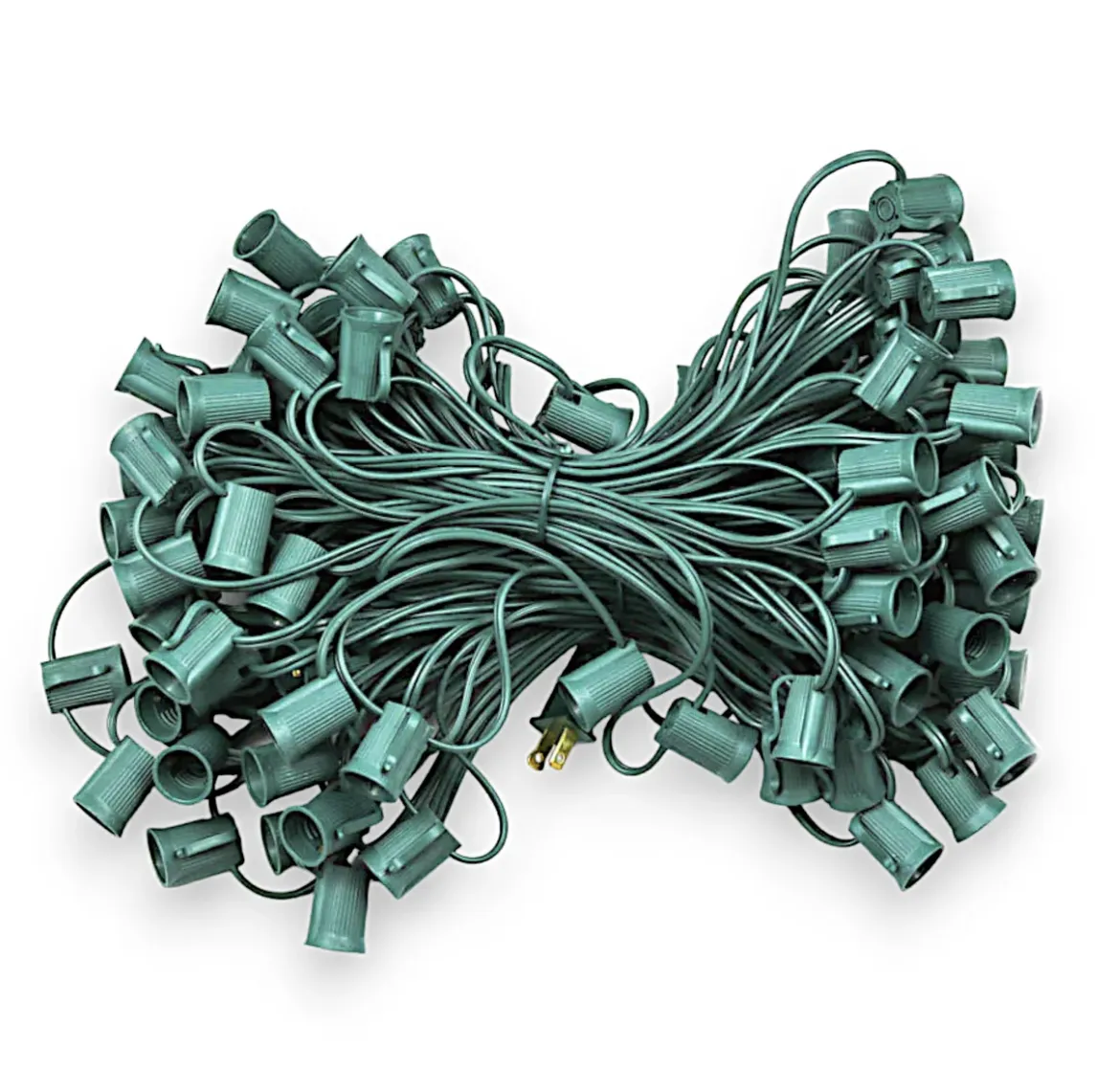
C9 12" Spacing Socket Wire Stringers
Our 25', 50' or 100' Holiday Light String features professional-grade, UV-protected 18-gauge wire with sockets spaced 12" apart. Designed for both indoor and outdoor use, these UL-recognized strings offer 5 Amp capacity SPT-1 insulation and durable sockets with weep holes for all-weather performance. Compatible with E12 Candelabra base bulbs (C7, C9, G30; sold separately), these versatile strings allow end-to-end connectivity for extended displays. Perfect for holiday decorations, event lighting, and year-round use in residential and commercial settings. Available in Green, White, Brown and Black.
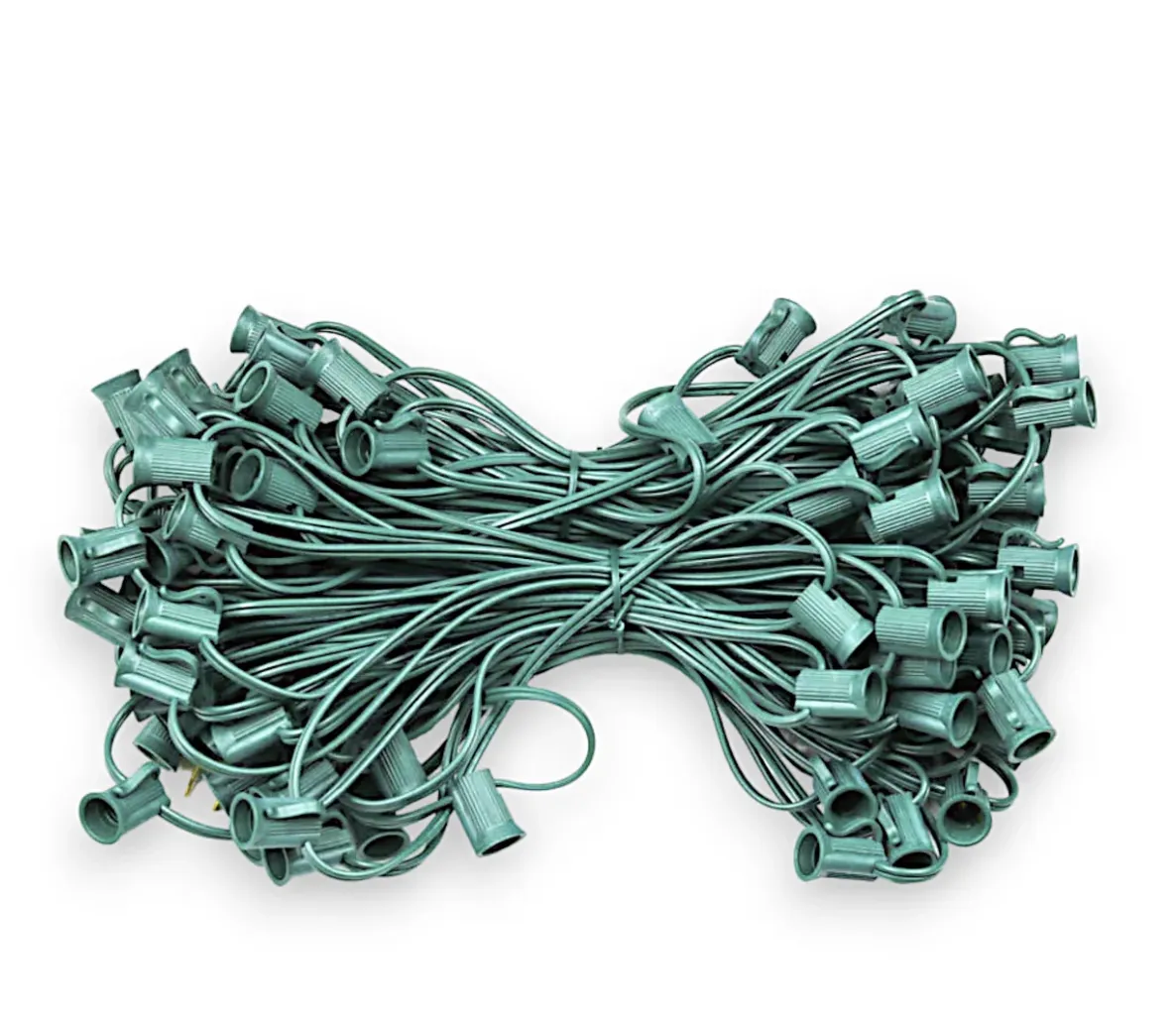
C7 12" Spacing Socket Wire Stringers
Our professional-grade 25', 50' or 100' light string features sockets spaced 12" apart, perfect for commercial and residential decorators. Designed for both indoor and outdoor use, it's compatible with incandescent or LED C7, G30, and G40 bulbs (sold separately). The SPT-1 insulated wire offers 5 Amp capacity and includes weep-hole sockets for all-weather performance. With male and female plugs for end-to-end connections, these UL-recognized strings can handle up to 480 watts per run. Ideal for holiday displays, patio lighting, and year-round events, these durable strings ensure long-lasting, brilliant illumination for any occasion. Available in Green, White, Brown and Black.
Frequently Asked Questions
What's the difference between socket wire spools and stringers?
cket wire spools are bulk reels of wire with sockets at regular intervals, allowing for custom-length cuts. Stringers are pre-cut lengths of socket wire, typically with plugs attached, ready for immediate use.
Can I use the same socket wire for both C7 and C9 bulbs?
No, C7 and C9 bulbs require different socket sizes. Always check the product specifications to ensure you're using the correct socket wire for your chosen bulb type.
How do I determine the right spacing for my project?
Common spacings are 12", 15", and 24". Use closer spacing (12"-15") for dense, vibrant displays on rooflines or fences. Wider spacing (24" or more) works well for tree wrapping or creating a more subtle effect.
Are these socket wires suitable for outdoor use?
Most of our socket wires are rated for both indoor and outdoor use. Look for products labeled as "weatherproof" or "outdoor-rated" for the best durability in external conditions.
How many bulbs can I safely connect on a single run?
This depends on the wire's amperage rating and the wattage of your bulbs. For example, on an 8-amp wire, you can typically run up to 160 sockets with 5-watt incandescent bulbs or 384 sockets with 1-watt LED bulbs. Always check the product specifications and local electrical codes for safe operation.
Discover Expert Tips on Our Blog
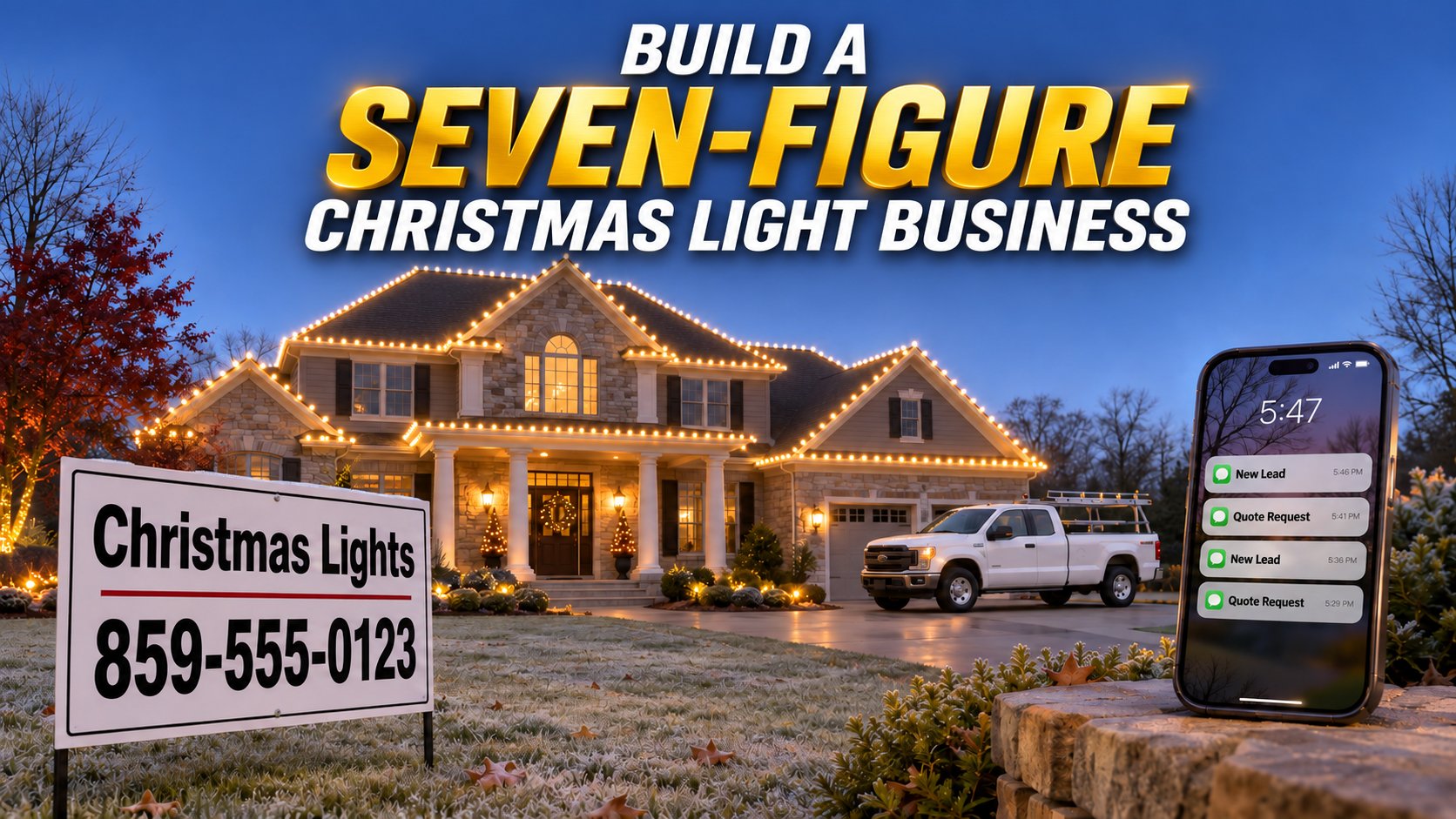
How Installers Build a Seven-Figure Christmas Light Business: Pricing, Hiring, Marketing, and Follow-Up
We are right in the middle of Christmas light season, and installers are closing little jobs, big jobs, and huge ones. One installer got a call about a job that could be $50,000 to $100,000. Others are on pace for a million dollars this year. A former garbage truck worker now runs a million-dollar-plus Christmas light business in 2026. These are normal people taking abnormal actions.
This guide covers what helps installers grow toward $500,000, $750,000, a million dollars, and beyond: pricing, hiring, marketing, knowing your customer, follow-up, and systems. It also answers common questions on clips, timers, wreaths, and yard signs. If you want more strategies for growing a Christmas light installation business, start here.
Where the Season Stands Right Now
When the weather turns chilly, people get in the Christmas spirit, and your phone starts ringing. Mondays are typically busy, and people start saying yes. Make sure your marketing is working and that you are following up by text, phone, and email.
The Next Three Weeks Matter Most
Now is the time to put signs out. Put out a hundred a week, or even two hundred. This week and the next two weeks are when you make most of your money, and about 90% of your calls come in these three weeks. The week before Thanksgiving is the biggest week of all. Some installers get a couple hundred phone calls a day that week.
If you've done your homework, collected your reviews, and put out your yard signs, that is the week everybody buys from you. It can be stressful, but you have to get through it.
Pricing: Fewer, Better Customers
Other installers in your area may charge $4 or even $3 a foot. What your competitors charge has nothing to do with you. The materials are the same, so when you post pictures or go on a sales call, quit posting light bulbs and quit talking about them.
Five Hundred Customers Beat a Thousand
It's much easier to get 500 customers to pay you $2,000 than to deal with 1,000 customers paying you $1,000. A $1,000 customer is often the biggest pain, and 1,000 installs is a lot of work for little money.
Installers who have done more than a million dollars have done it with about 500 customers. Five hundred customers can be handled with two or maybe three crews. A thousand customers would take six crews. It is easier to get customers to pay $2,000 than to staff six crews of two people to hang a thousand jobs.
Never Lower Your Price
At what point do you lower your price? Never. The better question is when to raise it. If you're booked out two weeks, raise your prices. Some installers raise prices or add a crew when they're booked out a week. Rather than lowering your price, get more leads. It beats doing more jobs for less money.
Sell What the Customer Wants
Quit selling the product and help the customer get what they want. Do they want bulbs, or time with their family? Do they want to see their grandkid's face or their kid's face? Feel the magic yourself, because when you can give that feeling to your customer, you close more jobs. For more on selling the feeling, visit ChristmasLights.io.
Hiring: Too Many Jobs and No Helpers
Too many jobs and no helpers is not a good problem to have. One installer hired four to six people this year who turned out to be rock stars. Within two to three days of being shown how, they were putting up more lights than last year's crew did all year. He was so booked out that he was able to pull up a bunch of jobs.
How He Found Them
He didn't say, "There is no good help around here." If you say those words, you get bad employees. He went out and networked. He asked people whose work slows down this time of year, "Do you have two or three guys who can help me hang Christmas lights?" and he got four.
Watch Your Words
Negative language shapes results. One coaching client always said nobody would pay $8 a foot and that he couldn't find good help. If you don't believe a customer will pay $8 a foot, your customer won't either. It works the same way with employees. Chick-fil-A makes as much money as McDonald's while open only six days a week, and it's a different mindset. Ask what mindset your business has.
Marketing: Test, Test, Test
Marketing has been interesting this year. Facebook ads worked great for many installers last year, and for some of the same people they have barely worked this year. Facebook ads still work for others and help them grow. The point is to test.
Here is what installers have found:
Three installers spent a combined $15,000 with a provider many people recommend and may have made a combined $5,000.
One installer paid $5,000 for a service meant to deliver leads, paid $2,000 for a website, and got about four times more leads from the website.
Test, and understand what is working and what isn't. Some people do well on Facebook and some don't.
Spend Money on Marketing
Many installers say they don't believe in marketing and don't spend any. Then they say they haven't grown. Marketing is what grows this business. Yard signs are part of that. For more on building a lead machine, visit ChristmasLights.io.
Know Who Your Customer Is
Many installers have no clue who their customer is. Everybody is not your customer. Someone in a double wide might pay $1,500 to $2,000, but there aren't many of them.
Show the Right Houses
What pictures of houses are you putting up? Small houses or big houses? This will grow your business more than almost anything else. In pressure washing, people love to show nasty, dirty houses. That's not your Christmas light customer.
Think about the neighborhood you want to work in. In northern Kentucky you can get $8 to $10 a foot, but not many people pay it. That is why installers there drive to areas with more customers like that, as long as they do the marketing and go get it done.
Lifetime Value
What is the lifetime value of your customer: $2,000 or $50,000? A Christmas light customer can be worth $10,000, $20,000, $30,000, or $50,000 over the years. That is why follow-up matters.
Follow Up Until You Get a No, and Then Follow Up Again
After you spend money on marketing, what is your follow-up? Are you calling, texting, and following up until you get told no? Even if they say no, keep following up. People who get followed up with say yes.
Installers are getting calls from people who weren't interested a month ago. That is why you follow up on every quote from last month and every quote from last week. Call them and text them and let them know you can do their Christmas lights.
Build Systems and a CRM
If it's all in your head, you can't get where you want to go. Do you have a CRM? Is there a system for getting leads into it? Does the CRM follow up for you? Are you doing texts, calls, and emails, and how many?
A lot of the growth people see isn't magic sauce. It is back to the basics.
Get Reviews Everywhere
How many reviews have you gotten this year? Have you asked? Are you getting Google reviews, Yelp reviews, and Facebook reviews? As AI becomes a bigger part of how customers search, you'll get more AI following you.
Closing In Person and Door to Door
If you're going door to door or giving in-person quotes, close the job right then and there. Even if you have to do it on paper, sit down at the table, go over the price, and say, "We can do this on Thursday at two o'clock. Just sign right here." If they don't like it, offer a cheaper package. Don't email the quote, because that usually means a no.
That is why in-person sales conversations run 20, 30, 45 or even 50 minutes. One young installer who figures out the whole quote as he walks the house closes the job on the spot, and his average ticket is over $2,000.
Real Installer Wins This Season
One installer did $95,000 in a single week.
Another had over $110,000 on the books for the coming week and talked about aiming for $150,000 or even $200,000.
Two installers did a couple hundred thousand in October and are planning on four or five hundred thousand in November.
One installer is going from $600,000 last year to a million this year, and another who started at zero may reach $1.5 to $1.6 million.
Another installer is headed to $700,000 to $750,000 in Christmas lights alone, and another to $200,000 to $300,000 in his second year.
Install Tips and Product Answers
Bushes: Minis or Nets?
Most professional installers use mini lights on bushes. Nets can work, but they can tangle up. Some customers don't want the perfect line look of a net, though some do. Most people like the more random look.
A Big Tree Job
One recent tree was a blue spruce about 22 feet tall. The installation used C9s going up and down at 15-inch spacing, mini lights in a spiral, and blinker bulbs on top. It took about 600 feet of C9s and 22 strands of minis, and it could be seen from about a mile away. With minis alone, the tree was hard to space because the limbs were far apart. Together with the C9s and multicolor, it looked great.
Clips: Wedge vs. Original, Zip Clips, and Ridge Clips
Wedge clips beat the original TuffClip in this installer's opinion. They grip, slide easily under shingles with one hand, and don't fall off the roof the way the original sometimes did. The wedge outsells the original about three to one at Christmas Lights HQ. Shingle tabs are harder to use because you have to get two small tabs under the shingle. Find clips at Christmas Lights HQ.
On zip clips, keep it simple. Regular clips work. Ridge clips are fine, and you need them if the house will be seen from both sides. If it's seen from one side, slide the clip up under the roof and be done.
Timers: A Common Source of Callbacks
Photocell versus digital is personal preference. Digital timers can go off schedule when batteries die, and photocells can be a pain too. Roughly half of callbacks come from timers, by one estimate, because they're sensitive when unplugged and plugged back in. A brand-new timer can fail. When a timer is bad, cut the end off so it can't be used on another house.
Timers are part of the all-inclusive service.
Wreaths and Garland
The best way to upsell wreaths is to put them on the quote, such as a big wreath here and 24-inch wreaths on all the windows. Windows are a superpower for some installers. Some charge a lot for wreaths and some don't, as long as the cost is covered. Buy good wreaths and garland, because garland looks awesome when done right and looks bad when cheap. Both are expensive to ship. A 48-inch wreath shipped to Tennessee cost around $140. Shop wreaths and garland at Christmas Lights HQ and plan for storage space.
Ground Lights, Ice, and Rain
Ground lights in a state with ice are fine. Ice and snow typically don't hurt, but rain is the biggest headache and the source of callbacks. Snow can hurt ground lights if it piles up.
Yard Signs This Season
Results on yard signs are mixed. Some installers do really well and some don't, and some who do well in pressure washing don't do as well in Christmas lights. Possible reasons are sign design, too many signs out there, warm weather, and an election year. One installer running Google Ads has put out about 2,000 signs and has about 3,000 more coming.
The design problem: clutter on top, a little house and bulbs, and a phone number that isn't big. Make the number big.
Get Supplies Fast
Christmas Lights HQ ships the same day when your order is in before 2:00. At the last report, about 65% of orders arrived within two days and about 85% within three days, counting weekends. Shipping is free, and in most states there's no sales tax. California customers save about 10 to 12% that way. If you have a $5,000 to $10,000 order, ask about better pricing on big orders. Use code SAVE5.
Take Action
Now is the time. Put out signs, follow up on every quote, and keep going. For more training and support, visit ChristmasLights.io or the online class.

When do most Christmas light calls come in?
About 90% of calls come in the three weeks before Thanksgiving. The week before Thanksgiving is the biggest week.
How many yard signs should I put out now?
Put out 100 to 200 a week. Learn more at ChristmasLights.io.
When should I raise my prices?
If you're booked out two weeks, raise your prices. Some installers raise prices or add a crew when booked out one week.
Should I ever lower my price?
No. Get more leads instead of lowering your price.
Are minis or nets better on bushes?
Most professional installers use minis. Nets can tangle, and many customers like a more random look.
Which clip is best for shingles?
This installer prefers the wedge clip over the original TuffClip and shingle tabs. Browse clips at Christmas Lights HQ.

What is the best way to upsell wreaths?
Put them on the quote, such as a big wreath and 24-inch wreaths on the windows.
Why do timers cause so many callbacks?
They're sensitive. If they get unplugged, lose a battery, or fail, the lights come on at the wrong time. Roughly half of callbacks are timer-related, by one estimate.
How should I handle in-person or door-to-door quotes?
Close on the spot. Sit down, go over the price, offer a cheaper package if needed, and don't email the quote.
How fast does Christmas Lights HQ ship?
Orders in before 2:00 go out the same day. About 65% arrive in two days and about 85% in three, counting weekends. Shipping is free.

Copyright ©2026 All Right Reserved website designed by christmaslights.io
Terms of Service / Privacy Policy
Have questions or need assistance?
Contact us at (855)619-LITE