

Christmas Lights Business Website
🎄 A Real Website for Your Christmas Light Business. Custom-built for Your Business, Your Services, Your Service Area.
The Same Site We Built for Installers Already Booking Their Season🎄
Structured for search from the first day it goes live. Not a template with your logo dropped in the corner.
Every page written from scratch for your services, your service area, and your name on the work. Built to win jobs, not just to be online.
Two ways to pay: $199 a month, or $2,000 upfront at a discount.
The Honest Truth
Your Business Grew. Your Website Should Too.
A basic starter site does one job: it makes you real. Somebody Googles your name, something shows up, you exist. That's a fine place to start.
But a starter site can't tell your story, can't rank for the towns you work in, and can't out-sell the installer down the road. When a homeowner is comparing three companies, "exists" doesn't win the job.
What This Is
The Site for When You're Done Starting
Every page custom written for your business. Your services, your towns, your crew, your name on the work. A pricing page that answers what homeowners actually search. Service area pages for every market you want to own.
Structured for search from the day it goes live.
What's Included
Everything Your Christmas Light Business Needs Online
Custom Multi-Page Website
Designed for Christmas light and permanent lighting installers. Fast, mobile-first, and built to turn a phone visitor into a booked quote.
Written for Your Market
Your services, your towns, your crew, your name on the work. Every page written from scratch for your business.
Service Area Pages
Individual pages for the towns you actually work in, so homeowners in each one can find you when they search.
Quote Request Form
Built to capture the lead and route it straight to you. Budget selector, address field, and text-message consent language included.
Analytics & Search Console
We set up Google Analytics and Google Search Console on your site at launch, tracking your traffic and your rankings from day one.
Hosting, Security & Support
Your site stays online, backed up, secure, and supported. Most issues handled within two business days.
Domain Included
Don't have a domain yet? We'll register one for you as part of the build. Already have one? We'll point it at your new site.
Built for Search From Day One
Clean page titles, real descriptions, and a structure Google understands. Done during the build.
Ready Before the Season
Only a few weeks from onboarding to launch, so your site is live and working before homeowners start searching.
The Build
10 to 15 Pages, Each One With a Job to Do
Every page targets something a homeowner is already searching for. Nothing is filler.
|
✓ Home — your offer, your proof, your quote form ✓ Residential Installation — the page that books most of your season ✓ Commercial Installation — storefronts, offices, HOAs ✓ Pricing — the question every homeowner searches first ✓ Permanent Lighting — your year-round revenue page ✓ Takedown & Storage — the service that wins the repeat customer ✓ About — your face, your family, your name on the work |
✓ Reviews — your proof, in one place ✓ Service Areas — the hub for every town you cover ✓ Individual Town Pages — built for your top markets ✓ FAQ — answers the objections before the call ✓ Contact — phone, form, and hours ✓ Terms & Privacy — published from the policies you provide |
Why Choose Our Christmas Lights Business Website?
Don't Take Our Word For It
Go Look at One We Built
Elite Christmas Lights in Fort Wayne, Indiana. Real installer, real crew, real photos off their own phones. Open it on your phone and click through it the way a homeowner would.
For Your Convenience
Two Ways to Pay. Pick Whichever Suits You.
Same website, same terms, same support either way. Spread it out monthly, or pay upfront and take the discount.
Pay Monthly
$199/month
24-month agreement. Nothing large due up front.
- The complete website build
- Domain registration if you need one
- Analytics and Search Console setup
- Hosting, security, and support
- Predictable monthly cost
Pay Upfront
$2,000
One payment. Same 24-month agreement.
- The complete website build
- Domain registration if you need one
- Analytics and Search Console setup
- Hosting, security, and support
- No monthly billing to track
Both options include the same website, the same hosting, and the same support, and both run on the same 24-month agreement. After 24 months your service converts to month-to-month, cancellable with 48 hours' notice.
Straight Answer
Why a 24-Month Agreement?
This Is a Custom Build
Every page is written and designed for your business from scratch. The agreement is what lets us build at this level without charging the full cost of a custom site on day one.
Your Site Has to Stay Live
Hosting, security, backups, and support don't stop after launch. The agreement covers keeping your site online and working through two full Christmas seasons.
Search Takes Time to Reward You
A site built right still needs months of being live before Google fully trusts it. Two seasons is where the work starts paying you back.
Your Website Starts Here
Frequently Asked Questions
Do I need technical skills?
None at all. We build the entire site for you and handle the technical side. You send us your information, we do the rest.
What's included after my site launches?
Everything that keeps your site online and working: hosting, security, backups, and technical support. Your website isn't something you have to think about again — it just stays up and does its job through the season.
How long does it take?
Faster than most people expect. Once we have your completed onboarding form, your photos, and your business information, most sites launch within a few weeks.
Can I use my own domain name?
Yes. If you already own one, we'll point it at your new site. If you don't have one, we'll register it for you as part of the build.
What if I don't have photos of my work yet?
No problem! We'll launch with professional stock imagery but we'd always rather use yours, so send whatever you've got.
What happens after 24 months?
Your service converts to a month-to-month plan that covers hosting, security, and support. You can cancel any time with 48 hours' notice.
Will this guarantee me leads?
No, and be careful with anyone who tells you otherwise. A website is the foundation. Getting found still takes reviews, Google Business Profile work, ads, and getting your name out in your market. We build you the foundation that's worth marketing.
Your Competitor's Site Is Already Up
Every day your site isn't live is a day customers in your towns are finding somebody else. There's no wrong time to fix that.
Questions first? Call (855) 619-LITE.
Discover Expert Tips on Our Blog

Christmas Light Pricing: Is Your Quote Too Low?
Professional Christmas light installers charge $8 to $12 per foot, even though the materials on a roofline may only cost $1 to $2 a foot. If your number is lower, that gap is not extra profit. It pays for takedown, callbacks, crews, insurance, and the marketing that grows a real business.
Drawn from the coaching inside the ChristmasLights.io installer community, this guide covers what that price pays for, why cheap pricing keeps installers stuck, how to sell at $8 to $12 a foot, and a first-year plan that has taken new installers past $100,000.
Quick Answer: Charge $8 to $12 per foot. Materials run $1 to $2 a foot, but the price also covers takedown, repairs, callbacks, crew wages, workers' comp, vehicle insurance, gas, and marketing. If this is your first year and you are nervous, start at $8 a foot and learn the sales process from there.
What Does $8 to $12 Per Foot Actually Cover?
The price covers the whole job, not just the bulbs. Installers who price off materials alone forget most of what it costs to stay in business.
Cost | What it pays for |
|---|---|
Materials | Bulbs, clips, socket wire, male and female plugs, and far more extension cord than you expect |
Takedown and service | Removing the display, fixing anything that breaks, and every callback |
Labor | A good living wage for every employee on the job |
Protection | Workers' comp and commercial insurance on vehicles and trailers |
Operations | Gas to get from job to job |
Growth | Marketing paid for out of profit |
Materials Are More Than Clips and Bulbs
Beyond C9 LED bulbs and clips, you will use far more extension cord and female plugs than you expect.
Installation Is Only Half the Job
You also take it down, fix anything that goes out, and go back for callbacks. One Michigan installer had already made two service calls on a single job. The price has to cover every trip.
Crews, Workers' Comp, and Liability
Pay employees a good living wage. Workers' comp is not required everywhere, but skipping it puts a lot at risk. Whether you do $100,000 or $5 million a year, a worker falling off a roof can mean hundreds of thousands of dollars in medical expenses.
Paying workers on W-9s works until one gets hurt or dies. Then the worker sues you, the homeowner can sue you, and the homeowner's insurance, which will not cover your mistake, may come after you too.
Vehicles and Commercial Insurance
Gas gets you from job to job, and your vehicles need commercial insurance. If your lettered trailer is in a wreck, they will come after you. "It never happened to me" is what everyone thinks until it does.
Why Does Cheap Pricing Keep Christmas Light Installers Stuck?
The installers who reach six and seven figures fastest are usually not the ones charging $5 or $6 a foot. Doing more work for less leaves no profit for marketing and no margin for great customer service.
One installer near Cincinnati runs a Facebook ad that says "starting at $499." That message attracts bottom feeders, the customers you do not want. Another Cincinnati installer gets $9 to $10 a foot in the same market.
Your Price Starts With What You Believe
If you believe you can only get $6 a foot, that is all you will ever get. When someone says local competitors charge $5 a foot, ask how many companies they called to find that price. Many installers never answer the phone, and customers regularly say, "You're the first person to answer."
Let the Catfish Feed
Let the cheapest installers feed on the bottom like catfish. You want to be the big fish at the top. David Hamill charges around $11 to $12 a foot and passed $450,000 this season, on pace to blow past his $750,000 goal.

Is It Too Late to Start a Christmas Light Business This Season?
No. October is actually the perfect time to start thinking about a Christmas light business.
Justice Baker started the last week of November and did over $30,000 his first year. Three to four years later, his goal this year is $750,000.
Another installer started November 1 and is on track for over half a million dollars this year.
A business that started two weeks ago is closing 25 to 27 percent of quotes, shooting for a $2,700 average ticket, with 10 to 12 jobs lined up.
A first-year installer recently closed a $13,000 bid.
You Are in Chapter One, Not Chapter Ten
The installers posting $10,000 and $20,000 jobs have years in business, 20 to 100 five-star reviews, and heavy spending on ads and SEO. You are in chapter one; they are in chapter ten. Even with a million-dollar installer's lead flow, you would not yet know how to close those leads. Do not get discouraged.
How Do You Sell Christmas Lights at $8 to $12 Per Foot?
You sell the feeling, not the bulbs. You can be the best installer out there and still be broke if you cannot sell. Anybody can sell bulbs. Professionals sell magic, dreams, and visions.
If this is your first year and you are not comfortable, start at $8 a foot. Very few people get a yes right away, and every no gets you closer to one.
Sell the Feeling
Once you close the job where grandma wants to go all out for her last Christmas, or watch a kid run outside thrilled to see the lights, that feeling becomes easy to sell. Ask why they want lights. When you learn the grandkids are coming over, you are selling smiles and the best-looking house on the block.
Phone Quotes vs. In-Person Quotes
A price given straight off the phone usually covers only the front roofline. A written quote lets you offer upsells like a wreath or ground stake lighting. In-person quotes bring higher close rates and tickets, but with Christmas lights typically closing at 15 to 30 percent, many trips may yield few closes.
If You Go in Person, Close in Person
Give the quote right then. Cover options two, three, and four with a piece of paper so they see one option.
Read the person. Know their DISC profile and love language. About 69 percent of people need you there for 45 minutes.
Let them talk. If you talk 60 percent of the time, you have about a 60 percent chance of losing the job.
Sit at the kitchen table. That is where family and friends sit.
Keep it a conversation. Be excited, and compliment their landscaping or truck.
Answer the Phone and Quote Fast
Studies show the first company to answer is about 90 percent more likely to close. If you can send the quote within five minutes, you are more likely to sell the job. Most installers close about 20 percent, so expect eight nos for every two yeses, and follow up every quote by call, text, and email.

How Can a First-Year Installer Get to $100,000?
Yard signs, social media, a Google Business Profile, and steady reviews can do it. One North Atlanta installer came to training in September and used this system to do over $220,000 his first year.
Put Out Yard Signs on a Schedule
Budget for signs. About $3,000 buys 1,000 yard signs. Ordering in mid-October, 500 is workable.
Order fast. Order through MoneyBushes.com and pick the WCR option to get them in under a week.
Get them out by the last week of October so they work through the first week of December.
Add a second wave of about 200 the week before Thanksgiving and 200 the week before that.
Spread them out. Four on one corner gets you in trouble with the county.
David Hamill places three to four thousand signs a year. Overdo one small area, though, and it backfires: one installer got a one-star review from a local resident upset about his signs. Signs also keep working after people drive by, because people photograph them and call later.
Pick One Channel and Hammer It
Choose yard signs or door hangers, not both, or you probably will not do either well. Justice Baker grew his first year with yard signs and Facebook videos. Facebook and Google ads can get you there faster.
Use Yelp as a Citation
In our experience, unpaid Yelp profiles rarely show five-star reviews, while one-stars post fast. If Yelp has sent you good jobs, the roughly $10 to $20 a month plan can be worth it, and the listing serves as a citation for your Google Business Profile.
Build Systems for Leads, Reviews, and Referrals
Decide what happens the moment a lead comes in. Then ask for the five-star review three times:
On the phone: "Our goal is to make you so happy you want to tell all of your friends and give us a five-star review."
At the door: Repeat that goal in person.
At the end of the job: "Is there any reason you wouldn't give me a five-star review?"
Referrals usually bring the highest ticket and close rate. One installer gives a $100 Texas Roadhouse gift card and four free appetizers for every referral.
Which Commercial Customers Should You Be Calling?
Bars, restaurants, car dealerships, churches, and car washes all buy Christmas lights. One local church spends $25,000 to $50,000 a year on its lights, and even a small mom-and-pop church spent $4,000 to $5,000. One car wash owner saw more business after his lights went up.
What Separates Six- and Seven-Figure Installers?
Two People on Every Job
You really need two people on every job. One $1 million business started its first year with two partners and an occasional helper. A person dedicated to answering the phone and sending quotes can be the difference between success and failure.
Know Who Your Customer Is
If everybody were your customer, you would have a 100 percent close rate. The customers buying $2,000 to $5,000 displays typically make $150,000 to $200,000 or more a year.
Take Massive Imperfect Action
Nobody grew a business by hoping or by being perfect. A former garbage man of 16 years built a seven-figure business, and a former forklift driver now does $500,000 to $750,000 a year. Very few people reach $1 million without coaching. Recommended reading: Endless Customers by Marcus Sheridan, The Law of Success and Think and Grow Rich by Napoleon Hill, and Profit First by Mike Michalowicz.
Free Tools and Supplies for Professional Installers
Tree lighting calculator for pricing tree wraps
Bush lighting calculator for strand counts and pricing
AI mockup tool to mock up a customer's house and measure rooflines
Christmas Lights HQ stocks Pro Light Kits, socket wire and plugs, and everything else a growing business needs. Questions about equipment, materials, or a job? Call or text 855-619-5483. To keep growing, explore Christmas light training or join the free installer community.

How much do professional Christmas light installers charge per foot?
Professional installers charge $8 to $12 per foot. Materials may only cost $1 to $2 a foot, but the price also covers takedown, callbacks, crew wages, insurance, gas, and marketing.
Why charge $8 to $12 a foot if materials only cost $1 to $2?
Installation is only half the job. The price also covers takedown, repairs, callbacks, a good wage for employees, workers' comp, commercial vehicle insurance, gas, and marketing.
What should a first-year Christmas light installer charge?
If you are new and not comfortable going higher, start at $8 a foot and learn the sales process. Every no gets you closer to a yes.
Should I give a Christmas light price over the phone?
Usually not. A phone price tends to cover only the front roofline, while a written quote lets you add wreaths and ground stake lighting. If you can design and quote the house quickly, a phone quote may be fine.
What close rate should Christmas light installers expect?
Most installers close about 20 percent, or two yeses out of 10 quotes. Christmas lights typically close at 15 to 30 percent, so send more quotes and follow up on every one.
How fast should I respond to Christmas light leads?
Answer the phone and quote as fast as you can. Studies show the first company to answer is about 90 percent more likely to close, and a quote sent within five minutes is more likely to sell.
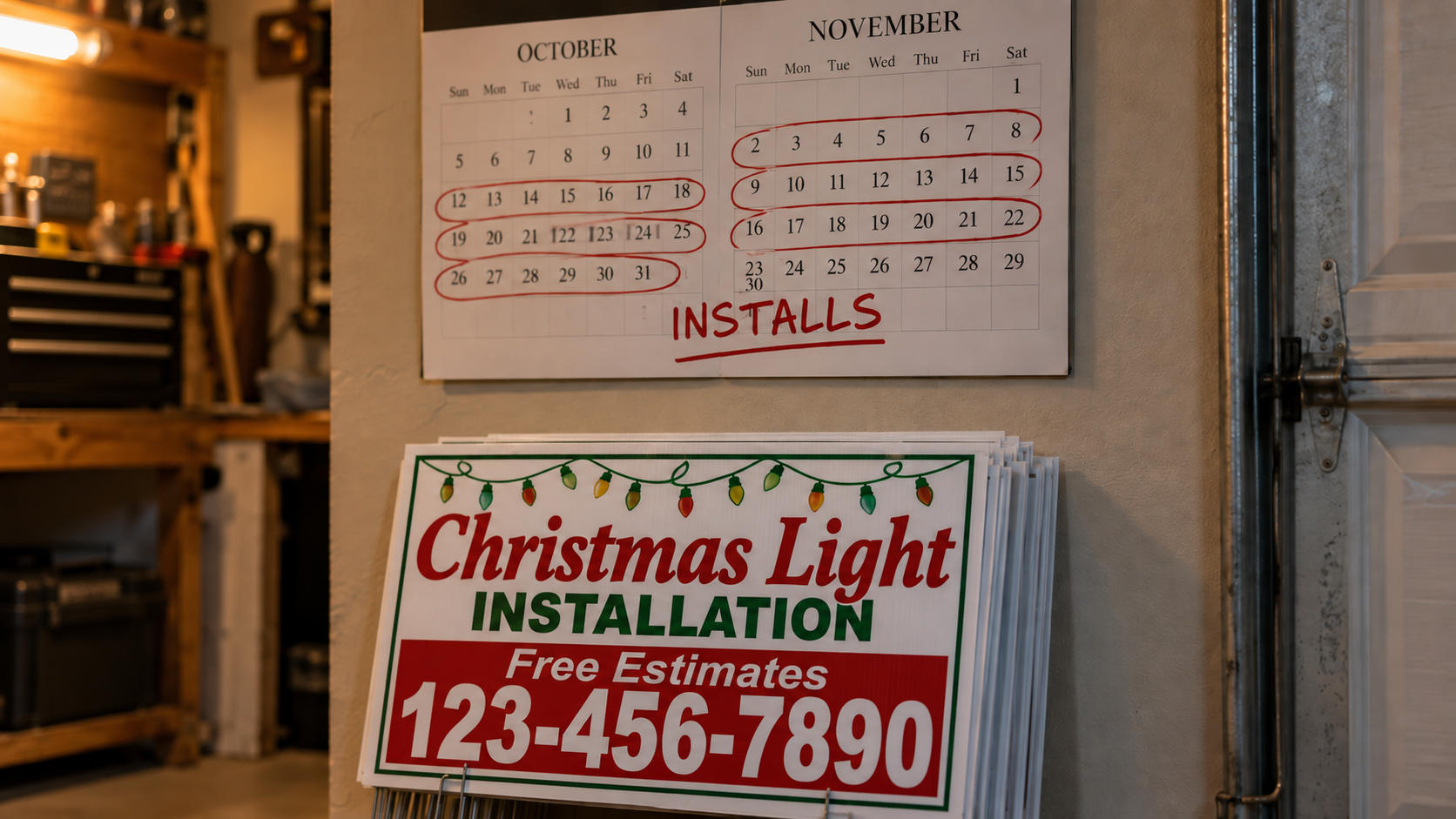
How many yard signs does a first-year installer need?
About $3,000 buys 1,000 signs, and ordering in mid-October, 500 is workable. Get them out by the last week of October, add about 200 the week before Thanksgiving and 200 the week before that, and spread them out.
Is it too late to start a Christmas light business in October or November?
No. Justice Baker started the last week of November and did over $30,000 his first year. Another installer started November 1 and is on track for over half a million dollars this year.
Do Christmas light installers need workers' comp?
It is not required everywhere, but going without it is a big risk. A fall from a roof can mean hundreds of thousands of dollars in medical expenses and lawsuits from the worker, the homeowner, and the homeowner's insurer.
How do I get more five-star reviews for my Christmas light business?
Ask three times: on the phone, at the door, and at the end of the job. Tell customers your goal is to make them so happy they give you a five-star review, then ask if there is any reason they would not.

Copyright ©2026 All Right Reserved website designed by christmaslights.io
Terms of Service / Privacy Policy
Have questions or need assistance?
Contact us at (855)619-LITE