

Wholesale Pricing Presale Christmas Lights Bulbs
Pre-Season C9 Commercial Elite LED Bulbs
AS LOW AS $.50 Per BULB!
Want to know how to get the cheapest Christmas lights at wholesale pricing?
The more you buy, the more you save!
Experience the next level of holiday lighting with our C9 Commercial SMD LED bulbs, featuring advanced Surface-Mounted Device (SMD) LED technology. These bulbs are designed to shine brighter and last longer, all while maintaining exceptional durability and energy efficiency. Perfect for both indoor and outdoor use, these bulbs are a must-have for any professional or residential Christmas light display.
5-Year Warranty – Best in the Industry
Our C9 Commercial SMD LED bulbs are backed by an industry-leading 5-year warranty, ensuring that your investment in top-quality holiday lighting is fully protected. These bulbs are designed to shine brighter, last longer, and perform better, making them the ultimate choice for both professional and residential Christmas light displays.
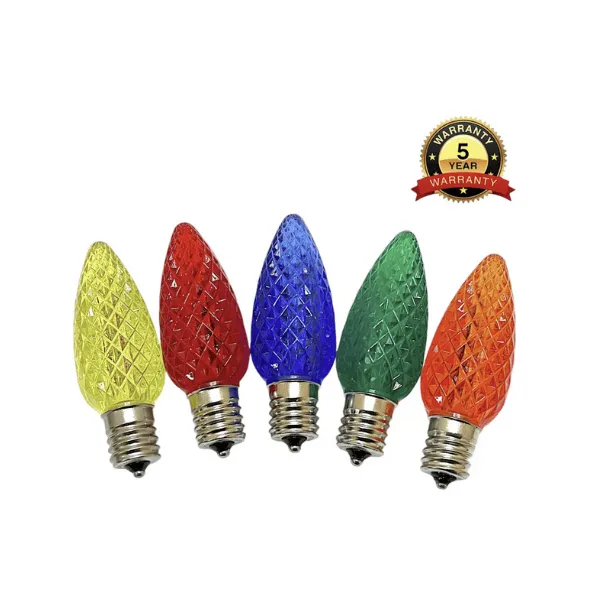
Available In:
500 Bulbs
5000 Bulbs
10,000 Bulbs
50,000 Bulbs
100,000 Bulbs
Many Different Colors to Choose From:
Sun Warm White
Warm White
Winter Warm White
Pure White
Cool White
Red
Green
Blue
Orange
Yellow
Purple
Pink
Teal
Multi-Color
Key Features:
SMD LED Technology: Offers a more brilliant light source with a reflective core design for superior optics, ensuring your
Virtually Unbreakable Construction: Highly durable bulbs are built to last, with a lifespan of up to 60,000 hours. These bulbs are designed to withstand the rigors of outdoor installations, making them virtually unbreakable.
Nickel-Plated Bases: Prevent corrosion and improve connectivity, saving you time and money during installation and ensuring reliable performance throughout the season.
Energy Efficient: Low wattage LED bulbs reduce power consumption by up to 90%, allowing you to safely create longer runs of light without overloading circuits.
Cool to the Touch: LED bulbs remain cool, even after hours of operation, making them safer to handle and install.
Larger Diamond-Cut Pattern: Faceted bulbs feature a diamond-cut design that generates beautiful light halos, adding a touch of elegance to any display.
Pre-Season C9 Minleon V2 LED Bulbs
AS LOW AS $.47 Per BULB!
Enhance your professional-grade Christmas lighting displays with Minleon V2 LED C9 bulbs. Featuring a faceted finish, these bulbs cast a bright and inviting light, making them an ideal choice for creating stunning, energy-efficient holiday displays.
Upgrade your holiday lighting with Minleon V2 C9 LED Christmas Light bulbs and experience the benefits of bright, energy-efficient, and durable lighting solutions.
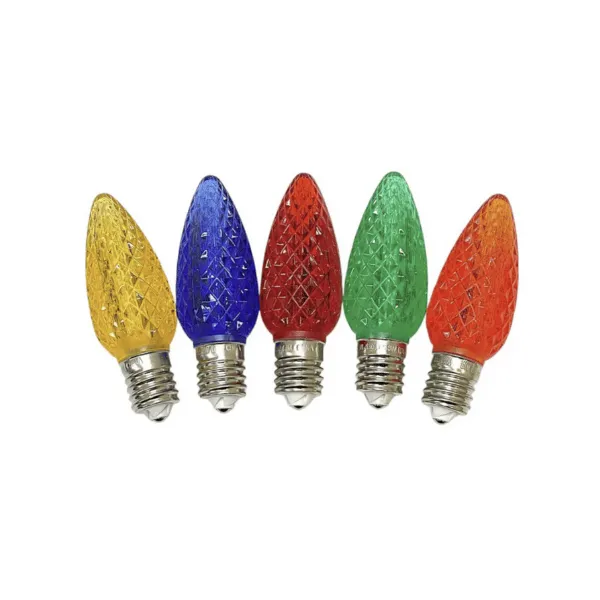
Quantities Available:
500 Bulbs
5000 Bulbs
10,000 Bulbs
50,000 Bulbs
100,000 Bulbs
Colors Available:
Sun Warm White
Warm White
Winter Warm White
Pure White
Cool White
Red
Green
Blue
Orange
Yellow
Purple
Pink
Teal
Multi-Color
Key Features:
Durable Multi-Faceted Construction: These Minleon V2 LED bulbs are crafted from high-quality, multi-faceted plastic, ensuring they resist fading, chipping, and breaking. This durability makes them perfect for both commercial and residential installations, maintaining their vibrant appearance season after season.
Energy Efficiency: These LED Christmas light bulbs reduce power consumption by more than 90% compared to traditional incandescent bulbs. With an actual power consumption of just 0.58W, they allow for longer runs and lower energy costs, though it’s recommended to use 2W for installation calculation purposes.
Standard C9 Socket Compatibility: Designed to fit any standard C9 socket with an E17 base, these LED bulbs integrate seamlessly into your existing lighting setups, making them versatile and easy to use for any holiday lighting project.
Upgrade your holiday displays with our C7 SMD LED bulbs, featuring advanced Surface-Mounted Device (SMD) LED technology. These bulbs are designed to shine brighter, last longer, and provide exceptional durability, making them an excellent choice for both residential and commercial Christmas lighting.
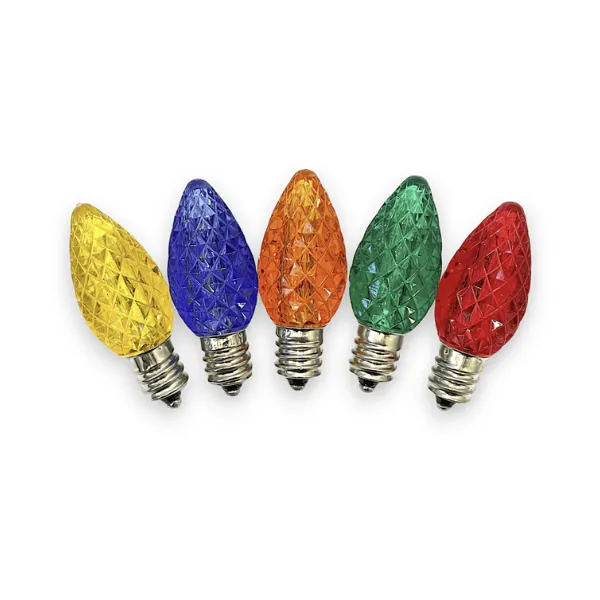
Quantities Available:
500 Bulbs
5000 Bulbs
10,000 Bulbs
50,000 Bulbs
100,000 Bulbs
Colors Available:
Sun Warm White
Warm White
Winter Warm White
Pure White
Cool White
Red
Green
Blue
Orange
Yellow
Purple
Pink
Teal
Multi-Color
Key Features:
SMD LED Technology: Experience a more brilliant light source with SMD LED bulbs. The reflective core design enhances optics, ensuring your holiday displays are vibrant and eye-catching.
Virtually Unbreakable: These C7 LED bulbs are constructed from highly durable materials, making them virtually unbreakable. With a lifespan of up to 60,000 hours, they are built to withstand the rigors of outdoor and indoor installations.
Nickel-Plated Bases: The nickel-plated bases prevent corrosion and improve connectivity, saving you time and money during installation and ensuring long-lasting performance.
Larger Diamond-Cut Pattern: The bulbs feature a diamond-cut pattern with larger facets, generating beautiful light halos that add a touch of elegance to any holiday display.
Energy Efficiency: These low wattage LED bulbs reduce power consumption by up to 90% compared to traditional incandescent bulbs. This allows you to safely make longer runs of light without overloading circuits, making them ideal for large-scale installations.
Cool to the Touch: LED technology ensures that the bulbs remain cool, even after hours of use, enhancing safety during installation and operation.
Indoor/Outdoor Use: Perfect for both indoor and outdoor settings, these C7 SMD LED bulbs are versatile enough to meet all your holiday lighting needs.
Our super bright and brilliant Multi Minleon V2 LED C7 replacement bulbs will save you money on your electric bill this year and for many more Christmas holidays to come.
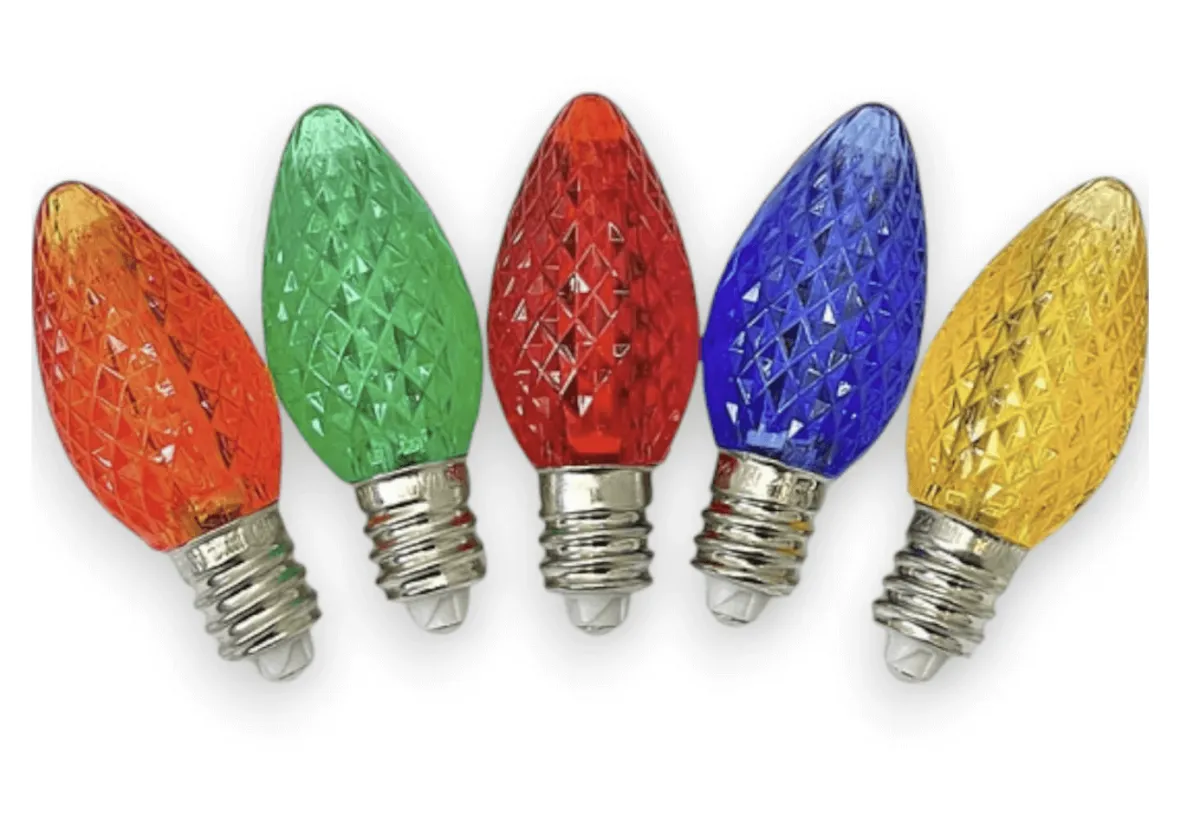
Quantities Available:
500 Bulbs
5000 Bulbs
10,000 Bulbs
50,000 Bulbs
100,000 Bulbs
Colors Available:
Sun Warm White
Warm White
Winter Warm White
Pure White
Cool White
Red
Green
Blue
Orange
Yellow
Purple
Pink
Teal
Multi-Color
Key Features:
These bulbs are made of durable, multi-faceted plastic so they won't fade, chip, or break like incandescent bulbs
Reduce your power consumption by more than 90% compared with conventional incandescent bulbs)
0.58W and 0.66W actual power consumption, but use 2W for installation calculation purposes
Fits into any standard C7 socket; E12 base
Frequently Asked Questions
What’s the difference between C9 and C7 LED bulbs?
C9 bulbs are slightly larger than C7 bulbs, making them ideal for larger displays such as rooflines, trees, and commercial decorations. C7 bulbs are smaller and better suited for smaller spaces, window frames, or accent lighting.
Are C9 and C7 bulbs interchangeable?
While both C9 and C7 bulbs use standard bases (E17 for C9 and E12 for C7), they are not interchangeable due to their size differences. Be sure to match your sockets to the correct bulb size.
Are C9 and C7 LED bulbs energy-efficient?
Yes! C9 and C7 LED bulbs consume up to 90% less energy than traditional incandescent bulbs. This energy efficiency allows you to safely run longer strands without overloading circuits.
Can I use C9 and C7 LED bulbs outdoors?
Absolutely! Both C9 and C7 LED bulbs are designed for indoor and outdoor use. They are highly durable, weather-resistant, and can withstand extreme temperatures, making them perfect for any holiday display.
Do C9 and C7 LED bulbs come in different colors?
Yes, C9 and C7 LED bulbs are available in a wide variety of colors, including warm white, cool white, red, green, blue, yellow, and multi-color options, allowing you to customize your holiday lighting displays.
How long do C9 and C7 LED bulbs last?
C9 and C7 LED bulbs are built to last with a lifespan of up to 60,000 hours. Their durable construction ensures they remain bright and vibrant season after season.
Discover Expert Tips on Our Blog

5 Christmas Light Pricing Mistakes That Are Killing Your Profit
My first full Christmas light season, I grossed $40,000 and thought I was crushing it. I wasn't. I was just busy and broke on a ladder. Every dollar I left on the table that year came down to the same handful of pricing errors — the wrong price per foot, bad labor math, and no idea how to present a full job. The jobs kept coming, so I never stopped to ask why I was working harder than everyone and keeping less.
Here's the truth most installers never hear: the gap between a $40,000 season and a six-figure season usually isn't more hustle. It's knowing exactly where to quote and stopping the money that leaks out before the estimate ever gets sent. Below are the five pricing mistakes that quietly drain profit from established installation businesses — and how to fix each one this season.
Mistake #1: Pricing From Your Own Wallet Instead of Your Customer's Reality
This is the most expensive mistake in the business, and almost everyone makes it. You pull up to a $600,000 home, picture writing a check for $4,000 worth of lights yourself, flinch, and quote $1,500 instead. You just decided your customer's budget based on your bank account.
Your customer is not you. A homeowner in a $600,000 house with today's interest rates is likely paying $5,000 to $6,000 a month just to live there. To that person, a beautiful, fully installed display is a rounding error — and it buys them something they genuinely can't get any other way: time, safety, and the feeling of having the best-looking house on the block.
The numbers prove it. There are installers charging $6 a foot complaining they can't get more in their market, while another company a few miles away charges $12 to $15 a foot to the same customers and stays booked. One installer who attended training and charged what the market would actually bear did over $220,000 in his very first season hanging lights. Another, working in rural Tennessee, did $50,000 his first year charging $8 a foot in an area "experts" online swore would only pay $6.
The fix is simple to say and hard to live: price the job, then ask whether your best customer would flinch — not whether you would. Profit is not a dirty word. When you underprice, you aren't being generous; you're taking money out of your own pocket and convincing yourself the customer made you do it.
Mistake #2: Getting the Labor Math Wrong
The second profit-killer hides in your time estimates. You bid a job assuming it'll take an hour. The roof is steeper than it looked, the access is awkward, and three or four hours later you're still up there. You priced for one hour of labor and bought yourself half a day.
Two things drive this. First, new crews are slow — and that's normal. A second-year crew will install dramatically faster than a first-year crew, even one that only completed a handful of jobs. Speed comes from reps, better gear, and getting comfortable on roofs, not from talent. If you're thinking about adding installation to your business, the takeaway is to start this season even if it feels late. Three or four jobs this year means you'll install twice as fast next year.
Second, most installers never build labor reality into their per-foot price. Your rate has to assume real-world conditions — difficult pitches, second stories, the time it takes to pre-bulb and pre-clip strands at the shop, drive time, and takedown in January. When your price only covers a perfect, fast install, every imperfect job eats your margin. Price for the job you actually get, not the job you hope for.
Mistake #3: Quoting Only What the Customer Asked For
A homeowner calls and says, "I just want lights on the roofline." So you quote the front roofline, send an $800 estimate, and then wonder why your average ticket never climbs above $1,200.
You gave them exactly what they asked for and nothing more — and in doing so you skipped the entire job. The customer doesn't know what's possible. That's your job. Walk the property and present the whole display:
The full roofline, not just the front — peaks, ridges, and the back lines, which can easily double your linear footage.
A wreath over the garage or on the front of the house. A large statement wreath is one of the highest-margin, highest-visual upsells you can offer.
Columns and porch posts, priced individually.
Tree wrapping, priced by the foot of tree height — a single 20-foot evergreen wrapped properly can rival the price of the roofline.
Bushes and shrubs, lit with mini-light strands.
Walk through a typical home this way and an $800 "roofline only" quote becomes a $2,800 to $3,500 ticket — for the same trip, the same crew, the same drive time. The homeowner may not take everything, and that's fine. But if you only present the roofline, the roofline is all you'll ever sell.
Mistake #4: Selling Light Bulbs Instead of Selling the Magic
Here's where most pricing problems actually start: in how you talk about the work. If you describe the right bulb size, the clip spacing, and how you "pick the bulbs and cut them to length," you've already lost — because your customer doesn't care about any of that.
You are not selling Christmas lights. You're selling the feeling a family gets when they pull into the driveway at night, the grandkids in the back seat, coming home from Christmas Eve service, and the whole house is glowing. You're selling the magical look on a child's face, the neighbors' jealousy, and the relief of a homeowner who knows they will never have to climb a ladder in December. Some customers cry when they see their finished home. That is the product.
When you sell the magic, price stops being the conversation. A homeowner deciding between two installers who both quote "lights on the roof" will pick the cheap one. A homeowner who can picture their home as the most beautiful house on the street — and trusts you to deliver it — will happily pay a premium. Lead with the feeling, then put the line items underneath it.
Mistake #5: Losing the Sale Before You Ever Talk Price
You can fix the first four mistakes and still bleed profit if you can't sell on the phone. The first ten to twenty seconds of a call set the tone for the entire sale — and plenty of installers lose the job in the first five seconds without realizing it.
Speed matters more than almost anything: the faster you respond to a new lead, the higher your win rate. So does language. Never use the word "minimum" — it sounds like a barrier. Say "our packages start at $1,200," which is an invitation. Lead by asking what the homeowner is hoping for and whether they've ever had lights professionally installed; their answer tells you exactly how to position yourself.
If you're not sure where your calls fall apart, record yourself and review the transcripts honestly. You don't have to be a natural salesperson — you have to know where you talk too much, where you should listen, and where you fail to paint the picture. Then close the loop after the install: get the review. Reviews are still king, and they matter more than ever for how AI tools and search engines recommend local businesses. Use tap cards or QR codes to make leaving a review effortless, and collect them on Google, Yelp, and beyond — because plenty of platforms and AI assistants pull from those sources.
A Quick Christmas Light Pricing Reference
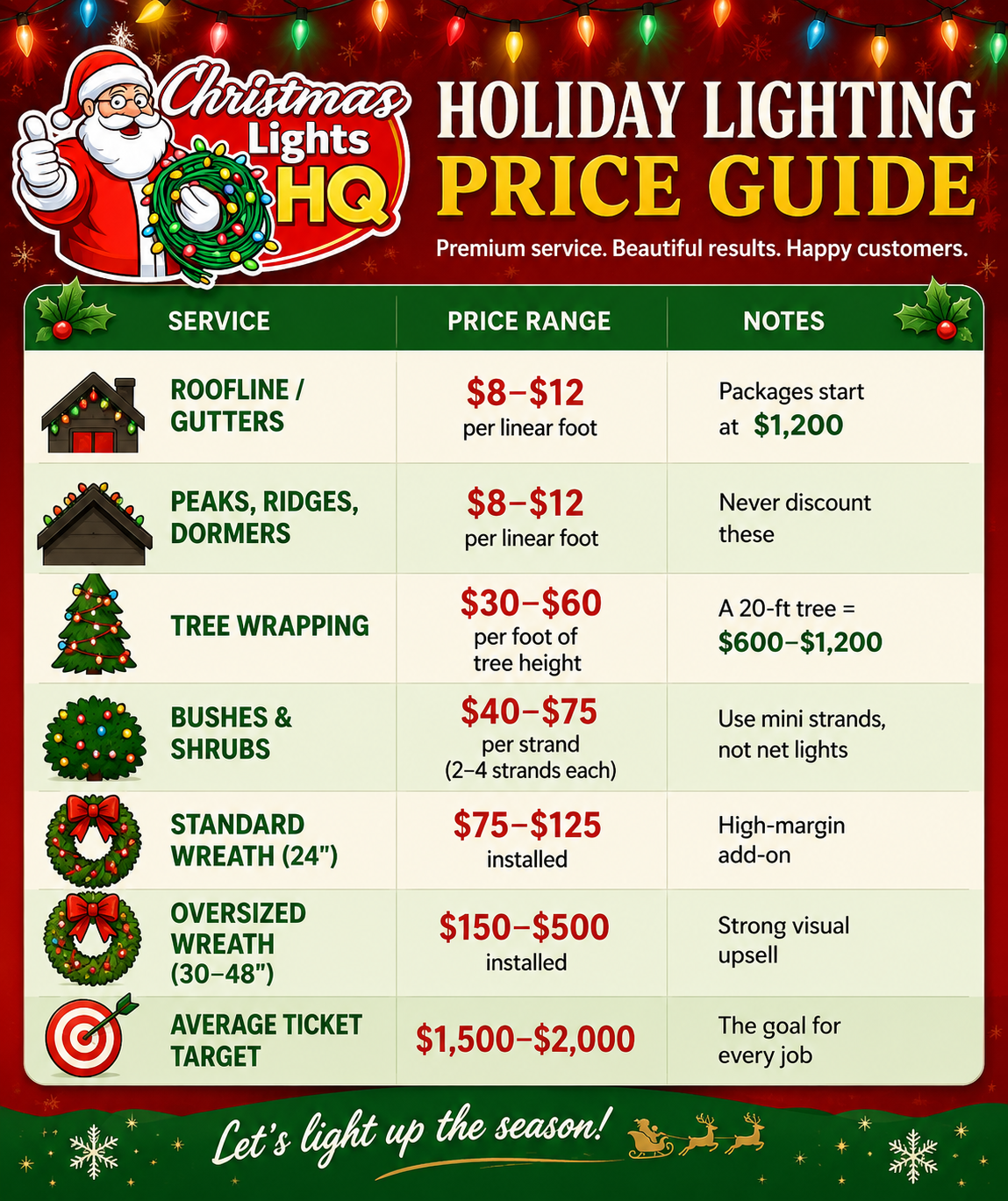
Use these field-tested ranges as your starting point. Adjust for your market, but resist the urge to drop below them:
The Real Difference Is Between Your Ears
Here's the math that should change how you think. An installer doing 35 jobs at a $1,000 average ticket makes $35,000. The same installer doing the same 35 jobs at a $2,000 average ticket makes $70,000 — double the money for the exact same work, the same drive time, the same number of roofs.
That's the whole game. You don't need more jobs; you need a higher average ticket. And the only thing standing between most installers and that number is the belief that their market "won't pay it." Find out where that belief came from. Usually it's advice from someone who underprices their own work or wants to sell you cheaper product. Surround yourself instead with operators charging premium rates and getting it.
A six-figure season is achievable in your first year. Seven figures is achievable for installers who treat this like a real business — set their prices with confidence, present the full display, sell the feeling, and pick up the phone. Whatever you decide today won't matter unless you take action on it. Price the next job the right way, and watch what happens.
Want hands-on help pricing, selling, and scaling your installation business? Explore the training and marketing resources at ChristmasLights.io.
How much should I charge per foot for Christmas light installation?
Most professional installers charge between $8 and $12 per linear foot for roofline installation, and many in stronger markets charge $12 to $15 or more. If you're charging $6 to $7 a foot, you're almost certainly leaving significant profit on the table. Price based on what your best customer will pay, not on what you personally would spend.
What is a good average ticket for a Christmas light job?
A healthy target average ticket is $1,500 to $2,000 per job. Raising your average from $1,000 to $2,000 doubles your revenue without adding a single extra job, which is why your average ticket — not your job count — is the number to focus on first.
How do I price tree wrapping for Christmas lights?
Price tree wrapping by the foot of tree height rather than charging a flat fee per tree. A common range is $30 to $60 per foot of height, so a 10-foot tree runs roughly $300 to $600 and a 20-foot tree runs $600 to $1,200. Charging one flat rate per tree almost always undercharges the tall, high-value trees.
Can I really charge premium prices in my market?
Yes. In nearly every market there are installers charging double what their cheapest competitors charge, serving the same customers and staying booked. Premium homeowners care about quality, reliability, and not climbing a ladder — not about finding the lowest price. The belief that your area "won't pay" is usually the only thing holding your prices down.
Why shouldn't I just quote what the customer asks for?
Because the customer doesn't know what's possible — that's your expertise to bring. If someone asks for "just the roofline," presenting the full display (back rooflines, peaks, wreaths, columns, trees, and bushes) can turn an $800 estimate into a $2,800 to $3,500 ticket on the same visit. Always present the complete vision and let the homeowner choose.
How do I stop underestimating how long a job takes?
Build real-world conditions into your pricing instead of assuming a perfect, fast install. Account for steep pitches, second stories, difficult access, shop prep time, and drive time. New crews are also naturally slower — that's normal — so price for the job you actually get, and your speed will improve dramatically by your second season.
Is it too late to start a Christmas light business this year?
No. Starting late and landing even three or four jobs this year is far better than waiting, because the experience makes you roughly twice as fast next season. Every install builds the reps, confidence, and gear knowledge that let you charge more and work faster going forward.
How important are online reviews for getting jobs?
Reviews are critical, and they matter more than ever as AI tools and search engines increasingly recommend local businesses based on reputation signals. Make leaving a review effortless with tap cards or QR codes, and gather reviews across multiple platforms — including Google and Yelp — since many search and AI systems pull from those sources.
What is the biggest mistake new installers make with pricing?
Pricing from their own wallet. They imagine paying for the lights themselves, get sticker shock, and quote low. The fix is to price the job and then ask whether your best customer would flinch — not whether you would. Your budget should never set your customer's price.
Why does "selling the magic" matter more than the lights themselves?
Because price objections shrink when a homeowner can picture their finished home and trusts you to deliver it. Customers don't buy bulbs and clips; they buy the feeling of the best-looking house on the street and the joy on their family's faces. Lead with that feeling and the line-item price becomes a much easier conversation.

Copyright ©2026 All Right Reserved website designed by christmaslights.io
Terms of Service / Privacy Policy
Have questions or need assistance?
Contact us at (855)619-LITE